
Basketball Defenses and Offenses Explained: Zone, Man-to-Man, and More
On this page9
- 01The Two Base Defenses: Man-to-Man and Zone
- 02Zone Defense Formations, Alignment by Alignment
- 03Strengths and Weaknesses of Man-to-Man Defense
- 04Strengths and Weaknesses of Zone Defense
- 05Combination Defenses and the Full-Court Press
- 06Basketball Offenses: Built to Attack a Specific Defense
- 07How to Attack a Zone vs. How to Attack Man-to-Man
- 08Core Actions, Cuts, and Matchup Schemes
- 09Where This Fits Into the Bigger Game Plan
Basketball defenses split into two families — man-to-man, where each defender is locked onto one specific opponent everywhere they go, and zone defense, where each defender guards a fixed area of the floor and picks up whoever enters it. Teams also blend the two into combination defenses and can apply either one full-court as a press. Offenses, in turn, are built and called specifically to attack whichever defense they’re facing.
The Two Base Defenses: Man-to-Man and Zone
Every defensive scheme in basketball is a variation on one of these two ideas.
Man-to-man defense assigns each of the five defenders a single opponent to guard for the entire possession, usually matched by size and role (point guard on point guard, center on center). It creates direct accountability — if a player scores, everyone knows exactly who was responsible — and it’s the standard base defense at the NBA level.
Zone defense assigns each defender a slice of the court instead of a player. A defender in a 2-3 zone, for example, guards whichever offensive player is standing in their corner or wing area, then hands that player off to a teammate once they move to a different zone. Zone is far more common in college, high school, and international basketball than in the NBA.
Zone Defense Formations, Alignment by Alignment
Zone defenses are named for how many defenders line up per row, counted from the top of the key toward the baseline.
| Formation | Alignment (top to baseline) | Best used against |
|---|---|---|
| 2-3 zone defense | 2 guards up top, 3 across the baseline | Strong post scoring and offensive rebounding threats |
| 3-2 zone defense | 3 across the perimeter, 2 near the basket | Teams that struggle to shoot from outside |
| 2-1-2 zone | 2 up top, 1 at the free-throw line, 2 on the baseline | A balance between perimeter pressure and paint protection |
| 1-2-2 zone | 1 point defender, 2 wings, 2 baseline | Trapping the ball on the perimeter |
| 1-3-1 zone defense | 1 up top, 3 across the middle, 1 on the baseline | Generating steals and disrupting ball movement, at the cost of the corners |
Picture the half court as a grid: the 2-3 packs the baseline to wall off the paint but leaves the wings and the top of the key more open; the 1-3-1 stretches a defender the length of the middle of the floor to jump passing lanes, which is aggressive but leaves both corners exposed if the ball gets reversed quickly.
Strengths and Weaknesses of Man-to-Man Defense
Man-to-man’s biggest strength is on-ball pressure. Because a specific defender owns a specific opponent, coaches can call traps, force turnovers, and hold individual players accountable for boxing out, which is why boxing out in basketball is emphasized so heavily in man-to-man schemes — every defender has a clear rebounding assignment.
The weakness shows up against ball screens. When an offense uses off-ball screens in basketball or on-ball picks to force a switch, a man-to-man defense can end up with a mismatch — a small guard stuck guarding a much bigger post player, or vice versa. Elite offenses are built to hunt exactly that mismatch.
Strengths and Weaknesses of Zone Defense
Zone defense protects the paint by design — there are almost always multiple defenders near the basket regardless of where the ball is — and it tends to produce fewer fouls since defenders aren’t chasing shooters around screens. It’s also a useful equalizer for a team that lacks foot speed or depth.
Its main weakness is the seam: the soft spots between two defenders’ zones, usually the high post, the short corner, and the gaps that open when the ball moves faster than the defense can shift. A zone can also be attacked on the offensive glass, since “guard the area, not the player” assignments sometimes leave nobody boxing out a specific opponent.
Combination Defenses and the Full-Court Press
Coaches don’t have to pick strictly one or the other. Combination defenses — box-and-one, diamond-and-one, triangle-and-two — put one or two defenders in man-to-man coverage on a specific dangerous scorer while the rest of the team plays zone around them. It’s a situational tool for shutting down a single elite player without fully switching styles.
Either base defense can also be stretched across the entire floor as a full-court press in basketball, applied the instant the ball is inbounded. Presses are designed to force turnovers, speed up the pace against a team that wants to play slow, and wear down an opponent’s ball handlers over the course of a game.
Basketball Offenses: Built to Attack a Specific Defense
Offensive systems aren’t generic — they’re designed with a defense in mind.
The triangle offense creates a sideline triangle and a weak-side two-man game that’s especially effective at breaking down man-to-man defense through spacing and reads rather than called plays. Motion offense in basketball relies on continuous player movement, cutting, and screening to create advantages against either man-to-man or zone, since the constant motion forces defenders to communicate and rotate correctly on every pass.
How to Attack a Zone vs. How to Attack Man-to-Man
Beating a zone and beating man-to-man require different tools:
- Against zone: move the ball faster than the defense can shift (skip passes and ball reversal), flash a player into the seams at the high post or short corner, crash the offensive boards, and knock down open catch-and-shoot looks created by ball movement.
- Against man-to-man: use screens to force switches and hunt mismatches, attack closeouts off the dribble, and run cutting actions that make defenders fight through contact to stay attached to their assignment.
Core Actions, Cuts, and Matchup Schemes
Systems are built from smaller building blocks. On offense, the pick-and-roll is the league’s most-used action, while off-ball movement like the give-and-go, the backdoor cut, and the post-up create advantages without a ball screen. On defense, man-to-man defense is the foundation — its team-wide safety net is help defense — and coaches can spring a junk look like the box-and-one to smother a single dominant scorer.
Where This Fits Into the Bigger Game Plan
Defenses and offenses aren’t chosen in a vacuum — they shift possession to possession and series to series based on matchups, foul trouble, and score. That chess match becomes even more pronounced in the postseason, when coaching staffs have days to prepare a single game plan; see how the NBA playoffs work for how that extra preparation time changes strategy. Which scheme fits also depends on personnel — and that starts with knowing what each role does, covered in our basketball positions explained guide. For more explainers on basketball systems and terminology, visit the Basketball & NBA/WNBA hub.
Frequently asked questions
What is the difference between man-to-man and zone defense in basketball?+
In man-to-man defense, every defender is assigned one specific offensive player to guard everywhere they go on the floor. In zone defense, each defender guards a fixed area of the court and picks up whichever offensive player enters that area. Man-to-man creates individual accountability and on-ball pressure; zone protects the paint, conserves energy, and hides weaker individual defenders.
What are the main types of zone defense in basketball?+
The most common zone formations are the 2-3 zone defense, 3-2 zone defense, 1-2-2 zone, 2-1-2 zone, and the aggressive 1-3-1 zone defense. Each name describes how many defenders line up per row, from the top of the key back to the baseline (or vice versa for the 3-2).
Why do teams switch between man-to-man and zone defense?+
Coaches change defenses to disrupt an offense's rhythm, hide foul trouble or a slower defender, control tempo, protect the paint against strong post players, or simply because their personnel is better suited to one style. Mixing looks also forces the opposing offense to adjust in real time, which can lead to turnovers and rushed shots.
What is a combination defense in basketball?+
A combination defense blends man-to-man and zone principles in the same possession, such as box-and-one or triangle-and-two, where one or two defenders shadow a specific scorer man-to-man while the rest of the team plays zone. Coaches use it to shut down a single dominant offensive player without fully committing to man-to-man across the board.
How do you beat a zone defense in basketball?+
The best ways to attack a zone are ball reversal and skip passes to move the defense faster than it can shift, flashing a player to the high post or short corner (the classic soft spots in most zones), offensive rebounding since zones can struggle to box out, and knocking down open perimeter shots created by ball movement.
What is a full-court press in basketball?+
A full-court press is a defense — man-to-man or zone — applied across the entire length of the court starting the moment the ball is inbounded, designed to force turnovers, speed up the pace, and tire out the opposing offense. See our dedicated guide to the full-court press in basketball for the setups and traps teams use.
What basketball offenses are designed to beat man-to-man defense specifically?+
The triangle offense and modern motion offense are both built primarily to attack man-to-man defense, using constant player and ball movement, spacing, and off-ball screens to create mismatches and open driving lanes that a set defensive matchup struggles to guard.
Do NBA and college teams mostly play man-to-man or zone defense?+
Man-to-man is the dominant base defense at the NBA level, though zone principles and switching schemes are used situationally. College and international basketball see far more zone defense, including full possessions of 2-3 or 1-3-1 zone, since roster depth and shot-clock rules differ from the NBA.
Sources
Play & tools
Free browser games and tools — no account, no download.
- Play 82-0 — Draft five, one per position, and see if your lineup can go a flawless NBA season.
- Play Era Ball — Draft an all-time NBA roster from a single era, then simulate a season and chase a perfect run.
- Play 32-0 — Draft five college basketball legends, one per position, and chase a perfect 32-0 national title.
- Explore all our games →
- Get the printable bracket — Download and print a blank tournament bracket to fill out by hand.
- Open the TS% calculator — Calculate TS% from points, field goal attempts and free throw attempts — scoring efficiency in one number.
- Explore all our free sports tools →
Related basketball guides
View all →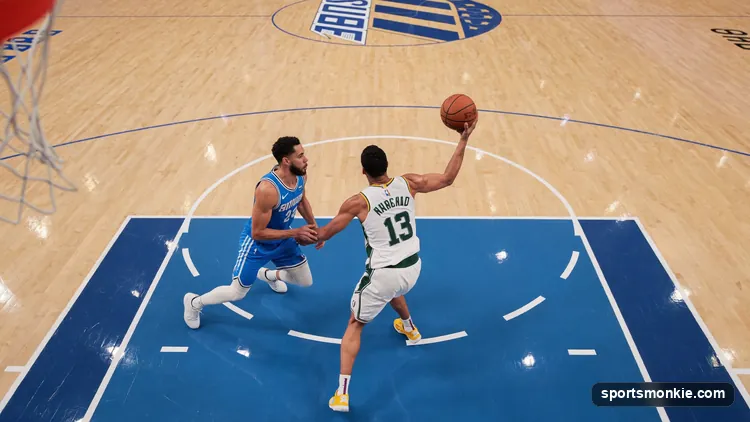
Backdoor Cut in Basketball: Definition, When to Use It, and How to Run It
What a backdoor cut is in basketball, when players use it against overplaying defenders, and how to execute and defend it correctly.
Box and One Defense: How It Works, When to Use It, and How to Beat It
The box and one defense mixes zone and man-to-man: four defenders form a box while one shadows the opponent's top scorer. Setup, uses, and counters.
2-3 Zone Defense in Basketball: Alignment, Roles, and How to Attack It
The 2-3 zone defense lines up two guards up top and three defenders low, guarding areas instead of players. Here's how it works and how to beat it.
Help Defense in Basketball: How It Works, Positioning, and Key Rules
Help defense is when off-ball defenders shift toward the ball to stop dribble penetration. Learn positioning, rotations, stunts, tags, and closeouts.
Motion Offense in Basketball Explained: Rules, Alignment & Keys
What is a motion offense in basketball? Learn the rules, spacing, formations (5-out, 4-out 1-in), player roles, strengths, weaknesses, and how to run it.
2-3 Zone vs Man-to-Man Defense: Full Basketball Comparison
2-3 zone vs man to man defense compared: coverage, pick-and-roll, 3-point defense, rebounding, and when coaches at every level pick each.