
2-3 Zone vs Man-to-Man Defense: Full Basketball Comparison
On this page8
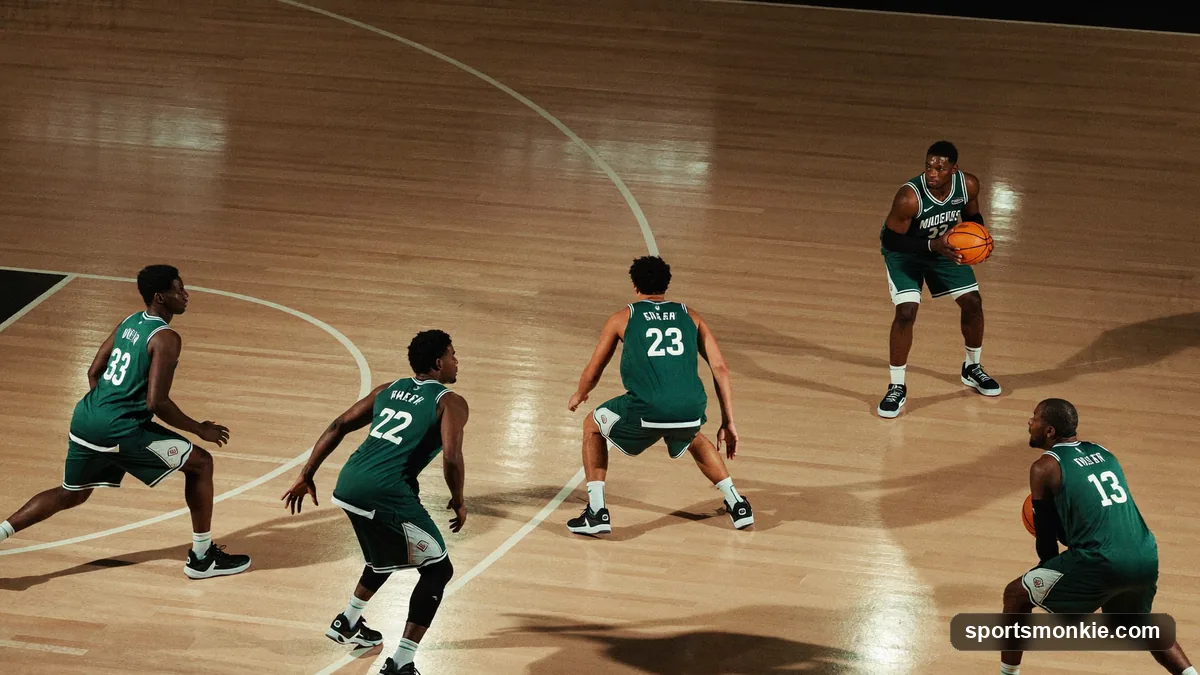
A 2-3 zone assigns defenders to areas of the floor to clog the paint and protect the rim, while man-to-man assigns each defender to a specific opponent to guard everywhere they go — the choice between them comes down to personnel, foul trouble, and what the opponent does best. Both are legal, common defenses at every level of basketball, and most coaching staffs use both across a single season, sometimes in the same game.
What Is Man-to-Man Defense
Man-to-man defense is a defensive formation in which a coach assigns each player on the floor a specific offensive player to follow and defend, no matter where that player moves. It is considered the foundation of defensive basketball because it teaches individual accountability: when a defender gets beat, the breakdown is obvious to the player, the coach, and everyone watching. That accountability is why most programs — from youth leagues to the basketball hub at SportsMonkie — teach man-to-man defense first, before layering in zone concepts.
Man-to-man demands strong individual defenders, tight closeouts, and disciplined help defense rotations so a beaten defender isn’t left on an island. It is more physically demanding than zone because defenders chase their assignment through screens and cuts for the full possession.
What Is 2-3 Zone Defense
In a 2-3 zone defense, two defenders guard the area near the free-throw line and top of the key, while the remaining three defenders guard the baseline in a row, forming a “2” and a “3.” Instead of chasing a specific player, each defender is responsible for whoever enters their zone, then passes that player off as they move to the next area.
The 2-3 zone is built to keep the ball as far from the rim as possible. It packs the paint, discourages dribble penetration, and can trigger quick double-teams when the ball enters the corner or wing. It’s a cousin of the 3-2 zone defense, which flips the alignment to prioritize the perimeter over the baseline.
2-3 Zone vs Man-to-Man: Head-to-Head Comparison
| Category | 2-3 Zone | Man-to-Man |
|---|---|---|
| Coverage type | Area-based | Player-based |
| Physical demand | Lower — less full-court chasing | Higher — constant one-on-one tracking |
| Paint protection | Strong; packs three defenders on the baseline | Depends on individual defenders and help rotations |
| Perimeter/3-point defense | Vulnerable to ball movement and corner threes | Stronger; defenders stay attached to shooters |
| Rebounding | Boxing-out assignments can get confused | Clearer, since each defender already has a body |
| Foul trouble management | Easier to hide a foul-prone player in a zone | Harder; that player is directly exposed |
| Transition defense | Slower to get matched up | Faster once matchups are set |
| Best used against | Weaker outside-shooting teams, teams in a hurry | Teams with multiple three-point threats |
Defending the Pick-and-Roll
The pick-and-roll is the single most common action in modern basketball, and it stresses these two defenses differently. In man-to-man, a screen forces a decision — switch, hedge, or fight through — because both defenders are tied to their specific assignments, and any miscommunication opens a driving lane or a wide-open roll man.
A 2-3 zone handles ball screens more passively: the defender whose area the ball-handler enters simply steps up to contest, and the screener’s defender rarely has to leave his zone at all, since the screen itself doesn’t “beat” anyone the way it does in man-to-man. The tradeoff is that zones can be slow to tag the roll man cutting to the rim, since no one is technically “his” defender until he enters someone’s area.
Defending the 3-Point Line
Man-to-man generally provides tighter 3-point defense because defenders stay attached to shooters wherever they relocate. A 2-3 zone is naturally more exposed on the perimeter — especially at the top of the key between the two guards and in the corners between the wing and baseline defenders — because ball reversals can outrun the zone’s rotation. Teams that shoot it well from outside are the classic matchup problem for a 2-3 zone; teams that struggle from three rarely punish it. This is also the scenario where a mixed basketball offense-and-defense approach — spacing shooters to attack zone gaps — becomes most important for the offense to counter.
Rebounding Differences
Man-to-man tends to produce cleaner defensive rebounding because every defender already has an assigned body to box out when a shot goes up. In a 2-3 zone, defenders are boxing out an area rather than a person, which can leave gaps for offensive players crashing from angles no one is technically covering — a well-known weakness that zone-heavy teams have to drill specifically with box-out rotations.
Youth vs Pro: Which Suits Which Level
At the youth level, most coaching guides recommend teaching man-to-man fundamentals first — footwork, closeouts, positioning — before introducing zone concepts around ages 12 to 14, and many youth leagues restrict zone defense outright to force individual skill development. At the high school and college level, the 2-3 zone is a staple, especially for teams that lack elite individual defenders but have size and length in the paint (Syracuse’s decades-long 2-3 zone identity is the sport’s most famous example).
In the NBA, zone defense was illegal until 2001, when the league replaced its old illegal-defense rules with the defensive three-second rule. Since then, NBA teams mix in zone possessions and matchup zones situationally, but man-to-man remains the base defense at the pro level because elite individual defenders and spacing make pure zone easier to exploit.
Which Defense Should a Coach Choose
There’s no universal answer — it depends on personnel and situation. A coach leans on the 2-3 zone when the roster lacks elite on-ball defenders, when foul trouble threatens a key player, when the opponent is a poor outside-shooting team, or when the coach wants to slow down a fast-paced opponent. Man-to-man is the call against teams stacked with three-point shooters, in late-game situations that need clear defensive assignments, and whenever a team has the individual defenders to win one-on-one matchups. Most successful programs, at every level covered in the SportsMonkie basketball hub, don’t pick one permanently — they build both into the game plan and switch based on what the scoreboard and the opponent’s shooting demand.
Frequently asked questions
What is the main difference between 2-3 zone and man-to-man defense?+
2-3 zone defense assigns each of the five defenders to a specific area of the court, while man-to-man defense assigns each defender to guard one specific offensive player everywhere on the floor. Zone is area-based; man-to-man is player-based.
Is 2-3 zone or man-to-man better for defending the pick-and-roll?+
Man-to-man requires a clear switch, hedge, or hard-show call to survive a pick-and-roll, since both defenders are tied to their assigned players. A 2-3 zone naturally absorbs ball screens because the defender in that area simply steps up to meet the ball-handler, and the screener's defender never truly leaves his zone — but it can create momentary confusion about who tags the roller.
Why do teams struggle to shoot against a 2-3 zone?+
They don't always struggle from three — a well-spaced 2-3 zone actually concedes the corners and top of the key if the offense moves the ball fast enough. What the 2-3 zone reliably takes away is the mid-range and paint, since it packs three defenders along the baseline and two at the free-throw line.
Which defense is better for rebounding?+
Man-to-man generally produces cleaner rebounding because each defender already has a body to box out. Zone defense can create rebounding chaos since defenders are boxing out an area, not a person, and offensive players can crash from angles no one is directly assigned to.
At what age should players learn zone defense?+
Most youth coaching guides recommend mastering man-to-man fundamentals first — footwork, closeouts, help-side positioning — before introducing zone concepts, typically starting around ages 12 to 14. Many youth leagues also restrict zone defense entirely below a certain age to force skill development.
Does the NBA use 2-3 zone defense?+
Yes, though less than college or high school. The NBA banned zone defense outright until 2001, when the illegal defense rules were replaced by the defensive three-second rule. Since then, teams have mixed in zone possessions and matchup zones, but man-to-man remains the base defense at the pro level.
Can a team mix 2-3 zone and man-to-man in the same game?+
Yes. Many coaches use man-to-man as their primary defense and switch to a 2-3 zone to change tempo, protect players in foul trouble, disrupt a hot-shooting opponent's rhythm, or close out a half. This mix-up value is one of the biggest reasons both defenses stay in a coach's playbook.
Which defense is easier to teach?+
Man-to-man is simpler to teach individually — one player, one assignment — but harder to execute as a full team under pressure. A 2-3 zone is conceptually easier for beginners to hold their spot in, but it demands more communication and shifting as the ball moves, which can confuse less experienced teams.
Sources
Play & tools
Free browser games and tools — no account, no download.
- Play 82-0 — Draft five, one per position, and see if your lineup can go a flawless NBA season.
- Play Era Ball — Draft an all-time NBA roster from a single era, then simulate a season and chase a perfect run.
- Play 32-0 — Draft five college basketball legends, one per position, and chase a perfect 32-0 national title.
- Explore all our games →
- Get the printable bracket — Download and print a blank tournament bracket to fill out by hand.
- Open the TS% calculator — Calculate TS% from points, field goal attempts and free throw attempts — scoring efficiency in one number.
- Explore all our free sports tools →
Related basketball guides
View all →
Box and One Defense: How It Works, When to Use It, and How to Beat It
The box and one defense mixes zone and man-to-man: four defenders form a box while one shadows the opponent's top scorer. Setup, uses, and counters.
1-3-1 Zone Defense in Basketball: Alignment, Roles & How to Attack It
The 1-3-1 zone defense explained: player alignment, roles, traps, strengths, weaknesses, and how offenses beat it. A full coaching breakdown.
2-3 Zone Defense in Basketball: Alignment, Roles, and How to Attack It
The 2-3 zone defense lines up two guards up top and three defenders low, guarding areas instead of players. Here's how it works and how to beat it.
3-2 Zone Defense in Basketball: Alignment, Roles, and How to Attack It
The 3-2 zone defense explained: alignment, player roles, strengths, weaknesses, and how offenses attack this high-pressure zone.
Basketball Defenses and Offenses Explained: Zone, Man-to-Man, and More
Basketball defenses and offenses explained: man-to-man, zone defense in basketball, presses, and the plays teams run to attack each one.
Man-to-Man Defense in Basketball: Rules, Roles, and How It Works
Man to man defense explained: on-ball, denial, and help roles, stance, closeouts, and how it differs from zone. Full breakdown with drills and FAQs.