
3-2 Zone Defense in Basketball: Alignment, Roles, and How to Attack It
On this page7
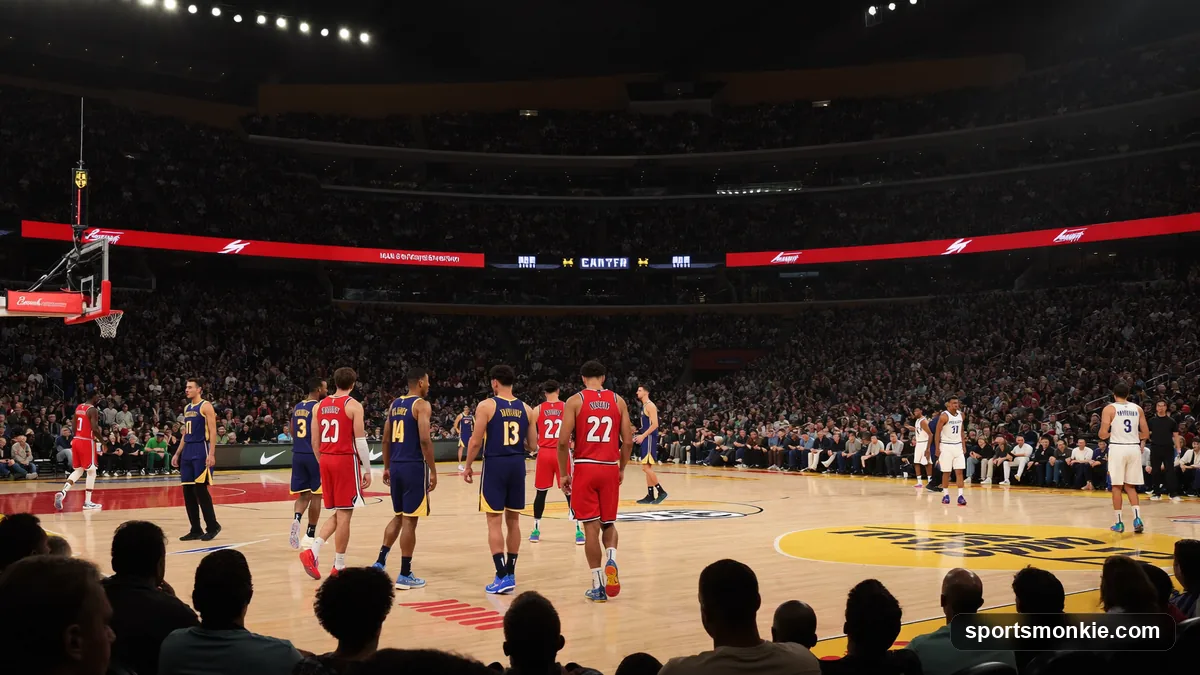
A 3-2 zone defense positions three defenders across the free-throw line — two wings and a middle “rover” — with two more defenders holding the low blocks near the basket. It’s built to deny the wings and high post, choke off driving lanes, and rebound well, at the cost of leaving the top of the key relatively open. It’s one of several zone options within basketball defenses and offenses, alongside sibling schemes like the 2-3 zone and 1-3-1 zone.
Alignment: What a 3-2 Zone Looks Like
Picture the floor split into two lines. The first line sits at or just above the free-throw line: a defender on each wing (roughly at the elbows extended) and one defender in the middle, commonly called the “rover” or “point” defender. The second line sits low, with one defender on each low block, just outside the lane.
That’s the “3-2” name in a nutshell — three up top, two down low. Compared to a 2-3 zone (two up top, three across the baseline), the 3-2 shifts defensive weight toward the perimeter and high post instead of the baseline and low block.
| Line | Defenders | Primary responsibility |
|---|---|---|
| Top (3) | Two wings + rover | Deny wing passes, deny high post, contest top-of-key shots |
| Bottom (2) | Two low-post defenders | Protect the rim, front the post, anchor rebounding |
Player Roles and Responsibilities
Each of the five spots in a 3-2 zone has a distinct job, and the defense only works if all five understand how their role connects to the others.
| Position | Location | Main job |
|---|---|---|
| Rover (middle-top) | Free-throw line area | Deny the high post, help on penetration, close out on top-of-key shooters |
| Wing (x2) | Elbow-to-wing area | Deny wing entry passes, funnel dribble drives baseline or middle |
| Low post (x2) | Blocks, just outside the lane | Front or side the post, protect the rim, box out |
The rover is the most demanding position. It requires the length and instincts to guard the high post one possession and sprint out to contest a three the next. The two wings apply the denial pressure that makes the 3-2 disruptive, and the low-post pair anchors interior defense and rebounding.
Strengths of the 3-2 Zone
- Denies the wings and high post. Aggressive wing denial forces the offense to reverse the ball or attack through the elbows — sets most teams don’t run often, which disrupts rhythm.
- Few driving gaps. With three defenders spread across the top, dribble penetration lanes are narrower than in most zones.
- Strong rebounding. The two low-post defenders and the rover naturally form a rebounding triangle around the basket, limiting second-chance points.
- Good interior and shot-blocking presence. Two dedicated low-post defenders can protect the rim and contest shots at the basket more consistently than a single-big zone.
- Disguises a weaker perimeter defender. A team can hide a slower or foul-prone player in a zone role rather than exposing them in isolation defense.
Weaknesses of the 3-2 Zone
- Vulnerable at the top of the key. Because the rover often sags to cover the high post, the point guard can survey the defense patiently and get comfortable, uncontested looks from the top.
- Weak-side rebounding gaps. When the ball is on one side, only one defender is typically responsible for weak-side rebounding — exactly where long misses tend to land.
- Struggles against elite outside shooting. Teams that shoot well from the top and wings can pick this zone apart before it fully rotates.
- Skip-pass exposure. A fast skip pass across the court can catch the defense mid-rotation, creating a brief window for an open shot.
- Fewer bodies on the baseline. With only two low defenders covering the entire baseline, strong low-block scoring or a skilled offensive rebounder can overwhelm that side.
How to Attack a 3-2 Zone Defense
Offenses that consistently beat a 3-2 zone tend to lean on a handful of proven counters:
- Attack the top-of-key gap. Since the rover splits attention between the high post and the top, a ball-handler who can shoot or drive from the top forces an immediate choice the defense can’t fully cover.
- Flash the high post. A skilled passing big flashing to the free-throw line collapses the zone and opens kick-out threes to the wings or corners.
- Use skip passes. A quick pass from one wing to the opposite wing, skipping the ball-side defenders, catches the zone before it can slide over.
- Overload one side. Stacking three offensive players on one side of the floor stretches the 3-2’s coverage and creates a numbers advantage.
- Attack the baseline. Since only two defenders cover the entire bottom of the zone, quick ball reversal to the corner or baseline can isolate a single post defender.
- Keep shooters spaced. Standing at the elbows and top of the key — right where the zone is thinnest — punishes any late rotation with an open jumper.
Where the 3-2 Zone Fits in Basketball Strategy
The 3-2 zone sits alongside other core defensive schemes covered in our guide to basketball defenses and offenses. Coaches reach for it in specific situations rather than as a default defense:
- Size advantage inside, less lateral quickness outside. Teams with two capable low-post defenders but limited perimeter speed benefit from the 3-2’s interior strength.
- Protecting a player in foul trouble. Hiding a foul-prone or slower defender in a zone role, rather than exposing them in man-to-man isolation, is a common in-game adjustment.
- Disrupting an unfamiliar offense. Teams that rarely see zone defense often struggle to execute their half-court sets against it, at least initially.
- Controlling tempo. A 3-2 zone can slow a fast-paced opponent by forcing more deliberate half-court possessions.
It’s most common in youth, high school, and college basketball, where shooting is less consistent and offenses take longer to solve a zone. It shows up far less often in the NBA and WNBA, where spacing and shooting are advanced enough to exploit the open top of the key almost immediately — one reason zone looks in the pros usually favor packed-in schemes over a 3-2’s perimeter denial. For the broader landscape of pro-level strategy, see our basketball NBA & WNBA hub.
Comparing 3-2 to Other Zones
| Zone | Top coverage | Baseline coverage | Best against |
|---|---|---|---|
| 3-2 | Strong (3 defenders) | Weaker (2 defenders) | Wing-heavy, high-post offenses |
| 2-3 | Weaker (2 defenders) | Strong (3 defenders) | Low-post, baseline-driven offenses |
| 1-3-1 | Very strong at point/wings | Thin in corners | Ball-movement offenses, forcing turnovers |
Each zone trades strength in one area for weakness in another — understanding those tradeoffs is the key to picking (or attacking) the right one.
Frequently asked questions
What is a 3-2 zone defense in basketball?+
A 3-2 zone defense is a zone scheme with three defenders positioned across the free-throw line area — two wings and a middle player often called the 'rover' — and two defenders stationed on the low blocks near the basket. It's designed to deny the wings and high post while protecting the paint and rebounding well.
How is the 3-2 zone different from the 2-3 zone?+
The 2-3 zone puts two defenders up top and three across the baseline, prioritizing baseline and low-post coverage. The 3-2 zone flips that emphasis: three defenders up top pressure the wings and high post, while only two defenders cover the entire baseline, which is why the 3-2 is more vulnerable to strong low-post scoring but tighter on the perimeter passing lanes.
What is the biggest weakness of a 3-2 zone defense?+
The top of the key. Because the middle defender ('rover') often sags to cover the high post, the point guard is left with room to survey the defense, shoot an open jumper, or initiate offense unpressured. Skilled outside shooting teams can pick a 3-2 zone apart from the top and wings.
How do you attack a 3-2 zone defense?+
Attack the gaps between the top defender and the two wings, flash a shooter or ball-handler into the open space at the top of the key, use skip passes to the weak-side wing before the zone can rotate, and work the ball into the high post to collapse the defense before kicking out for open threes.
Who typically plays the 'rover' position in a 3-2 zone?+
The rover is usually the team's best combination of length, lateral quickness, and basketball IQ — often a wing or forward. The role requires covering the high post, closing out on top-of-the-key shooters, and helping on dribble penetration, so it demands more range than a standard zone position.
Is the 3-2 zone a good rebounding defense?+
Yes. The two low-post defenders and the rover naturally form a rebounding triangle around the basket on most shots, which is one of the main reasons coaches choose the 3-2 over more perimeter-oriented zones.
When should a coach use a 3-2 zone instead of man-to-man?+
A 3-2 zone makes sense when a team has good size and shot-blocking inside but lacks lateral quickness on the perimeter, wants to protect a player in foul trouble, needs to disrupt an offense that struggles against zones, or wants to control the tempo and force jump shots from the top of the key.
Does the 3-2 zone defense work at every level of basketball?+
It's most common in youth, high school, and college basketball, where perimeter shooting is less consistent and offenses often struggle to solve zones. It's rarer in the NBA and WNBA, where spacing, shooting, and ball movement are advanced enough to exploit the open top-of-the-key gap quickly.
Sources
Play & tools
Free browser games and tools — no account, no download.
- Play 82-0 — Draft five, one per position, and see if your lineup can go a flawless NBA season.
- Play Era Ball — Draft an all-time NBA roster from a single era, then simulate a season and chase a perfect run.
- Play 32-0 — Draft five college basketball legends, one per position, and chase a perfect 32-0 national title.
- Explore all our games →
- Get the printable bracket — Download and print a blank tournament bracket to fill out by hand.
- Open the TS% calculator — Calculate TS% from points, field goal attempts and free throw attempts — scoring efficiency in one number.
- Explore all our free sports tools →
Related basketball guides
View all →
1-3-1 Zone Defense in Basketball: Alignment, Roles & How to Attack It
The 1-3-1 zone defense explained: player alignment, roles, traps, strengths, weaknesses, and how offenses beat it. A full coaching breakdown.
2-3 Zone Defense in Basketball: Alignment, Roles, and How to Attack It
The 2-3 zone defense lines up two guards up top and three defenders low, guarding areas instead of players. Here's how it works and how to beat it.
Box and One Defense: How It Works, When to Use It, and How to Beat It
The box and one defense mixes zone and man-to-man: four defenders form a box while one shadows the opponent's top scorer. Setup, uses, and counters.
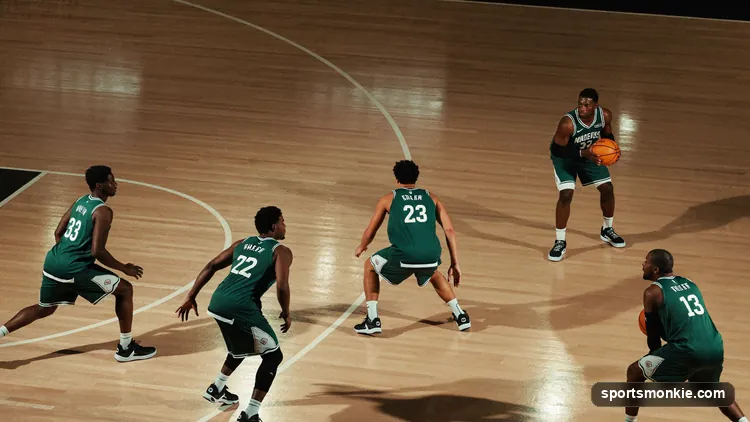
2-3 Zone vs Man-to-Man Defense: Full Basketball Comparison
2-3 zone vs man to man defense compared: coverage, pick-and-roll, 3-point defense, rebounding, and when coaches at every level pick each.
Man-to-Man Defense in Basketball: Rules, Roles, and How It Works
Man to man defense explained: on-ball, denial, and help roles, stance, closeouts, and how it differs from zone. Full breakdown with drills and FAQs.
Basketball Defenses and Offenses Explained: Zone, Man-to-Man, and More
Basketball defenses and offenses explained: man-to-man, zone defense in basketball, presses, and the plays teams run to attack each one.