
Backdoor Cut in Basketball: Definition, When to Use It, and How to Run It
On this page6
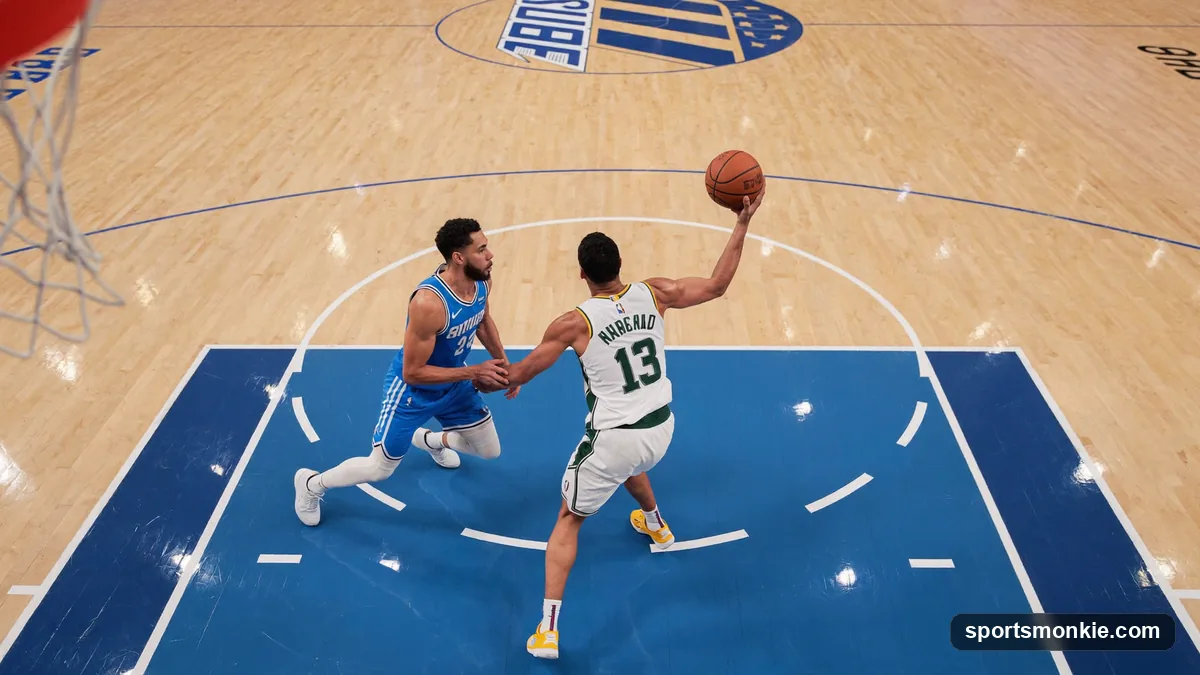
A backdoor cut is a basketball move where a player without the ball fakes toward the ball-handler to pull their defender out of position, then reverses direction and sprints straight to the basket behind that defender for a pass and an easy score. It is the single best counter to a defender who overplays the passing lane, and it is built into nearly every read-based offense in the sport, from youth leagues to the NBA.
How a backdoor cut works, step by step
Picture a wing player being guarded tightly, with the defender standing between them and the ball, denying any pass. That defender is “overplaying” — sacrificing rim protection to make the entry pass difficult. The backdoor cut punishes that decision directly:
- The cutter fakes toward the ball, taking one or two hard steps as if calling for the pass. This is the part that sells the whole move — a lazy fake gets read instantly.
- The defender reacts, shifting weight forward or sliding to stay in the passing lane, often turning their head to locate the ball.
- The cutter plants the foot nearest the passer and explodes in the opposite direction, cutting hard behind the defender toward the rim.
- The passer delivers the ball early, usually a bounce pass timed to arrive just as the cutter crosses in front of the basket, well before a help defender can rotate over.
- The cutter finishes with a layup or dunk, or kicks the read out if a second defender has already rotated to help.
The whole sequence takes one or two seconds. Speed and a convincing fake matter far more than athleticism — plenty of backdoor cuts are scored by players who aren’t the best leapers on the floor, simply because they read the defense correctly.
When a backdoor cut is the right read
A backdoor cut only makes sense against a specific defensive mistake: overplaying denial. Signs a defender is vulnerable to it include:
- Standing with their back partially to the basket, focused entirely on denying the pass
- Reaching or leaning into the passing lane rather than staying square
- Turning their head to watch the ball-handler instead of tracking their own man
- Playing unusually tight on a possession where the offense hasn’t shown a cut yet
If the defender is instead playing off, sagging into the paint, or squared up in a normal denial stance without overcommitting, a backdoor cut has no advantage — the defender can simply slide with the cutter and beat them to the spot. In those cases, a V-cut or basic give-and-go is the better tool.
Backdoor cut vs. other basketball cuts
| Cut | Starting action | Best used against | Cutter touches ball first? |
|---|---|---|---|
| Backdoor cut | Fake toward ball, reverse to basket | Overplaying denial defense | No |
| Give-and-go | Pass away, then cut | Any defender who relaxes after the pass | No, but cutter just passed |
| V-cut | Cut low, then pop back out | Defenders denying at the perimeter | No |
| Curl cut | Cut tight around a screen toward the rim | Defenders trailing over a screen | No |
| Flash cut | Cut hard into the high post or short corner | Defenders overplaying the wing or ball-side | No |
The backdoor cut is unique among these because it depends entirely on reading a defensive mistake rather than running off a set screen or scripted action — it is a reaction, not a play call.
Why backdoor cuts matter even when they don’t score
The threat of a backdoor cut changes defensive behavior on every possession, not just the ones where it’s actually run. Once a defense has been burned by one backdoor layup, defenders become noticeably more cautious about overplaying passing lanes for the rest of the game. That hesitation opens up simpler entry passes and normal offensive sets, which is why coaches teach backdoor cuts as much for their deterrent value as for the direct points they produce. It’s a core reason motion and read-and-react offenses — most famously the Princeton offense — build backdoor reads into their spacing rather than treating them as a trick play.
How to defend a backdoor cut
Stopping backdoor cuts comes down to positioning and communication rather than raw athleticism:
- Stay in a “see man, see ball” stance. Turning the head fully to track the passer is what creates the opening; defenders should deny with peripheral vision instead.
- Deny a step off the passing lane, not directly in it, so a fake doesn’t fully commit the defender’s weight.
- Communicate cuts loudly so help defenders can rotate over before the cutter reaches the rim.
- Funnel the cutter toward weak-side help rather than getting beaten cleanly to the baseline, where there’s no second line of defense.
Teams that struggle against backdoor cuts are usually playing denial defense without support — a lone defender overplaying with no one behind them to rotate.
Where the backdoor cut fits in a team’s offense
The backdoor cut is one piece of a broader cutting and screening toolkit. For the full picture of how teams structure their offense around it, see our guide to basketball defenses and offenses explained, which covers how man-to-man and zone schemes shape which cuts are available. It pairs naturally with the give-and-go, another off-ball action that punishes a defender who relaxes after a pass, and with off-ball screens, which create the driving lanes a backdoor cutter finishes through. For more basketball explainers like this one, browse the full basketball hub.
Frequently asked questions
What is a backdoor cut in basketball?+
A backdoor cut is when an offensive player without the ball moves toward the ball-handler as if expecting a pass, then suddenly changes direction and cuts hard toward the basket behind an overplaying defender to receive a pass for a layup or dunk. It is a direct counter to denial defense.
When should a player use a backdoor cut?+
Use a backdoor cut when a defender is overplaying the passing lane — standing between the ball and the offensive player with their back partly or fully to the basket, trying to deny an entry pass. If the defender is playing straight up or sagging off, a backdoor cut is unnecessary and just clears space for a normal cut instead.
How do you execute a backdoor cut correctly?+
Start with a normal cut toward the ball to sell the fake, plant the foot closest to the passer, and explode in the opposite direction toward the rim while keeping a hand up as a target. The passer must see the cut developing and deliver the ball early and low so the defender cannot recover or draw a charge.
What is the difference between a backdoor cut and a give-and-go?+
A give-and-go starts with a pass away from the cutter, who then sprints to the basket after releasing the ball. A backdoor cut never involves the cutter passing first — it is purely a reaction to a defender denying the ball, and the cutter never touches the ball before making the cut.
Why do backdoor cuts work against man-to-man defense?+
Backdoor cuts exploit defenders who play tight, overplaying denial defense with their eyes on the ball instead of their own man. The moment a defender turns their head to track the passer or gets caught leaning the wrong way, the cutter has a clear runway to the rim before help defense can rotate over.
How do you defend against a backdoor cut?+
Defenders should deny with their body turned so they can see both the ball and their man out of the corner of their eye, stay a step off the passing lane rather than fully in it, and communicate loudly when help is needed. Coaches also teach defenders to funnel cutters toward weak-side help rather than getting fully beaten to the baseline.
What offenses rely heavily on backdoor cuts?+
Read-and-react and motion-based systems — most famously the Princeton offense — build backdoor cuts into their spacing on nearly every possession, using them to punish aggressive denial defense and to keep defenses honest even when the cut isn't the actual target of a given play.
What is a common mistake players make on a backdoor cut?+
The most common mistake is a late or lazy fake that doesn't actually draw the defender's weight the wrong way, which lets the defender simply slide over and beat the cutter to the spot. A slow, obvious cut also gives weak-side help defenders time to rotate and take away the layup.
Sources
Play & tools
Free browser games and tools — no account, no download.
- Play 82-0 — Draft five, one per position, and see if your lineup can go a flawless NBA season.
- Play Era Ball — Draft an all-time NBA roster from a single era, then simulate a season and chase a perfect run.
- Play 32-0 — Draft five college basketball legends, one per position, and chase a perfect 32-0 national title.
- Explore all our games →
- Get the printable bracket — Download and print a blank tournament bracket to fill out by hand.
- Open the TS% calculator — Calculate TS% from points, field goal attempts and free throw attempts — scoring efficiency in one number.
- Explore all our free sports tools →
Related basketball guides
View all →
Basketball Defenses and Offenses Explained: Zone, Man-to-Man, and More
Basketball defenses and offenses explained: man-to-man, zone defense in basketball, presses, and the plays teams run to attack each one.
Box and One Defense: How It Works, When to Use It, and How to Beat It
The box and one defense mixes zone and man-to-man: four defenders form a box while one shadows the opponent's top scorer. Setup, uses, and counters.
What Is a Give and Go in Basketball? How It Works
A give and go in basketball is a pass, cut, and return-pass play between two players. See how it works, why it's so hard to stop, and how to defend it.
Help Defense in Basketball: How It Works, Positioning, and Key Rules
Help defense is when off-ball defenders shift toward the ball to stop dribble penetration. Learn positioning, rotations, stunts, tags, and closeouts.
Motion Offense in Basketball Explained: Rules, Alignment & Keys
What is a motion offense in basketball? Learn the rules, spacing, formations (5-out, 4-out 1-in), player roles, strengths, weaknesses, and how to run it.
Off-Ball Screens in Basketball: Types, Alignment & How to Use Them
A basketball screen set away from the ball is an off-ball screen. Learn the down, back, flare, cross, and elevator screens with alignment, roles, and counters.