
Motion Offense in Basketball Explained: Rules, Alignment & Keys
On this page7
A motion offense is a rules-based basketball system — not a memorized play — where players continuously cut, screen, and pass while reading the defense to create scoring advantages. Rather than running the same script every time down the floor, a team drilled in motion offense internalizes principles like spacing, screening away from the ball, and cutting hard to the rim, then reacts to whatever the defense gives it. It’s the backbone offensive approach at nearly every level of the sport, from youth leagues to college programs built around it.
The Basic Rules of Motion Offense
Every motion offense is built on a handful of core rules that players apply on the fly instead of following a fixed script:
- Spacing — players stay roughly 12-15 feet apart to keep passing lanes open and prevent help defenders from guarding two people at once.
- Pass and cut — after passing, a player often cuts hard to the basket (a “give and go”), forcing the defense to account for movement on every possession.
- Screen away from the ball — players away from the ball look to set screens for teammates, opening driving lanes or catch-and-shoot looks.
- Triple-threat pause — a perimeter player catching the ball squares up ready to shoot, drive, or pass, typically holding for a two-count so cuts and screens have time to develop.
- Purposeful dribbling — the ball is dribbled to attack a gap, improve a passing angle, or beat a zone defense — never just to kill time.
- Constant, disciplined movement — standing still is the one thing not allowed; every player without the ball is either cutting, screening, or repositioning for spacing.
These rules are the same ones that separate motion offense from a rigid, choreographed set — see how the two philosophies compare in our broader guide to basketball defenses and offenses explained.
Alignment: How a Motion Offense Sets Up
Coaches choose a starting formation based on their personnel, then let the rules take over once the ball is passed. The three most common alignments:
| Formation | Setup | Best For |
|---|---|---|
| 5-Out | All five players spaced around the three-point line, no one in the post | Guard-heavy, positionless teams; most common for youth/school ball |
| 4-Out 1-In | Four players on the perimeter, one player anchored in the post | Teams with one strong post scorer |
| 3-Out 2-In | Three perimeter players, two players operating from the post | Teams with two skilled post players who can screen and finish inside |
Some programs also run a simplified “circle motion” (a reduced rule set for beginners) or a dribble-drive motion that emphasizes attacking closeouts off the bounce rather than screening. Whichever alignment is chosen, the spacing stays constant — that floor balance is what separates motion offense from more structured systems like the triangle offense, which relies on a fixed sideline triangle rather than continuous re-spacing.
Player Roles Inside a Motion Offense
Because motion offense is largely “positionless,” every player learns the same base rules, but roles still shift by spot on the floor:
- Perimeter players make basket cuts, backdoor cuts, and V-cuts to get open, and they’re expected to attack a closeout with a live dribble when a defender overplays them.
- Post players screen for cutters, flash to the elbow or short corner, set ball screens, and rotate through the low block rather than camping in one spot.
- The ball handler reads whether a defender is playing them tight (attack off the dribble) or sagging off (look to pass and cut).
Screening is the engine that keeps the offense moving — for a full breakdown of screening technique and types, see our guide to off-ball screens in basketball.
Strengths of Motion Offense
- Hard to scout. Because there’s no fixed sequence, opposing defenses can’t simply memorize where the ball will end up.
- Works without elite size or talent. The same rules apply whether a team has a dominant post scorer or five interchangeable guards.
- Teaches transferable fundamentals. Spacing, cutting, and screening are skills that carry over to every offensive system a player will ever run, which is why it’s the standard teaching tool in youth basketball.
- Continuously creates advantages. Constant movement forces help defenders to make decisions, and every mistake — a blown switch, a late close-out — becomes a scoring chance.
Weaknesses of Motion Offense
- Demands high basketball IQ. Players must read the defense and make the correct decision in real time; younger or less experienced players can bog the offense down by standing still or over-dribbling.
- Can stall against disciplined defense. A defense that talks through every screen and denies cutting lanes can force a motion offense into late-clock, low-percentage shots.
- Harder to design a “last shot” from. Because it isn’t script-based, coaches sometimes call a specific set play in end-of-quarter or end-of-game situations rather than trusting free-flowing motion.
- Requires significant teaching time. Coaches must drill spacing, cutting, and screening rules in progression before players can run it fluidly, which is a bigger up-front investment than installing a single set play.
How to Attack and Defend a Motion Offense
For offenses running it, execution comes down to discipline: set screens with real contact rather than “lazy” brush screens, cut at game speed instead of jogging, and don’t let one or two players dominate the ball — motion offense breaks down fastest when the same player holds the ball every possession instead of trusting the next pass.
For defenses facing it, the counters are equally rule-based:
- Talk on every screen so defenders can fight through or switch without getting picked off blind.
- Deny the easy pass-and-cut by staying between the cutter and the ball.
- Hedge or switch ball screens decisively rather than getting caught in no-man’s-land.
- Force the action away from the middle of the floor, since motion offense relies on driving and passing lanes through the paint.
Teams that struggle defensively against constant cutting and screening often benefit from mixing in zone principles — see our explainer on basketball defenses and offenses for how zone looks disrupt spacing-based attacks.
Where Motion Offense Fits in the Bigger Picture
Motion offense sits at the “principles over patterns” end of the offensive spectrum, opposite rigid, choreographed systems. Indiana coach Bob Knight is widely credited with popularizing the modern version in the 1970s-80s — building on ideas from the Princeton offense and Henry Iba’s read-and-react teachings — and won three NCAA titles (1976, 1981, 1987) running it. Today it’s the default teaching offense at the youth and high school level — see our roundup of the best basketball offenses for youth teams for how it compares to other beginner-friendly systems — and still shows up, in modified form, in college and pro sets that blend motion principles with structured actions like ball screens and floppy/Spain pick-and-roll. For the full landscape of how offensive and defensive systems interact across a game, start with our basketball defenses and offenses explained hub, and browse more strategy breakdowns in Basketball (NBA/WNBA).
Frequently asked questions
What is a motion offense in basketball?+
A motion offense is an offensive system built on a small set of rules — such as pass-and-cut, screen away, and maintain spacing — rather than a memorized, repeating pattern. Players read the defense in real time and make decisions, which makes the offense unpredictable and hard to scout compared to a fixed set play.
What are the basic rules of a motion offense?+
Common rules include: space the floor 12-15 feet apart, pass and cut to the basket, screen away from the ball, set strong (not lazy) screens, hold the ball no longer than a two-count in triple-threat position, and keep moving without the ball. Coaches layer these rules in progressively as players master each one.
What is the difference between a motion offense and a set play?+
A set play is a scripted sequence with a defined start and finish — everyone knows their exact spot and action. A motion offense has no fixed ending; players react continuously to how the defense plays them, which is why it is often called a 'reactive' rather than a 'rehearsed' system.
What is 5-out motion offense?+
5-out motion offense spreads all five players around the three-point line with no player stationed in the post. It maximizes spacing and driving lanes and is the most common starting formation for youth and school teams because it is positionless and simple to teach.
Who invented the motion offense?+
Indiana coach Bob Knight is widely credited with popularizing the modern motion offense in the 1970s and 1980s, building on ideas from Princeton's offense and his own 'reverse action' sets at Army. Henry Iba's read-and-react principles are also cited as an early influence. Knight won three NCAA titles (1976, 1981, 1987) running motion-based offense.
What is the best way to defend a motion offense?+
Defenses counter motion offense by talking through every screen, switching or hedging picks decisively, denying the pass-and-cut lane, and forcing the ball away from the middle of the floor. Because motion offense relies on timing and spacing, disrupting cutters early and not getting lost on off-ball screens takes away its main advantage.
What formations can a motion offense use?+
The most common alignments are 5-out (no post player), 4-out 1-in (one post, four perimeter), and 3-out 2-in (two posts, three perimeter). Teams pick a formation based on personnel — guard-heavy rosters favor 5-out or 4-out 1-in, while teams with skilled post scorers use 3-out 2-in.
Is motion offense good for youth basketball?+
Yes. Motion offense is widely recommended for youth teams because it teaches spacing, cutting, screening, and decision-making rather than memorized plays, and it works regardless of a team's size or talent level since every player learns the same rules.
Sources
Play & tools
Free browser games and tools — no account, no download.
- Play 82-0 — Draft five, one per position, and see if your lineup can go a flawless NBA season.
- Play Era Ball — Draft an all-time NBA roster from a single era, then simulate a season and chase a perfect run.
- Play 32-0 — Draft five college basketball legends, one per position, and chase a perfect 32-0 national title.
- Explore all our games →
- Get the printable bracket — Download and print a blank tournament bracket to fill out by hand.
- Open the TS% calculator — Calculate TS% from points, field goal attempts and free throw attempts — scoring efficiency in one number.
- Explore all our free sports tools →
Related basketball guides
View all →
Off-Ball Screens in Basketball: Types, Alignment & How to Use Them
A basketball screen set away from the ball is an off-ball screen. Learn the down, back, flare, cross, and elevator screens with alignment, roles, and counters.
Backdoor Cut in Basketball: Definition, When to Use It, and How to Run It
What a backdoor cut is in basketball, when players use it against overplaying defenders, and how to execute and defend it correctly.
Basketball Defenses and Offenses Explained: Zone, Man-to-Man, and More
Basketball defenses and offenses explained: man-to-man, zone defense in basketball, presses, and the plays teams run to attack each one.
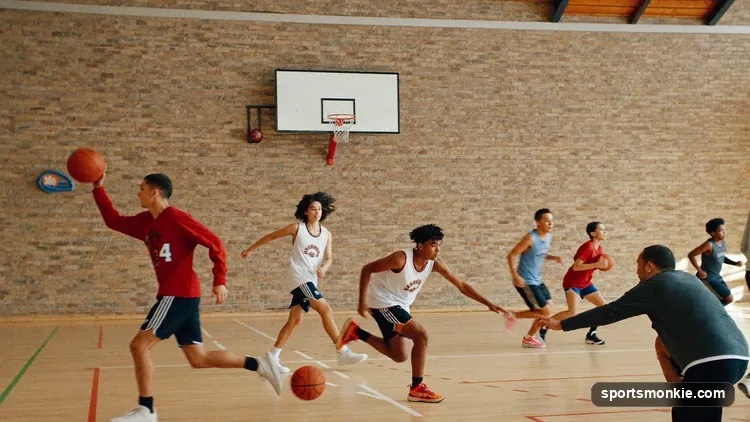
8 Best Basketball Offenses for Youth Teams (Ranked)
The best basketball offenses for youth teams are spacing-first systems like 5-out, 4-out 1-in, and Read & React that teach reads instead of memorized plays.
1-3-1 Zone Defense in Basketball: Alignment, Roles & How to Attack It
The 1-3-1 zone defense explained: player alignment, roles, traps, strengths, weaknesses, and how offenses beat it. A full coaching breakdown.
2-3 Zone Defense in Basketball: Alignment, Roles, and How to Attack It
The 2-3 zone defense lines up two guards up top and three defenders low, guarding areas instead of players. Here's how it works and how to beat it.