
Triangle Offense Explained: Formation, Roles, and How It Works
On this page8
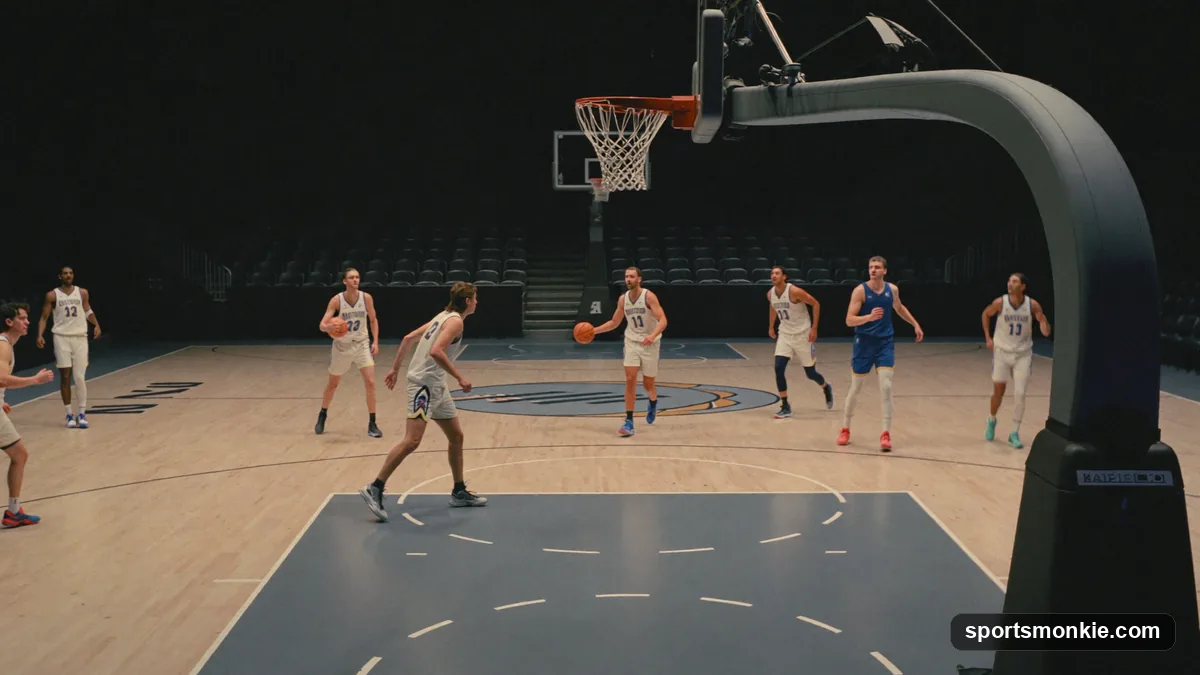
The triangle offense is a read-based system that spaces three players into a sideline triangle — corner, wing, and low post — with a two-man game on the weak side, letting players react to the defense instead of running scripted plays. Tex Winter developed it, and Phil Jackson used it to win 11 NBA titles with the Bulls and Lakers.
The alignment: how the triangle sets up
Picture a half-court with the ball on one wing. The triangle offense fills five specific spots:
| Spot | Player | Location |
|---|---|---|
| Low post | Center or big | Ball-side block |
| Wing | Forward | Ball-side wing, above the block |
| Corner | Guard | Ball-side corner |
| Top | Guard | Top of the key, weak side |
| High post | Forward | Weak-side elbow/free-throw line area |
The low post, wing, and corner form the actual “triangle” — three players spaced roughly 15-18 feet apart on the strong side, each open to a pass from the other two. The top guard and weak-side forward form a two-man game on the far side of the floor, ready to fill in on a reversal or attack if the defense over-helps.
This is not a formation the offense stays frozen in — it’s a starting alignment. As the ball moves, players cut, screen, and rotate, and the triangle “resets” on the new strong side after every pass, which is why it is sometimes grouped with other read-based systems on our basketball offenses and defenses hub.
Player roles inside the triangle
- Low-post player (usually the center or a skilled big): Sets up on the block, looking for entry passes and serving as a scoring and passing hub near the rim.
- Wing player: Occupies the space between the post and the corner, often the trigger point for post entries and cutting actions.
- Corner player: Spaces the floor from the corner, ready to shoot, cut backdoor, or relocate if the defense collapses toward the post.
- Top-of-the-key guard: Initiates ball reversals and can attack downhill if the defense overcommits to the strong side.
- Weak-side forward (high post): Flashes to the “pinch post” at the elbow to catch, facilitate, or screen, connecting the two sides of the floor.
No single player is locked into “point guard runs the play” duty — decisions get made collectively based on where the defense is weak.
Core actions and reads
Within the triangle, players choose from a small menu of reads rather than following a called play:
- Post entry — feeding the low-post player, who can score, kick out, or hit a cutter.
- Two-man game — a wing-corner exchange or dribble handoff to probe the defense.
- Backdoor cuts — if a defender overplays a passing lane, the offensive player cuts to the rim.
- Screens away from the ball — similar to the concepts on our off-ball screens breakdown, used to free shooters and cutters on the weak side.
- Ball reversal — swinging the ball to the two-man side to force the defense to shift and re-triangle on the new strong side.
Every read is defense-dependent: if the entry pass is denied, the offense cuts; if the cutter is covered, the ball reverses; if the reversal opens a shooter, they shoot.
Strengths of the triangle offense
- Hard to scout. Because there’s no fixed play call, opposing defenses can’t simply key on one action — they have to guard the whole floor.
- Balances scoring. Multiple players touch the ball on nearly every possession, which keeps role players engaged and reduces predictable isolation basketball.
- Built-in counters. Every denial by the defense has a built-in answer (cut, screen, reversal), so possessions rarely stall into a bad shot.
- Proven at the highest level. Six Bulls titles and five Lakers titles are the strongest evidence any offensive system in NBA history can offer.
Weaknesses and why it’s declined
- Steep learning curve. Reading the defense in real time demands high IQ and reps together, which is hard for teams that turn over their roster often.
- Slower initiation. Compared to modern spread pick-and-roll or motion systems, the triangle can take longer to generate a shot, which matters more with a shorter shot clock era of pace-and-space basketball.
- Star fit issues. A shot-hungry, high-usage ball-handler can clash with a system built on equal touches — a key reason later NBA rosters moved away from it.
- Public struggles. The Knicks’ well-documented, uneven attempt to install the triangle under Phil Jackson’s front office (2014-2017) reinforced the perception that it’s difficult to teach modern rosters.
How to attack (and defend against) the triangle
Teams that struggle against the triangle usually deny the first pass, forcing turnovers before the offense ever sets up — aggressive ball pressure on the entry pass disrupts the whole sequence. Switching everything also limits the cutting and screening reads that make the triangle dangerous. On the flip side, teams running the triangle counter denial defense with backdoor cuts and pinch-post reversals, which is why disciplined, well-drilled triangle teams are so hard to defend for a full 48 minutes.
Where the triangle fits today
Pure triangle offenses are rare in today’s NBA, which leans heavily on spread pick-and-roll and motion offense principles built around shooting gravity rather than post entries. But triangle DNA hasn’t disappeared — ball reversals, pinch-post reads, and off-ball cutting show up inside modern systems, and coaches who came through the Winter-Jackson coaching tree still lean on triangle spacing concepts. For a broader look at how it compares to zone-based defensive philosophies, see the full basketball offenses and defenses guide, part of our NBA and WNBA coverage.
Why it matters
The triangle offense remains one of basketball’s most influential systems — not because every team should run it today, but because it proved that spacing, ball movement, and shared decision-making could out-produce isolation scoring at the highest level, a principle that still shapes modern offensive design even as the exact formation has faded.
Frequently asked questions
What is the triangle offense in basketball?+
The triangle offense is a positionless, read-and-react offensive system that spaces five players into two groups: a three-man triangle on the strong side (ball-side corner, wing, and low post) and a two-man game on the weak side (a guard at the top of the key and a forward at the high post). Rather than running scripted plays, players read the defense and choose from a menu of options — post entries, cuts, screens, and reversals — to keep the ball moving until a good shot appears.
Who invented the triangle offense?+
Tex Winter is credited with developing the triangle offense, building on the 'triple-post' concepts he learned from USC coach Sam Barry in the late 1940s. Winter refined the system over decades as a college and pro coach before joining Phil Jackson's staff with the Chicago Bulls in 1989, where it became the foundation of a dynasty.
Why did Phil Jackson use the triangle offense?+
Phil Jackson adopted the triangle because it did not depend on one dominant scorer, which suited rosters built around two stars — Michael Jordan and Scottie Pippen in Chicago, later Kobe Bryant and Shaquille O'Neal in Los Angeles. The system's constant ball movement and multiple scoring reads reduced isolation basketball, kept role players involved, and forced defenses to guard the whole floor instead of loading up on one player.
How many championships did the triangle offense win?+
Teams running the triangle offense under Tex Winter and Phil Jackson won 11 NBA championships — six with the Chicago Bulls (1991-1993, 1996-1998) and five with the Los Angeles Lakers (2000-2002, 2009-2010). It is one of the most successful offensive systems in NBA history.
Why is the triangle offense less common in the modern NBA?+
The modern NBA prioritizes three-point volume, ball-handling from every position, and pick-and-roll actions that the triangle's slower, read-heavy structure does not naturally emphasize. Today's spacing comes from shooters stretching the floor rather than a fixed triangle formation, and most rosters now feature versatile perimeter players rather than a true low-post hub. The Knicks' rocky attempt to install it under Phil Jackson (2014-2017) also hurt its modern reputation, since several players struggled with its demands.
What skills does the triangle offense require from players?+
The triangle demands high basketball IQ, unselfish passing, and comfort playing without the ball, since there is no single primary ball-handler running set plays. Players need to read defensive positioning in real time, understand spacing principles, screen effectively away from the ball, and finish through post touches and cuts rather than relying purely on isolation or pick-and-roll scoring.
Is the triangle offense still used today?+
Full triangle systems are rare in the modern NBA, but many teams still use its core concepts — post entries, weak-side cuts, ball reversals, and read-based spacing — inside broader motion-offense frameworks. Some college and international programs continue to run adapted versions, and coaches who worked under Jackson or Winter have carried triangle principles into their own systems elsewhere.
What is the pinch post in the triangle offense?+
The pinch post is a secondary alignment inside the triangle where the weak-side big flashes to the high post (near the free-throw line) to receive a pass, creating a passing and cutting hub in the middle of the floor. It gives the offense another read — a big facilitating from the elbow, feeding cutters or reversing the ball to the weak side — when the primary strong-side triangle is denied.
Sources
Play & tools
Free browser games and tools — no account, no download.
- Play 82-0 — Draft five, one per position, and see if your lineup can go a flawless NBA season.
- Play Era Ball — Draft an all-time NBA roster from a single era, then simulate a season and chase a perfect run.
- Play 32-0 — Draft five college basketball legends, one per position, and chase a perfect 32-0 national title.
- Explore all our games →
- Get the printable bracket — Download and print a blank tournament bracket to fill out by hand.
- Open the TS% calculator — Calculate TS% from points, field goal attempts and free throw attempts — scoring efficiency in one number.
- Explore all our free sports tools →
Related basketball guides
View all →
Motion Offense in Basketball Explained: Rules, Alignment & Keys
What is a motion offense in basketball? Learn the rules, spacing, formations (5-out, 4-out 1-in), player roles, strengths, weaknesses, and how to run it.
Pick and Roll in Basketball: How It Works, Types, and How to Defend It
The pick and roll explained: how the screen-and-roll works, its variations, and the defensive coverages teams use to stop it.
Backdoor Cut in Basketball: Definition, When to Use It, and How to Run It
What a backdoor cut is in basketball, when players use it against overplaying defenders, and how to execute and defend it correctly.
Basketball Defenses and Offenses Explained: Zone, Man-to-Man, and More
Basketball defenses and offenses explained: man-to-man, zone defense in basketball, presses, and the plays teams run to attack each one.
Euro Step in Basketball: Rules, Footwork, and How to Do It
The euro step in basketball is a legal two-step move where a driver picks up the dribble and steps one way, then the other, to dodge a defender.
Off-Ball Screens in Basketball: Types, Alignment & How to Use Them
A basketball screen set away from the ball is an off-ball screen. Learn the down, back, flare, cross, and elevator screens with alignment, roles, and counters.