
Step-Back Jumper in Basketball: Footwork, Travel Rule, and Famous Users
On this page6
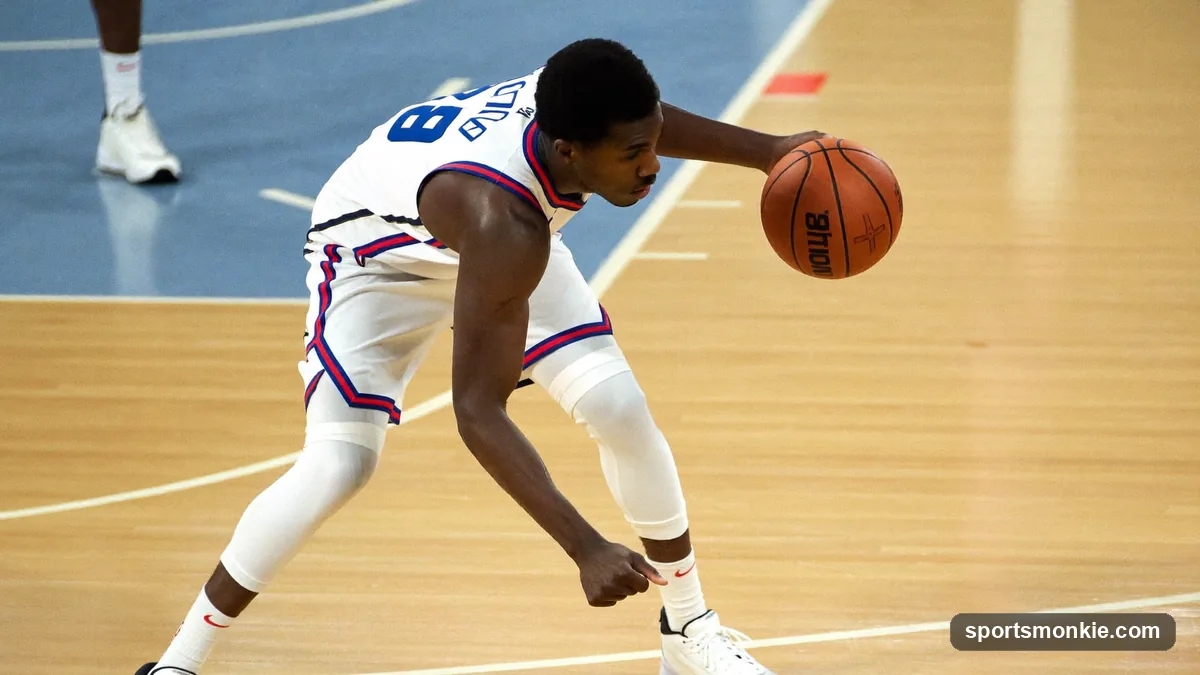
A step-back jumper is a scoring move where a ball-handler dribbles toward a defender, plants, and explosively pushes backward one or two steps to create separation before rising into a jump shot. It has become one of the most common — and most argued-about — shots in modern basketball, largely because of how it looks on a broadcast replay: a defender in perfect position suddenly guarding several feet of open air.
How the step-back jumper works
The move is built on a simple idea: a jump shot is nearly unblockable once the shooter has enough space, so instead of trying to shoot over a set defender, the ball-handler creates that space themselves off the dribble. It’s one of several types of basketball shots built around self-created separation rather than a pass or a screen, and it’s become a staple in basketball (NBA/WNBA) offenses at every level, from pickup runs to All-Star closeouts.
The sequence usually starts with the ball-handler attacking downhill, forcing the defender to backpedal or lean forward to stay in front of the dribble. That forward lean is what the step-back exploits — the defender’s momentum is moving the wrong way at the exact moment the shooter reverses direction.
Step-by-step footwork
Coaches break the move into a short, repeatable sequence. The details vary slightly by player, but the core mechanics are consistent:
- Attack the defender. Dribble in aggressively enough to get a reaction — a backpedal, a hip turn, or a lean — that shifts their weight.
- Gather the ball. Pick up the dribble with both hands, which is the moment the traveling clock effectively starts.
- Plant the outside foot. This is typically the foot on the same side as the dribbling hand; it becomes the pivot point for the push backward.
- Push backward. Drive the hips and shoulders back off that planted foot while the other foot lands behind it to square the shoulders to the rim.
- Rise straight up. Gather the base under the shoulders and jump vertically rather than continuing to drift backward, which is where accuracy is lost.
- Release before the third step. The shot has to leave the shooter’s hand before a third step touches the floor, or before the pivot foot lifts a second time.
| Phase | What happens | Common mistake |
|---|---|---|
| Attack | Dribble into the defender to draw a reaction | Not getting close enough to force a real reaction |
| Gather | Pick up the dribble with both hands | Gathering too early, giving the defender time to recover |
| Plant | Outside foot plants as the pivot | Planting too far forward, killing backward push power |
| Push | Explosive step(s) backward | Drifting sideways instead of straight back, losing balance |
| Rise | Jump vertically into the shot | Fading further back mid-shot, missing short or off-line |
| Release | Ball leaves the hand within the legal step count | Taking a third step or double-pivoting before releasing |
The travel rule debate
No move in basketball generates more rules arguments than the step-back, and the debate almost always comes down to the “gather step.” Under the NBA and FIBA rulebooks, the instant a player gathers the ball to end their dribble, they’re allowed a “zero step” that doesn’t count against their step total, followed by two more steps before the ball must be shot, passed, or dribbled again.
That means a step-back can legally look like three steps to the eye — the gather step, plus two real steps backward — without being a travel, as long as the shooter releases the ball or completes only one pivot-foot change within that window. The NBA has repeatedly and publicly confirmed that James Harden’s signature step-back is legal under this reading, even though it draws complaints from defenders and fans nearly every time it’s called clean. The confusion is understandable: the gather-step exception was formalized relatively recently in basketball’s long history, and it changed how aggressively players could load up a backward push before their feet “count.”
Step-back vs. fadeaway: what’s the difference
The step-back jumper is frequently confused with the fadeaway in basketball, and while both create separation, they do it differently. A fadeaway is usually shot from a stationary position — often in the post or midrange — where the shooter leans their upper body backward during the jump itself, without a distinct step backward beforehand. A step-back, by contrast, involves the feet actually traveling backward off the dribble before the shooter squares up and jumps essentially straight up.
In short: a fadeaway leans away, a step-back walks away first and then jumps. Step-backs are almost always perimeter, off-the-dribble shots, while fadeaways show up more often in the post or on isolation possessions closer to the basket. Both moves sit apart from simpler shots like the layup, which is designed to score at the rim with minimal separation rather than create space from distance.
Famous players who use the step-back jumper
The step-back’s popularity has a clear lineage. Dirk Nowitzki is widely credited with popularizing an early version in the 2000s — a one-legged step-back fadeaway built out of footwork he adapted from Hakeem Olajuwon, and it became one of the most difficult shots in the league to contest during his prime with the Dallas Mavericks. Michael Jordan and Kobe Bryant both used step-back-style separation jumpers earlier in their careers as well, though neither made it their signature shot the way later players would.
James Harden turned the deep, two-legged step-back three into his primary scoring weapon during his MVP seasons with the Houston Rockets, drawing both praise for its effectiveness and criticism over how physical the “gather” push looked in real time. Luka Doncic has since become the move’s most prolific modern user, pairing size and body control to shoot step-backs over smaller defenders from well beyond the three-point line. Damian Lillard, Kevin Durant, and Kyrie Irving all use the shot regularly in clutch situations, and in the WNBA, players like Sabrina Ionescu and Kelsey Plum have built it into their own self-creation toolkits.
Why it’s so hard to defend
The step-back’s core advantage is speed of separation. A defender who is in textbook position — chest on the ball, hands up, feet mirroring the dribbler — can still end up guarding several feet of open floor within a single second, because the backward push happens faster than most defenders can react and close. Sagging off to guard against the step-back in advance isn’t a real option either, since that concedes a straight-line drive to the rim instead.
That bind is what makes the shot so valuable for elite scorers: it punishes tight defense with separation and punishes loose defense with a drive, leaving very little middle ground. The best counters are anticipation — reading the move before the gather and staying attached through the dribble — and closing out with length rather than a full closeout, since a hard, committed closeout is exactly what sets the step-back up in the first place.
Frequently asked questions
What is a step-back jumper in basketball?+
A step-back jumper is a shooting move in which the ball-handler dribbles toward a defender, plants their outside foot, and pushes backward one or two steps to create separation before rising into a jump shot. The backward movement puts extra distance between the shooter and the defender's contest, which is what makes the shot so hard to guard even though it's slower to develop than a standard catch-and-shoot jumper.
Is the step-back jumper legal, or is it traveling?+
It is legal. Under the NBA and FIBA gather-step rule, a ball-handler is allowed a 'zero step' the instant they gather the dribble, followed by two more steps before they must shoot, pass, or dribble again. A step-back is legal when the backward push happens within that two-step window and the shooter releases the ball, or changes their pivot foot only once, before taking a third step. The league has repeatedly confirmed James Harden's step-back is legal under this reading of the rule.
How do you do a step-back jumper properly?+
Dribble into the defender to get them leaning forward, plant your outside foot (the same side as your dribbling hand) as you gather the ball, then push off that foot to drive your hips and shoulders backward while your other foot lands to square you up. Gather your base under your shoulders, use your off-arm to help balance, and rise straight up into your shot rather than drifting further backward as you release, which costs accuracy.
Who is credited with popularizing the step-back jumper?+
Dirk Nowitzki popularized an early, one-legged version of the move in the 2000s, building it out of Hakeem Olajuwon-style footwork into a shot that became one of the most unstoppable in the league. Michael Jordan and Kobe Bryant also used step-back-style separation moves earlier in their careers. James Harden turned the two-legged, deep step-back into his signature shot in the 2010s, and Luka Doncic has become its most prolific modern practitioner.
What is the difference between a step-back jumper and a fadeaway?+
A step-back jumper involves the ball-handler taking one or two literal steps backward off the dribble to create space before shooting, so the feet actually travel away from the defender. A fadeaway is typically shot from a stationary or post-up position, where the shooter leans their upper body backward during the jump itself without taking a separate step back first. Step-backs are usually perimeter, off-the-dribble shots; fadeaways are common in the post and midrange.
Which NBA and WNBA players are best known for the step-back jumper?+
James Harden and Luka Doncic are the two names most associated with the modern step-back, both using it as a primary scoring weapon from three-point range. Dirk Nowitzki's one-legged fadeaway step-back is the move's most famous origin point, and Damian Lillard, Kevin Durant, and Kyrie Irving all lean on step-backs in clutch situations. In the WNBA, scorers like Sabrina Ionescu and Kelsey Plum regularly use step-back threes to create their own shot off the dribble.
Why is the step-back jumper so hard to defend?+
The backward push creates several feet of separation in under a second, which is more distance than a defender can close by simply staying in front of the dribble. Because the shooter can pull it up off one or two dribbles from almost anywhere on the floor, defenders can't sag off to protect against it without conceding a drive, and closing out hard invites a jab step or hesitation that sets the step-back up even better.
Can a step-back jumper be blocked?+
It's difficult but not impossible. The best chance a defender has is anticipating the move early and staying attached through the dribble so the backward push doesn't create clean airspace, or using length to contest late without fouling. Because the shooter is moving away from the rim and the defender when the shot goes up, most step-backs that get contested are altered rather than blocked outright.
Sources
Play & tools
Free browser games and tools — no account, no download.
- Play 82-0 — Draft five, one per position, and see if your lineup can go a flawless NBA season.
- Play Era Ball — Draft an all-time NBA roster from a single era, then simulate a season and chase a perfect run.
- Play 32-0 — Draft five college basketball legends, one per position, and chase a perfect 32-0 national title.
- Explore all our games →
- Get the printable bracket — Download and print a blank tournament bracket to fill out by hand.
- Open the TS% calculator — Calculate TS% from points, field goal attempts and free throw attempts — scoring efficiency in one number.
- Explore all our free sports tools →
Related basketball guides
View all →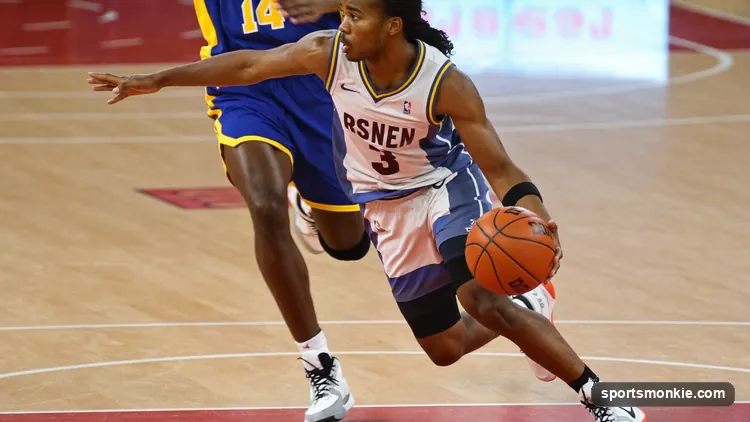
Euro Step in Basketball: Rules, Footwork, and How to Do It
The euro step in basketball is a legal two-step move where a driver picks up the dribble and steps one way, then the other, to dodge a defender.
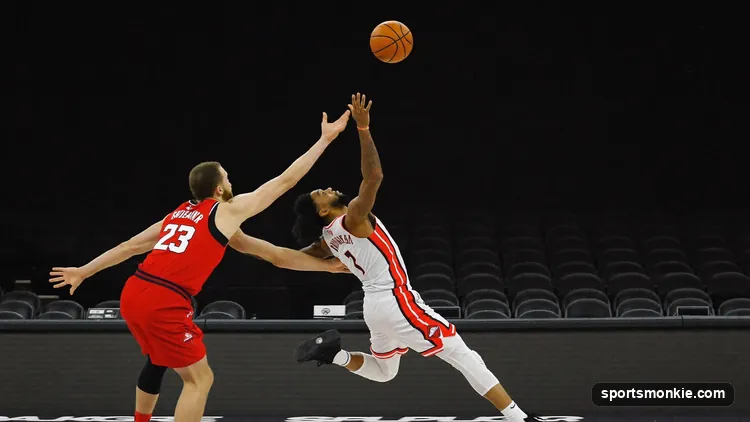
What Is a Fadeaway in Basketball? Technique, History & Best Shooters
A fadeaway in basketball is a jump shot taken while leaping backward, away from the defender, to create space. How it works, technique, and top shooters.
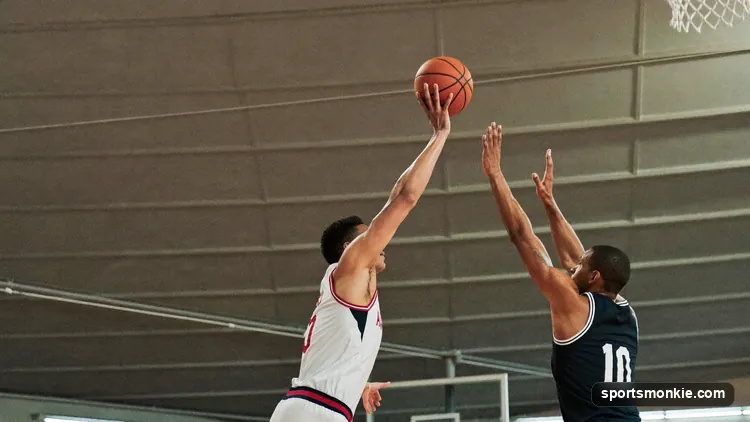
Types of Basketball Shots: Every Shot Explained
The main types of basketball shots are the layup, jump shot, three-pointer, dunk, floater, hook shot, bank shot, fadeaway, step-back, and euro-step.
Types of Shots in Basketball: 10 Every Player Needs
The 10 essential types of shots in basketball, from layups and jump shots to floaters, hooks, fadeaways and dunks, with coaching cues and when to use each.
Center Position in Basketball: Role, Skills & Famous Centers
The center position in basketball is the interior anchor who protects the rim, rebounds, screens, and finishes near the basket. Here's the full breakdown.
What Is a Layup in Basketball? Footwork, Types & Why It Scores
What is a layup in basketball? A close-range shot laid or banked off the glass after a drive. Learn the footwork, overhand vs. underhand, and variations.