
What Is a Fadeaway in Basketball? Technique, History & Best Shooters
On this page5
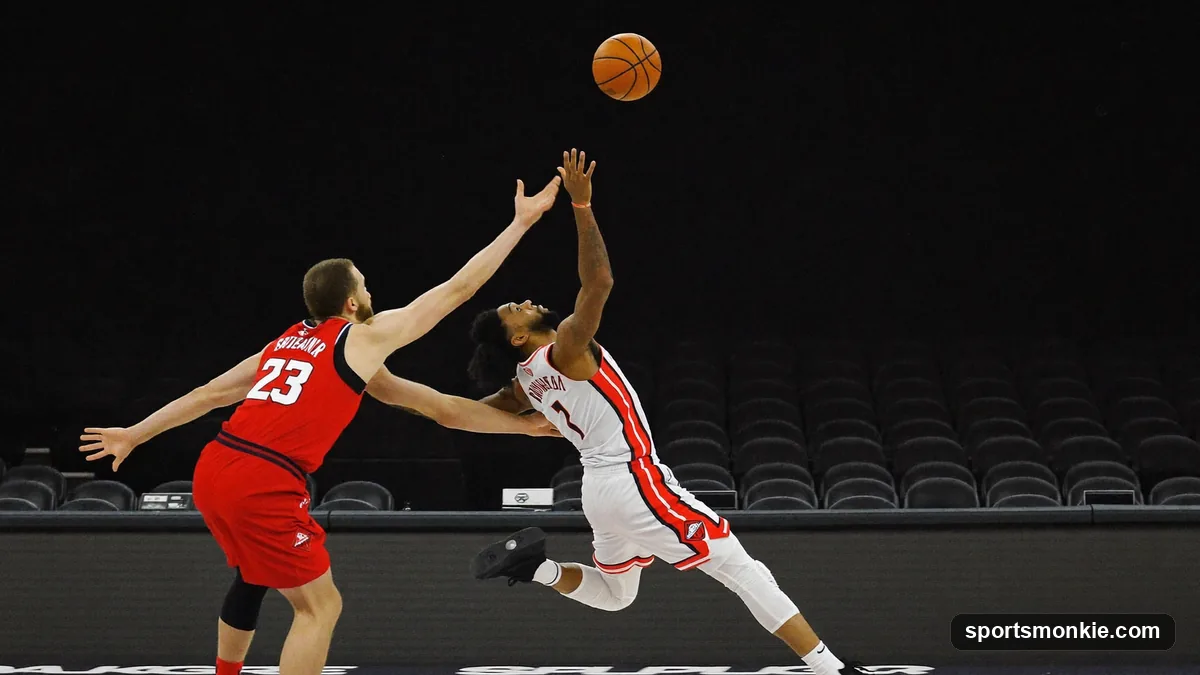
A fadeaway in basketball is a jump shot taken while the shooter leaps backward, away from the basket and the defender, to create separation right before the release. Instead of jumping straight up or forward like a standard jump shot, the shooter drifts away from the defense in mid-air, making the shot far harder to contest even though it sacrifices balance and accuracy to do it.
It is one of the signature shots among the many types of basketball shots, prized in NBA and WNBA basketball for being nearly unblockable in the right hands, and just as often criticized for being a low-percentage bailout in the wrong ones. Here is exactly how it works, how to shoot one, and who made it famous.
How the fadeaway works
The fadeaway’s entire purpose is separation. A defender guarding a shooter closely expects the shooter to attack toward the rim or rise straight up for a jumper, so their instinct is to stay attached and contest that space. On a fadeaway, the shooter instead pushes off and leaps backward, sometimes with a slight turn to one side, which pulls their whole body away from the defender at the exact moment the ball leaves their hand.
That backward drift is what makes the shot so tough to block. A defender would have to jump forward, into the shooter’s landing space, to get a hand up in time, which usually draws a foul or arrives a beat too late. The trade-off is real: leaning and jumping backward shifts the shooter’s center of mass away from the basket, which throws off the ball’s release angle and arc compared with a balanced, vertical jump shot. Research into shooting mechanics has found fadeaways are typically released at a steeper angle than the ideal 45-55 degrees for a jump shot, which helps explain why shooting percentages on fadeaways trail well behind a standard catch-and-shoot jumper.
Step-by-step technique
A clean fadeaway is a timing move as much as a shooting move. Most coaches break it down into the same basic sequence:
- Establish position with the ball. Most fadeaways start from the post, the mid-post, or a face-up isolation spot, with the shooter squared or slightly angled toward the defender.
- Load and push off backward. Instead of exploding upward or toward the rim, the shooter pushes off the front foot to launch their body backward and slightly upward.
- Rise to full extension. As the body drifts back, the shooter brings the ball up to the shooting pocket and extends the shooting arm, just like on a normal jump shot.
- Release at the peak. The ball is released near the top of the jump, with extra elevation compensating for some of the backward drift so the shot still has a clean line to the rim.
- Land balanced, away from the defender. Because the shooter is moving backward, they land further from the basket than they started, out of rebounding position, which is the shot’s biggest hidden cost.
Balance, a soft touch, and repetition are what separate an elite fadeaway from a wild, off-line heave. It is not a shot most players should reach for until their standard jumper is already reliable.
Famous fadeaway shooters
The fadeaway has a long lineage in the sport. Wilt Chamberlain is generally credited as an early pioneer of the shot, and Kevin McHale helped popularize it through the 1980s with his footwork-heavy post game. But it is most associated with a handful of legends who turned it into a career-defining weapon.
| Player | Signature version | Why it stands out |
|---|---|---|
| Michael Jordan | Mid-range turnaround fadeaway | Became one of his most reliable and feared isolation shots late in games |
| Kobe Bryant | Perimeter and post fadeaway | Studied and adapted Jordan’s footwork into his own go-to scoring move |
| Dirk Nowitzki | One-legged “flamingo” fadeaway | A uniquely balanced, one-footed release that was nearly impossible to time a block against |
| Kevin Durant | Long-limbed fadeaway jumper | His height and length let him fade away and still shoot over most defenders |
Jordan and Kobe Bryant are widely regarded as the two players who mastered the shot most completely, leaning on it constantly in isolation and post-up situations. Dirk Nowitzki’s version is the most visually distinct: he releases the ball balanced on one leg with the other kicked out behind him, a move nicknamed the “flamingo” that became one of the hardest individual shots in the league to defend. Kevin Durant, who has spoken admiringly about how unguardable Nowitzki’s version was, carried a taller, longer-limbed take on the same idea into his own game.
When to use a fadeaway (and when not to)
The fadeaway is a situational shot, not a primary scoring option for most players. It tends to show up in a few specific spots:
- Against tight, physical defense. When a defender has completely taken away a straight-up jumper or a drive, fading away creates the only clean look available.
- In the post. Bigger scorers use it to shoot over a defender who is fronting or backing them down close to the basket, similar in purpose to a hook shot in basketball but released differently, from above the head with the body leaping back rather than a sweeping sideways arm motion.
- Late in the shot clock. With no time to reset the offense, a fadeaway can manufacture a shot when nothing else is open.
It is generally not the first choice on possessions where a cleaner look is available, since the shooting percentage lags behind a balanced jump shot or a step-back jumper, which creates similar separation through a controlled dribble move rather than an off-balance backward leap. Because it is also harder to rebound out of, many coaches want it reserved for advanced, high-usage scorers rather than taught as an everyday shot for developing players.
Fadeaway vs. other separation shots
Basketball has several ways to manufacture space against a good defender, and the fadeaway is often confused with its closest relatives.
- Fadeaway vs. step-back jumper: A fadeaway is a straight backward leap, usually without a dribble move first, common in the post or a tight isolation. A step-back jumper involves a ball handler pushing off with a dribble to create lateral or backward space before rising into the shot, and is almost always a perimeter move.
- Fadeaway vs. hook shot: A hook shot is released with a sweeping arm motion while the body is turned sideways to the defender, used close to the rim. A fadeaway is released overhead while the whole body jumps backward, and can be shot from the post out to the mid-range.
Both moves exist for the same reason as the fadeaway: shielding the ball and buying an extra half-second before a shot-blocker can react.
Frequently asked questions
Is the fadeaway still used in today’s NBA? Yes, though less often than in the mid-range-heavy eras of Jordan and Kobe Bryant, since modern offenses favor shots at the rim and behind the three-point line. Elite scorers still pull it out in isolation, in the post, and in late-clock situations where it remains one of the most reliable ways to get a shot off against a set defense.
Sources: NBA.com, Wikipedia — Fadeaway, NBA Stats.
Frequently asked questions
What is a fadeaway in basketball?+
A fadeaway is a jump shot in which the shooter leaps backward, away from the basket and the defender, instead of straight up or forward. The backward drift creates separation from the defender at the exact moment the ball is released, which is what makes the shot so hard to contest even though it is lower-percentage than a standard jumper.
Why is the fadeaway so hard to block?+
A defender closes out on a shooter expecting them to jump toward the basket or straight up. On a fadeaway, the shooter's momentum carries them backward instead, so by the time the ball leaves their hand there is already daylight between shooter and defender. Even a well-timed contest usually arrives late or short, because the defender would need to jump forward into the shooter to get a hand up, which risks a foul.
Why do coaches consider the fadeaway a low-percentage shot?+
Leaping backward pulls the shooter's center of mass away from the rim, which changes the ball's release angle and arc compared with a balanced, vertical jump shot. Studies of shooting mechanics show fadeaways are released at a noticeably steeper angle than the ideal 45-55 degrees, and that inconsistency, combined with the shooter's reduced ability to chase their own miss for a rebound, is why many coaches rank it among the toughest shots to rely on as a first option.
Who is the best fadeaway shooter in NBA history?+
Michael Jordan and Kobe Bryant are the two names most associated with mastering the fadeaway, using it as a go-to shot in isolation and post-up situations throughout their careers. Dirk Nowitzki popularized a signature one-legged fadeaway, often nicknamed the 'flamingo,' that became one of the most unblockable moves of his era. Wilt Chamberlain is generally credited as an early pioneer of the shot, and Kevin McHale helped popularize it in the 1980s.
What is Dirk Nowitzki's one-legged fadeaway called?+
Dirk Nowitzki's signature shot is widely nicknamed the 'flamingo' fadeaway because he releases it while balanced on one leg, kicking the other leg out behind him as he leans away from the defender. It became one of the most recognizable and hardest-to-defend individual moves in modern NBA history and influenced a generation of skilled big men, including Kevin Durant.
When should a player use a fadeaway instead of a normal jump shot?+
The fadeaway is best used as a situational escape shot rather than a primary option: against a tightly contesting defender who has taken away a straight-up jumper, in the post when a shooter is being backed down or fronted, or late in the shot clock when there is no time to create a cleaner look. Because the shooting percentage is lower than a standard jumper or a step-back jumper, most coaches want it reserved for advanced scorers who have already mastered a balanced jump shot.
Is the fadeaway the same as a step-back jumper?+
No. A fadeaway sends the shooter drifting backward and often to one side, away from a defender who is right in front of them, frequently used in the post or on the block. A step-back jumper involves the ball handler pushing off and creating lateral or backward space with a dribble move before rising into a shot, usually from the perimeter. Both create separation, but the fadeaway is more of a leaning, off-balance release, while a step-back is a more controlled, athletic jump shot after a dribble.
What is a hook shot compared with a fadeaway?+
A hook shot is released with a sweeping, sideways arm motion while the shooter's body is turned away from the defender, typically used close to the basket by post players. A fadeaway is a jump shot released from above the head while the whole body leaps backward. Both are designed to shield the ball from a shot-blocker, but they use completely different body mechanics and are usually taught as separate types of basketball shots.
Sources
Play & tools
Free browser games and tools — no account, no download.
- Play 82-0 — Draft five, one per position, and see if your lineup can go a flawless NBA season.
- Play Era Ball — Draft an all-time NBA roster from a single era, then simulate a season and chase a perfect run.
- Play 32-0 — Draft five college basketball legends, one per position, and chase a perfect 32-0 national title.
- Explore all our games →
- Get the printable bracket — Download and print a blank tournament bracket to fill out by hand.
- Open the TS% calculator — Calculate TS% from points, field goal attempts and free throw attempts — scoring efficiency in one number.
- Explore all our free sports tools →
Related basketball guides
View all →
Types of Basketball Shots: Every Shot Explained
The main types of basketball shots are the layup, jump shot, three-pointer, dunk, floater, hook shot, bank shot, fadeaway, step-back, and euro-step.
Basketball Positions Explained: All 5 Roles, Numbers & Duties
Basketball positions explained: point guard, shooting guard, small forward, power forward, and center — roles, the 1-5 numbering, and positionless basketball.
What Is a Layup in Basketball? Footwork, Types & Why It Scores
What is a layup in basketball? A close-range shot laid or banked off the glass after a drive. Learn the footwork, overhand vs. underhand, and variations.
The Restricted Area in Basketball
The restricted area is a 4-foot arc under the basket where a defender can't draw a charge. What the semicircle means and how the no-charge rule works.
What Is an And-One in Basketball?
An and-one is when a player is fouled while making a basket and earns one free throw for a possible three-point play. How it works, explained.
Types of Shots in Basketball: 10 Every Player Needs
The 10 essential types of shots in basketball, from layups and jump shots to floaters, hooks, fadeaways and dunks, with coaching cues and when to use each.