
Types of Basketball Shots: Every Shot Explained
On this page6
The main types of basketball shots are the layup, jump shot, three-pointer, dunk, floater, hook shot, bank shot, fadeaway, step-back jumper, finger roll, euro-step layup, and alley-oop, and each one is built for a different range, matchup, or moment in a game. Learning what separates them is the fastest way to understand how modern offense actually works, whether you are picking up the sport or just want to follow along on TV. This guide breaks down every shot type, where it is used on the floor, and links out to a full technique guide for each one.
Close-range shots (0-5 feet)
Close to the basket, the priority is a high-percentage finish, not distance or arc.
Layup. The most common shot in basketball. A player dribbles toward the rim, gathers the ball, jumps off one foot, and lays it in off the backboard or straight through the net. It is usually the first shot taught to new players and remains the highest-percentage look at any level. See our full layup guide for footwork and finishing variations.
Finger roll. A soft, one-handed finish where the ball rolls off the fingertips rather than being pushed at the rim. Popularized by Julius Erving and George Gervin, it lets a player extend past a shot-blocker’s reach while keeping the touch needed to drop the ball gently over the rim. Full breakdown: finger roll in basketball.
Euro-step layup. A footwork move, not a shooting motion by itself, where the ball-handler takes one step in a direction, then a second step laterally to dodge a defender before finishing at the rim. Manu Ginobili made it famous, and it is now standard in every guard’s toolkit. Full guide: euro-step in basketball.
Dunk. The player throws the ball down through the rim from above it, using one or both hands. It is the most efficient shot by scoring percentage, though it requires enough vertical explosion and reach to finish above the rim, which limits who can attempt it consistently.
Alley-oop. A lob pass thrown near the rim that a teammate catches in midair and finishes with a dunk or layup before landing. It requires timing between passer and cutter more than shooting mechanics. Full guide: what is an alley-oop.
Mid-range shots (5-20 feet)
Mid-range shots require more mechanics than close-range finishes because there is no backboard or rim to lean on for margin of error.
Jump shot. The foundation of perimeter scoring. The shooter squares up, raises the ball above the eyes, and releases at the peak of the jump for better accuracy and a harder shot to block than a flat-footed attempt. Everything from a free throw to a three-pointer is a variation on this basic mechanic.
Floater. A high, soft arc released early in a drive, before a help defender can rotate over to block it. Guards who lack elite size lean on the floater to score over taller defenders near the paint without drawing contact. Chris Paul and Trae Young are two of the league’s best at it. Full guide: floater in basketball.
Hook shot. Shot with the shooter’s body turned sideways to the basket, sweeping the ball up and over the head with the far hand. Because the shooter’s own body shields the ball from the defender, it is one of the hardest shots to block, a staple move for post players from George Mikan to Kareem Abdul-Jabbar’s skyhook. Full guide: hook shot in basketball.
Bank shot. Any shot deliberately aimed at the backboard’s painted square instead of straight at the rim. It is most effective from 10-15 feet on either baseline angle, where the backboard gives a consistent target and a larger margin for error than shooting directly at the iron. Full guide: bank shot in basketball.
Perimeter and specialty shots (20+ feet and off-the-dribble moves)
These shots either come from beyond the arc or use extra footwork to manufacture space against a defender.
Three-pointer. A jump shot taken from beyond the three-point line, worth three points instead of two. The NBA line sits 22 feet in the corners and 23 feet, 9 inches at the top of the arc; college and international lines are shorter. It has reshaped offensive strategy at every level of the sport over the past decade.
Step-back jumper. The shooter dribbles toward a defender, then pushes off to create a full stride of separation before rising into a jump shot. James Harden and Kevin Durant turned this into one of the most efficient shots in today’s NBA, since a defender can rarely close out in time. Full guide: step-back jumper.
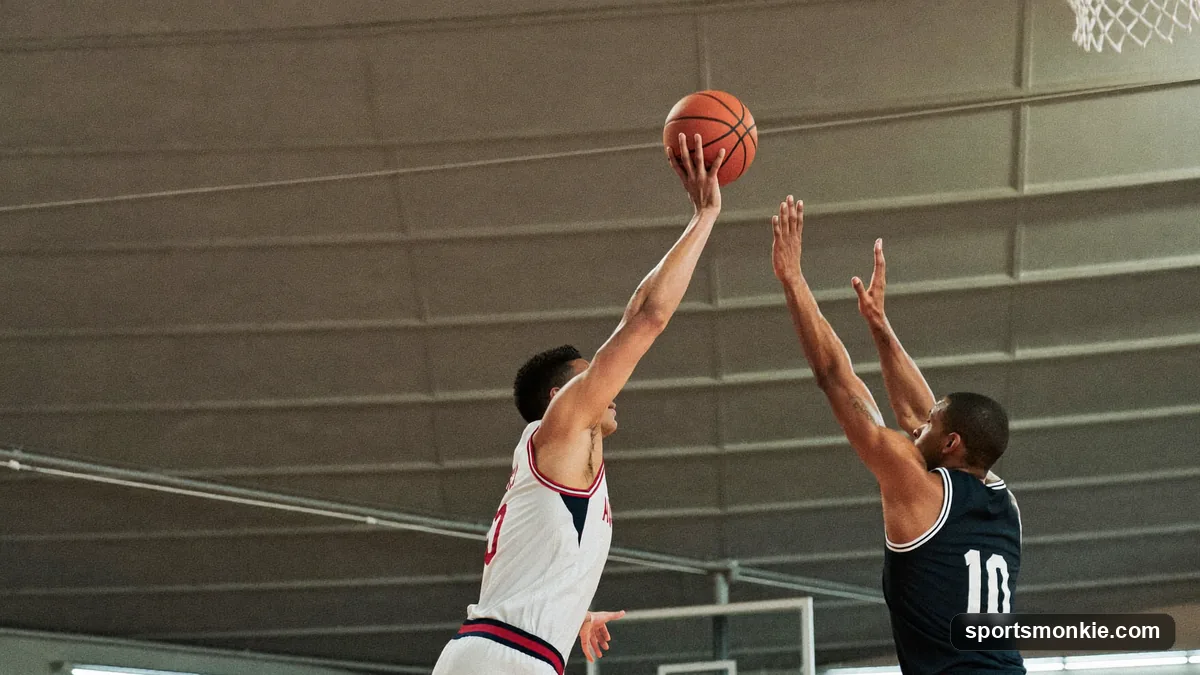
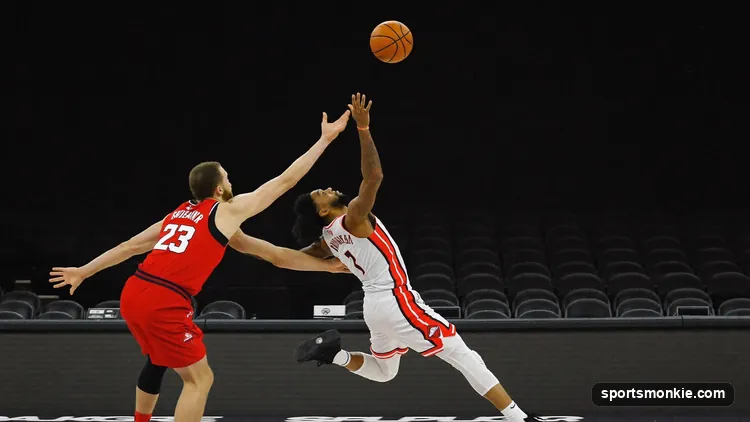
Fadeaway. The shooter jumps backward, away from the basket, while releasing the ball at the top of the jump. With no forward momentum helping the ball reach the rim, it demands more arm strength and touch than a standard jumper, one reason it is considered so hard to master. Michael Jordan and Kobe Bryant built signature scoring off it. Full guide: fadeaway in basketball.
Shots comparison table
| Shot | Typical range | Difficulty | Best used by |
|---|---|---|---|
| Layup | 0-3 ft | Low | Any position, driving to the rim |
| Finger roll | 0-5 ft | Medium | Guards finishing past shot-blockers |
| Dunk | At the rim | Medium-High (athleticism) | Athletic wings and bigs |
| Alley-oop | At the rim | Medium (timing-based) | Cutters with a lob passer |
| Floater | 4-12 ft | Medium | Smaller guards vs. tall defenders |
| Hook shot | 5-15 ft | Medium-High | Post players, back to the basket |
| Bank shot | 8-15 ft | Medium | Wings shooting from an angle |
| Jump shot | 10-23 ft | Medium | All positions |
| Step-back jumper | 18-25 ft | High | Ball-handlers creating separation |
| Fadeaway | 8-20 ft | High | Isolation scorers |
| Three-pointer | 22+ ft | Medium-High | Shooters and stretch bigs |
How to practice each shot type: a step-by-step approach
You do not need to drill every shot at once. Build in this order for the most efficient progression:
- Master the layup first. Work both hands and both sides of the rim before adding anything else.
- Add the finger roll and euro-step once layup footwork is automatic, since both build on the same base move.
- Groove the jump shot with stationary reps at 8-10 feet, focusing on a consistent release point above the eyes.
- Extend range gradually from mid-range out to the three-point line rather than jumping straight to deep shots.
- Layer in specialty moves — the step-back, fadeaway, floater, and hook shot — only after the base jump shot is reliable, since each borrows its balance and release from that foundation.
- Finish with live-defense reps. Shooting form breaks down under pressure, so the last stage is always shooting against a real or simulated defender.
This order mirrors how most basketball positions develop their shot diets: guards tend to lean on the layup, floater, and step-back, while forwards and centers spend more time on the hook shot, bank shot, and dunk.
Why shot selection matters as much as technique
Knowing how to execute a shot is only half the equation. Coaches at every level, from youth teams up through the NBA and WNBA, track shot selection because the value of a shot depends heavily on where it comes from. A well-defended long two-pointer is often a worse choice than a contested three or an open layup, simply because of the math of points per attempt. That is why modern NBA offenses have shifted so heavily toward shots at the rim and behind the arc, and away from the mid-range shots that dominated earlier eras.
Understanding the full menu of shot types, and which situations call for each one, is what separates players who simply have a shot from players who know when to use it.
Frequently asked questions
What are the main types of basketball shots?+
The main types are the layup, jump shot, three-pointer, dunk, floater, hook shot, bank shot, fadeaway, step-back jumper, finger roll, euro-step layup, and alley-oop. Each fits a different range and situation, from point-blank finishes at the rim to shots taken far beyond the arc.
What is the easiest basketball shot to learn?+
The layup is generally the easiest and most fundamental shot to learn. It only requires dribbling to the rim, gathering the ball, and laying it in off one foot, so beginners can build reliable form on it before adding jump shots or moves off the dribble.
What is the hardest shot in basketball?+
The fadeaway is widely considered one of the hardest shots to master because it requires jumping backward while staying balanced and squared to the rim, all with no forward momentum to help the ball reach the basket. The step-back three is a close second at the NBA level.
What is the difference between a jump shot and a set shot?+
A jump shot is released at the peak of a jump, which is standard in modern basketball because it is harder to block. A set shot is released with both feet on the floor, which was common in early basketball history and is still used for free throws by some players.
What shot is worth the most points in basketball?+
Any made field goal from beyond the three-point line is worth three points, the most available on a single shot in regulation play. A four-point play can occur when a three-point shooter is fouled and makes the free throw, but there is no standalone four-point shot.
Why do NBA players use the floater so often?+
The floater lets a smaller or faster player finish over taller shot-blockers by releasing the ball early, at the top of a high arc, before a defender can rotate over to contest it near the rim. Guards like Chris Paul and Trae Young rely on it heavily.
What is a bank shot and when is it useful?+
A bank shot is any shot deliberately aimed off the backboard rather than directly at the rim. It is most reliable from 10-15 feet on either baseline angle, where the backboard's painted square gives shooters a consistent target and a larger margin for error.
Sources
Play & tools
Free browser games and tools — no account, no download.
- Play 82-0 — Draft five, one per position, and see if your lineup can go a flawless NBA season.
- Play Era Ball — Draft an all-time NBA roster from a single era, then simulate a season and chase a perfect run.
- Play 32-0 — Draft five college basketball legends, one per position, and chase a perfect 32-0 national title.
- Explore all our games →
- Get the printable bracket — Download and print a blank tournament bracket to fill out by hand.
- Open the TS% calculator — Calculate TS% from points, field goal attempts and free throw attempts — scoring efficiency in one number.
- Explore all our free sports tools →
Related basketball guides
View all →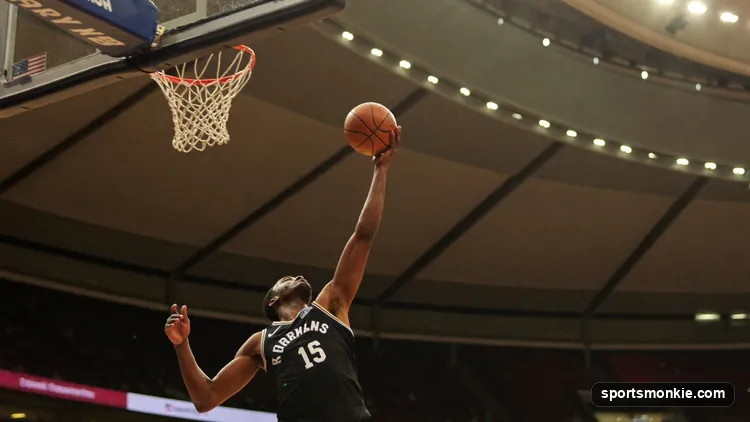
What Is a Layup in Basketball? Footwork, Types & Why It Scores
What is a layup in basketball? A close-range shot laid or banked off the glass after a drive. Learn the footwork, overhand vs. underhand, and variations.
What Is a Fadeaway in Basketball? Technique, History & Best Shooters
A fadeaway in basketball is a jump shot taken while leaping backward, away from the defender, to create space. How it works, technique, and top shooters.
Types of Shots in Basketball: 10 Every Player Needs
The 10 essential types of shots in basketball, from layups and jump shots to floaters, hooks, fadeaways and dunks, with coaching cues and when to use each.
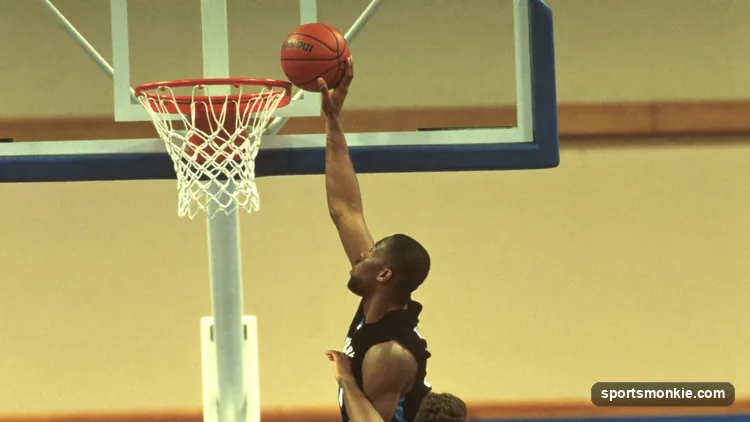
Hook Shot in Basketball: Technique, Skyhook, and Why It's Unblockable
The hook shot in basketball is a one-handed shot released in a sweeping arc with the shooter's body shielding the ball from the defender.
Basketball Positions Explained: All 5 Roles, Numbers & Duties
Basketball positions explained: point guard, shooting guard, small forward, power forward, and center — roles, the 1-5 numbering, and positionless basketball.
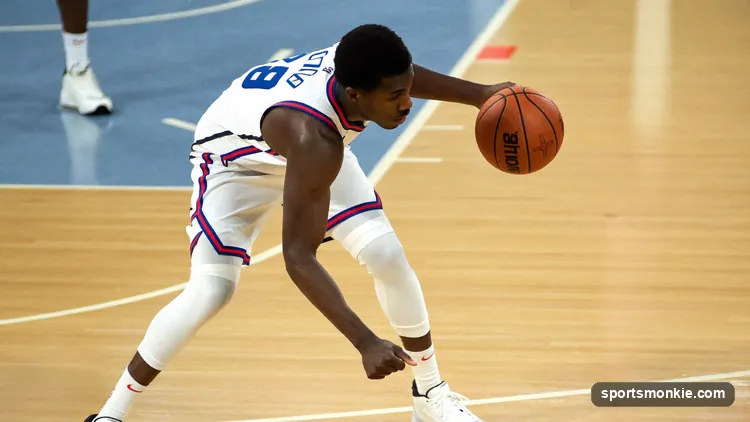
Step-Back Jumper in Basketball: Footwork, Travel Rule, and Famous Users
A step-back jumper is a move where a ball-handler dribbles at a defender, then pushes backward to create space for a jump shot. Here's the footwork and rules.