
Bank Shot in Basketball: Technique, Geometry, and Why It Works
On this page7
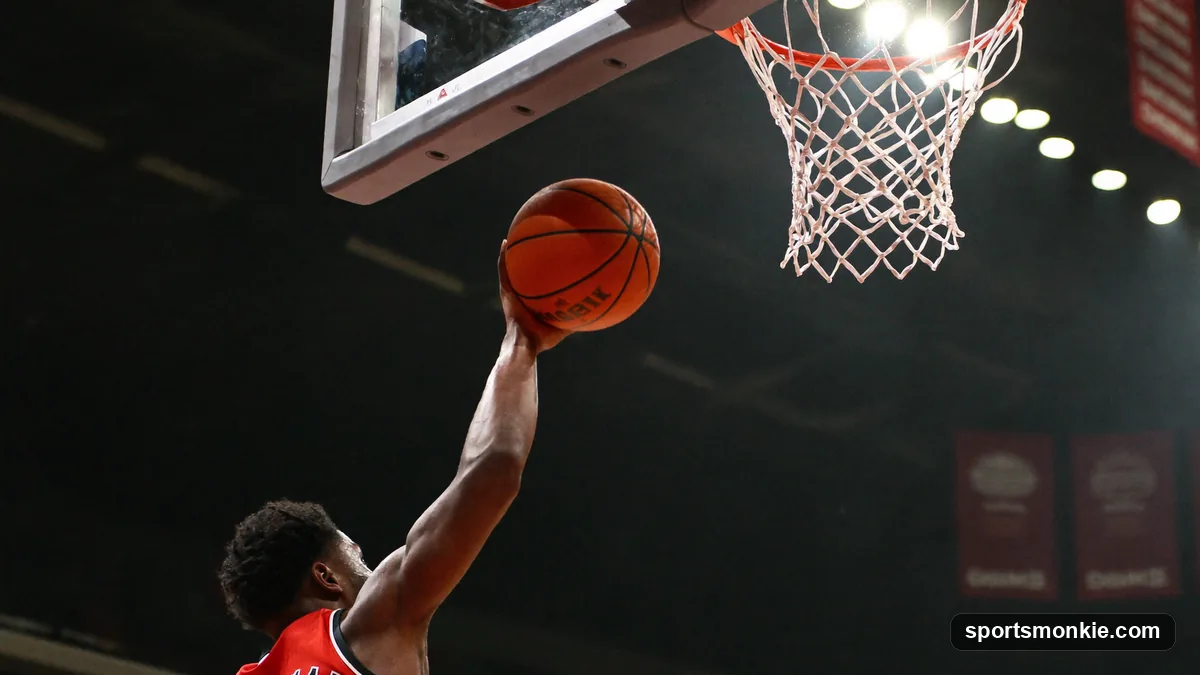
A bank shot in basketball is a shot the shooter intentionally bounces off the backboard before it falls through the hoop, using the glass as a target instead of shooting straight for the rim. It looks like a miss to anyone unfamiliar with the tactic, but from the right spot on the floor it’s one of the higher-percentage looks available, and it was the calling card of one of the greatest power forwards ever to play the game.
How the Bank Shot Works
Every bank shot starts the same way: the shooter picks a spot on the backboard, not the rim, as the actual target. The ball strikes the glass, sheds speed on contact, and drops into the basket at a gentler angle than a shot aimed directly through the hoop. That loss of speed is the whole point. A direct shot has to be threaded through an 18-inch rim with the ball still carrying most of its original momentum; a well-banked shot arrives at the rim slower and with more of its downward arc already established, which gives it a better chance of dropping rather than rattling out.
This is why the bank shot sits alongside other core scoring tools in a player’s arsenal — it belongs in the same conversation as the layup and the hook shot as one of the fundamental types of basketball shots every player learns before ever attempting a jumper from distance.
The Geometry: Aiming with the Shooter’s Square
Every backboard has a painted rectangle centered above the rim — often called the shooter’s square or the shooting box. That box isn’t decoration; it’s the built-in aim point for a bank shot. The rule of thumb taught by most coaches is simple: aim for the upper corner of the box that’s closer to your side of the floor. Shooting from the right wing, the target is the box’s upper-right corner; from the left wing, it’s the upper-left corner.
Physicist Larry Silverberg’s research at North Carolina State University refined this further. His study found that the ideal target point on the backboard depends primarily on the angle between the baseline and an imaginary line running from the basket out to the shooter — not on how far away the shooter is standing. In other words, once a player has established the correct aim point for a given angle, that same spot works whether the shot is coming from 8 feet or 12 feet out, as long as the angle to the basket stays the same. That’s a genuinely useful shortcut: it means a shooter only has to learn a handful of target spots around the arc of common angles, not a different spot for every distance.
Why Banking Increases the Margin for Error
A direct shot has one workable path: enter the cylinder above the rim close to dead center, or clip iron and hope for a favorable bounce. The backboard changes that math. Research covered by AIP’s Inside Science and NC State found that bank shots can be up to 20 percent more accurate than direct shots when taken from the right zones, generally within about 12 feet of the basket.
The advantage comes from two things working together. First, the backboard is a much bigger target than the rim, and a shooter has more room to be slightly off and still get a workable bounce. Second, the backboard bleeds off speed on contact, so the ball arrives at the rim traveling slower and dropping more steeply — both of which favor the ball going in rather than skipping off the front or back of the iron. Shots taken from directly in front of the basket, or from a sharp angle along the baseline, don’t get this benefit, because the backboard geometry doesn’t offer a useful bounce at those angles. That’s why bank shots cluster on the wings and the elbows, not under the rim or along the baseline.
Where the Bank Shot Works Best
| Zone on the floor | Angle to baseline | Bank shot value |
|---|---|---|
| Wings, inside the free-throw line extended | ~30–45 degrees | High — classic bank shot territory |
| Elbows of the free-throw area | ~45–60 degrees | High — Tim Duncan’s favorite spot |
| Straight-on, top of the key | ~90 degrees | Low — little backboard advantage |
| Baseline, near the corner | ~0–15 degrees | Low — backboard angle is too flat |
| Beyond about 15 feet | Any angle | Declining — margin-for-error benefit fades with distance |
Step-by-Step Technique
- Pick your target before you shoot. Locate the near-side corner of the backboard’s shooting box based on your angle to the basket, not your distance from it.
- Square up as you would for any jump shot. Footwork, balance, and a consistent release don’t change just because the target is the glass instead of the rim.
- Aim slightly higher than instinct suggests. New bank shooters tend to aim too low on the board and clank the front rim; the target spot is usually higher on the glass than it looks.
- Use a soft touch, not extra force. The backboard does the speed-killing work for you. Muscling the shot defeats the purpose of banking it.
- Follow through toward the backboard, not the rim. Your eyes and hand should finish pointed at the target spot on the glass.
- Repeat from the same spot until the bounce becomes automatic. Bank shooting is built through repetition at a handful of fixed angles, not through guessing on every attempt.
Famous Bank-Shot Artists
No player is more associated with the bank shot than Tim Duncan. Nicknamed “the Big Fundamental,” Duncan built a Hall of Fame career and five NBA championships with the San Antonio Spurs around unglamorous, high-percentage basketball, and the bank shot from the elbow was arguably his signature weapon — reliable enough that defenders knew it was coming and still couldn’t stop it.
Duncan wasn’t alone. Kobe Bryant, Dirk Nowitzki, and Dwyane Wade all leaned on the glass for mid-range jumpers during eras when the shot was more common league-wide. Further back, George Gervin, Elgin Baylor, Wilt Chamberlain, Bob Pettit, and Sam Jones were all known for using the backboard as a scoring tool rather than an accident.
Why the Bank Shot Has Faded — and Where It Survives
Modern NBA and WNBA offenses are built around three-pointers and shots at the rim, with the mid-range game — the bank shot’s home territory — squeezed out by analytics-driven shot selection. That’s made the bank shot rarer among NBA scorers than it was in Duncan’s era. But the shot hasn’t disappeared. It’s still a core teaching tool in youth, high school, and college basketball, where a reliable mid-range shot remains valuable, and it still shows up whenever a player gets switched onto a smaller or bigger mismatch in the post and needs a soft, high-percentage look rather than a contested straight-on attempt.
Learning it is worth the effort for exactly that reason. When a defender takes away the direct line to the rim, the backboard is often still open — and a shooter who has drilled the geometry has an answer that a straight-shooting defense can’t fully take away.
Frequently asked questions
What is a bank shot in basketball?+
A bank shot is a shot the shooter intentionally aims off the backboard rather than straight through the rim. The ball hits a target area on the backboard, loses speed, and drops into the basket at a softer angle than a direct shot would produce.
Why do bank shots go in more often than direct shots?+
Research led by physicist Larry Silverberg at North Carolina State University found bank shots can be up to 20 percent more accurate than shots aimed straight at the rim, from certain zones inside about 12 feet. The backboard slows the ball's speed and effectively enlarges the shooter's margin for error compared to threading it through an 18-inch rim.
Where is the best spot on the backboard to aim a bank shot?+
Aim for the upper corner of the painted box on the backboard closest to your shooting angle — the corner nearest the baseline side you're shooting from. The exact target shifts along the box as your angle to the basket changes, but the box gives a reliable visual reference at any distance from that angle.
From what angles and distances does the bank shot work best?+
Bank shots are most reliable from roughly 30 to 60 degrees off the baseline — the wings and the elbows of the free-throw area — and within about 12 feet of the basket. Shots from directly in front of the rim (near 0 degrees) or from the baseline (near 90 degrees) get little benefit from the backboard and are usually shot straight instead.
Which NBA players were known for their bank shot?+
Tim Duncan is the modern player most associated with the bank shot, using it constantly during his 19-year career with the San Antonio Spurs. Other noted practitioners include Kobe Bryant, Dirk Nowitzki, Dwyane Wade, George Gervin, Elgin Baylor, Wilt Chamberlain, Bob Pettit, and Sam Jones.
Is the bank shot still used in modern basketball?+
Less than it once was. The modern NBA emphasizes three-pointers and layups over mid-range shots, and the bank shot is primarily a mid-range weapon, so it has become rarer at the highest level. It remains a staple in college, high school, and international basketball, where mid-range scoring is still heavily used.
Does the backboard's angle or material affect the bank shot?+
Yes. Regulation glass backboards are flat and rigid, which makes the bounce predictable once a shooter has practiced a target spot. Softer or angled backboards, like some found on outdoor courts, change the rebound behavior and make the same aim point unreliable.
What is the difference between a bank shot and a layup off the glass?+
Both use the backboard, but a bank shot usually refers to a jump shot or set shot taken from mid-range that is deliberately banked in, while a glass layup is a shot taken right at the rim, often off a drive, where the backboard is used to soften a close-range finish. See our guide to what is a layup for more on that shot specifically.
Sources
Play & tools
Free browser games and tools — no account, no download.
- Play 82-0 — Draft five, one per position, and see if your lineup can go a flawless NBA season.
- Play Era Ball — Draft an all-time NBA roster from a single era, then simulate a season and chase a perfect run.
- Play 32-0 — Draft five college basketball legends, one per position, and chase a perfect 32-0 national title.
- Explore all our games →
- Get the printable bracket — Download and print a blank tournament bracket to fill out by hand.
- Open the TS% calculator — Calculate TS% from points, field goal attempts and free throw attempts — scoring efficiency in one number.
- Explore all our free sports tools →
Related basketball guides
View all →
Finger Roll in Basketball: Technique, History & How to Shoot One
A finger roll in basketball is a one-handed layup released off the fingertips with soft backspin so it arcs high over defenders. Full technique guide.
Types of Shots in Basketball: 10 Every Player Needs
The 10 essential types of shots in basketball, from layups and jump shots to floaters, hooks, fadeaways and dunks, with coaching cues and when to use each.
Hook Shot in Basketball: Technique, Skyhook, and Why It's Unblockable
The hook shot in basketball is a one-handed shot released in a sweeping arc with the shooter's body shielding the ball from the defender.
Box Out in Basketball: The Complete Rebounding Technique Guide
Learn how to box out in basketball with a step-by-step technique, common mistakes, and drills that turn positioning into extra rebounds.
What Is a Fadeaway in Basketball? Technique, History & Best Shooters
A fadeaway in basketball is a jump shot taken while leaping backward, away from the defender, to create space. How it works, technique, and top shooters.
What Is a Give and Go in Basketball? How It Works
A give and go in basketball is a pass, cut, and return-pass play between two players. See how it works, why it's so hard to stop, and how to defend it.