
What Is an Alley-Oop in Basketball? Definition, Technique & Famous Duos
On this page6
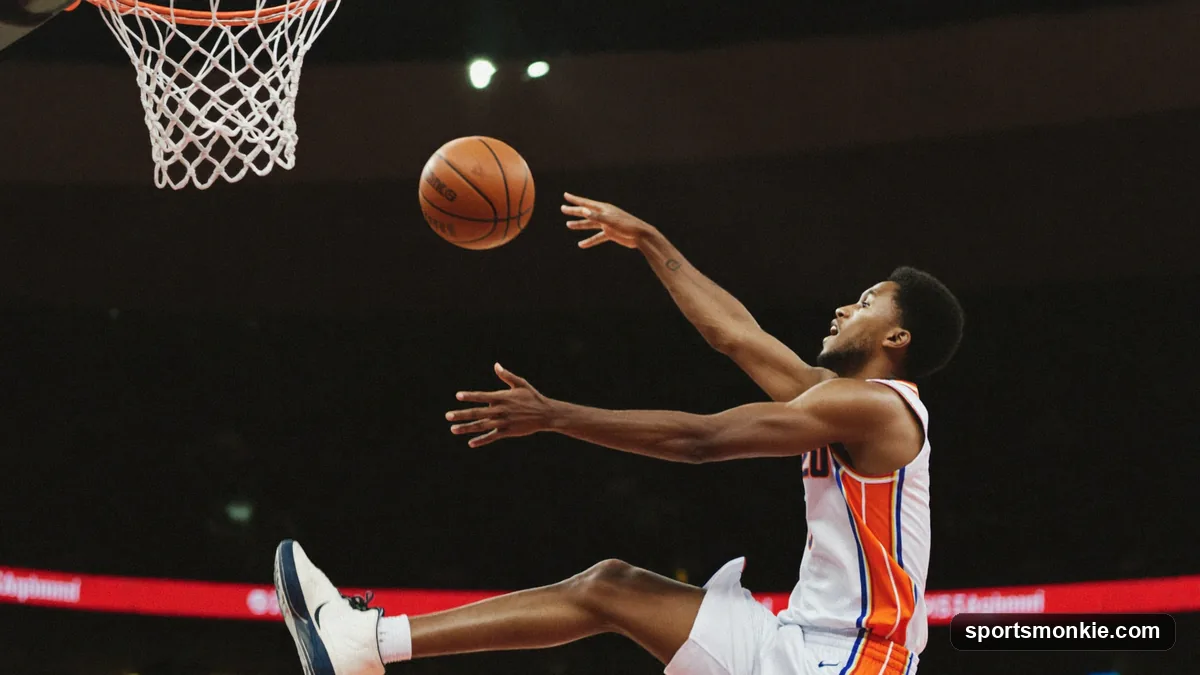
An alley-oop is a basketball play in which one player lobs the ball near the rim and a teammate jumps, catches it in mid-air, and finishes with a dunk or layup before landing. It’s a two-man play built entirely on timing: the passer has to drop the ball into a small window above the defense, and the finisher has to arrive at that window at the exact right split second. Get it right and it’s one of the most electric plays in basketball; get it wrong and it’s a turnover.
How an Alley-Oop Works
The play always has two roles. The passer — usually a guard bringing the ball up the floor or initiating a pick-and-roll — reads where the finisher is cutting or rolling toward the basket. The finisher, meanwhile, is sprinting or rolling into open space near the rim, timing a jump so their hands are at their highest point exactly when the ball arrives.
Unlike a standard entry pass, an alley-oop pass is never meant to be caught with both feet on the floor. It’s thrown high and slightly ahead of the finisher’s jump, forcing them to elevate to meet it. The catch and the score happen in the same airborne motion — there’s no dribble, no gather, no second jump. That’s what separates an alley-oop from a normal layup or a standard finger roll: the ball never touches the ground and the shooter never resets after the catch.
Where the Name Comes From
“Alley-oop” is an Americanized version of the French circus phrase allez hop! — the shout an acrobat’s partner would give right before a leap, roughly translating to “let’s go, up!” The phrase crossed into American sports vocabulary in the mid-20th century, first attached to a similar lob-and-catch play in football before basketball adopted the term for its own rim-finishing plays.
Basketball’s alley-oop is generally traced back to K.C. Jones and Bill Russell at the University of San Francisco in the mid-1950s, where Jones lobbed passes for the 6-foot-11 Russell to finish above defenders. David Thompson at NC State later became one of the play’s most famous college practitioners in the early 1970s — notable because dunking was not even legal in college basketball at the time, so Thompson had to finish alley-oops with a layup instead. Once the NCAA lifted its dunking ban in 1976, Magic Johnson and Greg Kelser turned the alley-oop into a signature weapon for Michigan State’s 1979 national title run, and it’s been a fixture of highlight reels ever since.
The Technique, Step by Step
Running a clean alley-oop comes down to five coordinated steps:
| Step | Passer’s Job | Finisher’s Job |
|---|---|---|
| 1. Setup | Reads the defense; identifies a cutter or roller with a clear driving lane to the rim | Sets up a defender with a fake, screen, or change of pace before cutting |
| 2. Read | Locates the exact spot above the rim where the finisher will jump | Times the cut so they arrive at the rim area just as the pass releases |
| 3. Release | Throws a high, soft-touch pass aimed slightly above and ahead of the rim, out of the defense’s reach | Explodes into a vertical jump, tracking the ball in the air |
| 4. Catch | — | Catches the ball at the peak of the jump with one or both hands, without bringing it down to gather |
| 5. Finish | — | Dunks or lays the ball in through the same continuous motion, landing after the shot is released |
The trickiest part is the release. Throw it too flat and a defender knocks it away; throw it too high or too far off target and even an elite leaper can’t reach it. That’s why the best alley-oop combos aren’t just athletic — they’ve built chemistry through hundreds of practice reps, learning exactly how high and how far ahead of the cutter to place the ball.
Alley-oops typically show up in one of two situations: in transition, where a point guard can throw a long, uncontested lob to a teammate running ahead of the defense, or in the half-court, usually off a back screen, a pick-and-roll, or a set play designed specifically to spring a team’s best above-the-rim finisher. Coaches often diagram these as part of a broader set of types of basketball shots built around getting a high-percentage look at the rim.
Famous Alley-Oop Duos
Few plays in the NBA and WNBA build a signature identity the way the alley-oop does. Some pairings became so associated with the play that fans expected it every time they touched the ball together.
- John Stockton to Karl Malone — The Utah Jazz pick-and-roll became the blueprint for the modern lob: Stockton would draw a defender on the screen, then drop a pass over the top for Malone to finish, a two-man game the pair ran for nearly two decades.
- Chris Paul to Blake Griffin and DeAndre Jordan (“Lob City”) — Starting around 2011, the Los Angeles Clippers built their entire offensive identity around Paul’s lob passes to Griffin and Jordan, turning nightly alley-oops into a national talking point and a franchise nickname.
- Magic Johnson to Greg Kelser — At Michigan State, Johnson’s court vision and Kelser’s leaping ability made the alley-oop a staple of their 1979 NCAA championship run, one of the plays that helped popularize above-the-rim basketball on national television.
- Lorenzo Charles’ game-winner — Not a recurring duo, but the single most famous alley-oop in college history: Charles caught an errant shot in the air and dunked it at the buzzer to win NC State the 1983 national title over Houston.
Alley-Oop vs. Other Finishes
It helps to see where the alley-oop sits next to basketball’s other close-range finishes:
| Play | How It’s Caught | How It’s Finished |
|---|---|---|
| Alley-oop | Caught in mid-air, above the rim | Dunk or layup, same motion as the catch |
| Standard layup | Caught with feet on the ground, then dribbled or gathered | One or two steps, then a soft shot off the backboard or rim |
| Finger roll | Usually gathered after a drive, not caught mid-air | Ball rolled off the fingertips rather than dunked or banked hard |
| Fast-break dunk | Player already has the ball in hand while running | Player jumps and dunks without needing a teammate’s pass timed mid-air |
The through-line is timing. Every other finish on that list gives the scorer at least a moment to gather themselves. An alley-oop doesn’t — it demands the catch and the score happen as one continuous, split-second action.
Why the Alley-Oop Matters
Beyond the highlight value, alley-oops are a genuine offensive weapon. They’re nearly impossible to block once the pass clears the defense, since the ball is already above the rim before the shot attempt happens. They also punish defenders who overhelp on a pick-and-roll, since the rolling big man is often left with a clean lane to the basket. That’s why coaches at every level, from AAU programs to NBA playbooks, still design specific sets to manufacture the play rather than leaving it to chance.
Frequently asked questions
What is an alley oop in basketball?+
An alley-oop is a two-player play where a passer throws the ball near or above the rim and a teammate jumps, catches it in the air, and dunks or lays it in before touching the floor again. It's one of basketball's most explosive and highest-difficulty plays because it depends entirely on timing rather than a normal catch-and-shoot sequence.
Why is it called an alley-oop?+
The term comes from the French exclamation 'allez hop!', the cry a circus acrobat's partner would shout right before a leap or catch. American sports broadcasters anglicized it to 'alley-oop' and applied it first to a similar football lob-and-catch play before it became standard basketball vocabulary in the 1950s and 1960s.
Who invented the alley-oop?+
K.C. Jones and Bill Russell are widely credited with popularizing the play at the University of San Francisco in the mid-1950s, with Jones lobbing passes for the 6-foot-11 Russell to finish above the rim. David Thompson and NC State later became closely associated with the play in the early 1970s, before dunking was even legal in college basketball at the time.
What is the difference between an alley-oop and a lob pass?+
Every alley-oop starts with a lob pass, but not every lob pass is an alley-oop. A lob is simply any high, arcing pass thrown over a defender. It only becomes an alley-oop when the receiving player catches that lob in the air near the basket and scores immediately, without landing first, typically with a dunk or a finger roll layup.
What skills does an alley-oop require?+
It requires a passer with touch and timing who can drop the ball into a precise window above the rim, and a finisher with elite vertical leap, body control, and hand-eye coordination to catch and score in one motion. Chemistry built through practice reps matters as much as raw athleticism, since even a slightly off pass can turn into a turnover.
Who are the most famous alley-oop duos in NBA history?+
John Stockton to Karl Malone is the archetype pick-and-roll lob combo from the Utah Jazz in the 1990s. The Lob City-era Los Angeles Clippers, with Chris Paul throwing for Blake Griffin and DeAndre Jordan starting around 2011, turned the alley-oop into a signature identity. Magic Johnson and Greg Kelser at Michigan State also popularized the play on the college stage in the late 1970s.
Is the alley-oop used in the WNBA?+
Yes. Alley-oops are less frequent in the WNBA than in the men's game because fewer players finish above the rim, but they still happen, particularly off fast breaks and set plays designed for a team's most athletic finisher. As WNBA rosters get more explosive, lob finishes off cuts and pick-and-rolls have become a more visible part of highlight reels.
Does an alley-oop count as an assist?+
Yes. If the pass directly leads to a made basket, official scorers credit the passer with an assist, exactly as they would on any other assisted field goal. The degree of difficulty doesn't change the scoring rule, though alley-oop assists are often the ones that show up first on nightly highlight shows.
Sources
Play & tools
Free browser games and tools — no account, no download.
- Play 82-0 — Draft five, one per position, and see if your lineup can go a flawless NBA season.
- Play Era Ball — Draft an all-time NBA roster from a single era, then simulate a season and chase a perfect run.
- Play 32-0 — Draft five college basketball legends, one per position, and chase a perfect 32-0 national title.
- Explore all our games →
- Get the printable bracket — Download and print a blank tournament bracket to fill out by hand.
- Open the TS% calculator — Calculate TS% from points, field goal attempts and free throw attempts — scoring efficiency in one number.
- Explore all our free sports tools →
Related basketball guides
View all →
What Is a Point Guard in Basketball? Role, Skills & Famous PGs
A point guard is basketball's floor general — the primary ball-handler who runs the offense. Learn the role, key skills, and famous PGs.
What Is a Layup in Basketball? Footwork, Types & Why It Scores
What is a layup in basketball? A close-range shot laid or banked off the glass after a drive. Learn the footwork, overhand vs. underhand, and variations.
What Is a Power Forward in Basketball? The 4 Position Explained
A power forward (the '4') is basketball's versatile big man — rebounding, defending, scoring in the post, and increasingly shooting threes.
What Is a Shooting Guard in Basketball? Role, Skills & Examples
A shooting guard is basketball's primary perimeter scorer — the '2' who shoots off the catch and dribble, hits threes, and guards the wing.
What Is a Small Forward in Basketball? Role, Skills & Best Players
A small forward is basketball's most versatile position (the '3'), scoring inside and out, defending multiple spots, and rebounding on the wing.
What Is a Fadeaway in Basketball? Technique, History & Best Shooters
A fadeaway in basketball is a jump shot taken while leaping backward, away from the defender, to create space. How it works, technique, and top shooters.