
What Is a Small Forward in Basketball? Role, Skills & Best Players
On this page6
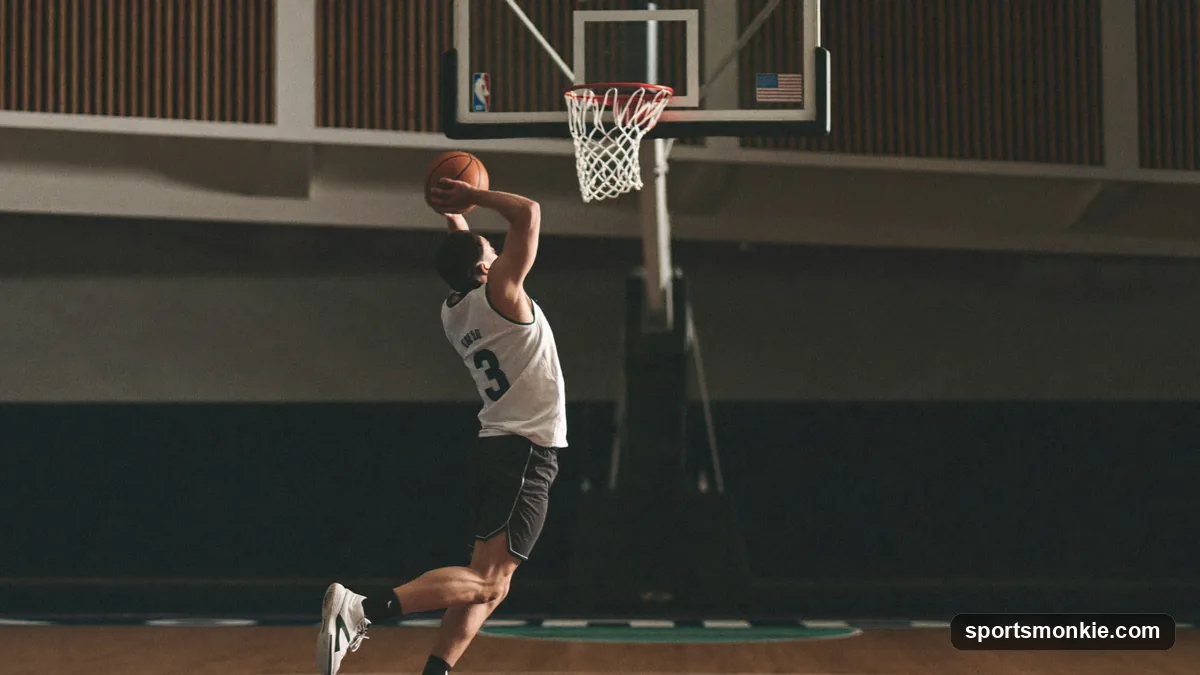
A small forward — the “3” in basketball’s five-position system — is the wing player who scores inside and out, defends multiple positions, and rebounds from the perimeter, making it the most versatile role on the floor. Slotted between the shooting guard and the power forward, the small forward blends guard-level skill with forward-level size, which is why coaches often build their offense around this position. For the full picture of where the “3” fits alongside the other four spots, see our breakdown of basketball positions explained, and for how the role differs across leagues, check our NBA and WNBA guide.
What Does a Small Forward Do?
The small forward’s job changes possession to possession more than any other position. On offense, they’re expected to knock down catch-and-shoot threes, attack closeouts off the dribble, finish through contact at the rim, and occasionally initiate the offense like a lead ball handler. On defense, small forwards are the team’s Swiss Army knife — asked to check the opponent’s best perimeter scorer one night and switch onto a bigger forward the next.
Core responsibilities include:
- Scoring from all three levels — three-point range, mid-range pull-ups, and drives to the basket
- Defending multiple positions, from quick shooting guards to bigger power forwards
- Rebounding on the wing, especially long rebounds that centers and power forwards can’t chase down
- Playmaking, setting up teammates when a play breaks down or the defense collapses
- Transition offense, using speed to finish fast breaks that guards start
Because small forwards rarely play with their back to the basket the way a center does, they need the footwork and handle to create their own shot — a skill set closer to a shooting guard than a traditional big man.
Skills That Define Elite Small Forwards
Not every great small forward looks the same. Some, like Kevin Durant, are pure shooters who can score over anyone regardless of size. Others, like LeBron James, rely on strength and physicality to bully smaller defenders and finish through contact. A third archetype — the slashing wing with an improving jumper — has become common as the position has modernized toward more shooting and switch-everything defense.
Five skills separate a good small forward from a great one:
- Two-way versatility — the ability to produce points and stop them, often against different-sized opponents in the same game
- Athleticism — the speed to beat guards and the strength to hold ground against forwards
- Shooting range — a reliable three-point shot has become close to mandatory at the position in the modern game
- Ball handling — enough dribble skill to create offense independent of a point guard
- Basketball IQ — reading mismatches in real time and knowing when to attack, pass, or defer
Small Forward vs. Other Positions
| Position | Number | Typical NBA Height | Primary Role |
|---|---|---|---|
| Point Guard | 1 | 6’1”–6’4” | Ball handling, playmaking |
| Shooting Guard | 2 | 6’3”–6’6” | Perimeter scoring, off-ball movement |
| Small Forward | 3 | 6’6”–6’9” | Scoring, versatile defense, wing rebounding |
| Power Forward | 4 | 6’8”–6’11” | Post scoring, screening, rebounding |
| Center | 5 | 6’10”+ | Rim protection, interior scoring, rebounding |
The small forward sits right in the middle of that size spectrum, which is exactly what makes the position so flexible. A team can play a small forward bigger to match up with a power forward in a small-ball lineup, or slide them down to guard a shooting guard when speed matters more than size.
Famous Small Forwards in NBA and WNBA History
Small forward has produced some of basketball’s greatest players precisely because the position rewards well-rounded talent. NBA Hall of Famers at the position include Larry Bird, Julius Erving, John Havlicek, Elgin Baylor, Scottie Pippen, Paul Pierce, James Worthy, Chris Mullin, and Dominique Wilkins. Modern stars who built their legacies at small forward include LeBron James, Kevin Durant, and Kawhi Leonard — three players whose two-way dominance defines what the position can be at its peak.
The WNBA has its own rich history at the position. Hall of Famers Cheryl Miller, Sheryl Swoopes, and Tamika Catchings all built championship résumés as small forwards, and current-era stars like Elena Delle Donne, Maya Moore, and DeWanna Bonner have carried the position’s versatile, do-everything reputation into today’s game.
Why the Small Forward Is Often the Most Flexible Position
Coaches love small forwards because they rarely force a lineup into just one shape. A skilled “3” can play alongside two bigger forwards in a traditional lineup, or slide into a small-ball five where shooting and switching matter more than size. That flexibility extends to team-building: a small forward who can shoot, defend multiple spots, and handle the ball in a pinch lets a coach mix and match the rest of the roster around them.
This adaptability is also why the position has evolved fastest as basketball has modernized. Twenty years ago, small forwards leaned on physicality and mid-range scoring. Today, the best ones combine that physical toughness with elite three-point shooting and switchable defense — a shift that mirrors the broader pace-and-space trend across the NBA and WNBA alike.
Small Forward FAQs
What is a small forward in basketball? A small forward is the wing player — the “3” — who scores from all three levels, defends multiple positions, and rebounds on the perimeter, making it the most all-around role among basketball’s five positions.
How tall is an NBA small forward? Most NBA small forwards stand 6’6” to 6’9”, while WNBA small forwards typically run 6’0” to 6’2”.
What’s the difference between a small forward and a shooting guard? Small forwards are generally bigger and more involved in rebounding and post-up defense, while shooting guards are quicker and rely more heavily on off-ball movement and perimeter shooting.
Who is considered the greatest small forward of all time? LeBron James and Larry Bird are the two names most commonly debated for the title, though Julius Erving, Scottie Pippen, and Kevin Durant are frequently part of that conversation too.
Frequently asked questions
What is a small forward in basketball?+
A small forward, or the '3', is a wing player who blends scoring, defense, and rebounding. Small forwards operate on the perimeter and in the mid-range, shoot from three-point range, attack the rim, defend multiple positions, and pull down rebounds their guards can't reach.
What number position is small forward?+
Small forward is the '3' in basketball's traditional 1-through-5 numbering system, sitting between the shooting guard (2) and power forward (4) in size and role.
How tall is an NBA small forward?+
NBA small forwards typically measure 6'6" to 6'9". WNBA small forwards are usually 6'0" to 6'2". Both ranges sit between the guard and power forward/center heights on a roster.
What skills does a small forward need?+
Elite small forwards need scoring versatility (three-point shooting, mid-range, and finishing at the rim), ball handling to attack off the dribble, playmaking vision to set up teammates, on-ball defense against multiple positions, and rebounding to help on the glass.
Who are the best small forwards in NBA history?+
Hall of Fame small forwards include Larry Bird, Julius Erving, Scottie Pippen, John Havlicek, Elgin Baylor, and Paul Pierce. LeBron James, Kevin Durant, and Kawhi Leonard are among the position's greatest modern players.
What is the difference between a small forward and a power forward?+
Small forwards are quicker and play more on the perimeter, prioritizing outside shooting, ball handling, and defending guards or wings. Power forwards are bigger and play closer to the basket, prioritizing post scoring, screening, and rebounding against forwards and centers.
Why is small forward considered the most versatile position?+
Small forward is considered the most versatile position because it demands guard-like skills (shooting, ball handling, playmaking) and forward-like skills (rebounding, post defense, physicality) in the same player, letting them slide up or down a matchup as needed.
Who are notable WNBA small forwards?+
Notable WNBA small forwards include Hall of Famers Cheryl Miller, Sheryl Swoopes, and Tamika Catchings, along with stars like Elena Delle Donne, Maya Moore, and DeWanna Bonner.
Sources
Play & tools
Free browser games and tools — no account, no download.
- Play 82-0 — Draft five, one per position, and see if your lineup can go a flawless NBA season.
- Play Era Ball — Draft an all-time NBA roster from a single era, then simulate a season and chase a perfect run.
- Play 32-0 — Draft five college basketball legends, one per position, and chase a perfect 32-0 national title.
- Explore all our games →
- Get the printable bracket — Download and print a blank tournament bracket to fill out by hand.
- Open the TS% calculator — Calculate TS% from points, field goal attempts and free throw attempts — scoring efficiency in one number.
- Explore all our free sports tools →
Related basketball guides
View all →
What Is a Point Guard in Basketball? Role, Skills & Famous PGs
A point guard is basketball's floor general — the primary ball-handler who runs the offense. Learn the role, key skills, and famous PGs.
What Is a Shooting Guard in Basketball? Role, Skills & Examples
A shooting guard is basketball's primary perimeter scorer — the '2' who shoots off the catch and dribble, hits threes, and guards the wing.
What Is a Power Forward in Basketball? The 4 Position Explained
A power forward (the '4') is basketball's versatile big man — rebounding, defending, scoring in the post, and increasingly shooting threes.
Basketball Positions by Number (1-5): The Complete Guide
Basketball positions by number: 1 is point guard, 2 shooting guard, 3 small forward, 4 power forward, 5 center. Learn the system and how coaches use it.
Basketball Positions Explained: All 5 Roles, Numbers & Duties
Basketball positions explained: point guard, shooting guard, small forward, power forward, and center — roles, the 1-5 numbering, and positionless basketball.
What Is a Layup in Basketball? Footwork, Types & Why It Scores
What is a layup in basketball? A close-range shot laid or banked off the glass after a drive. Learn the footwork, overhand vs. underhand, and variations.