
Euro Step in Basketball: Rules, Footwork, and How to Do It
On this page7
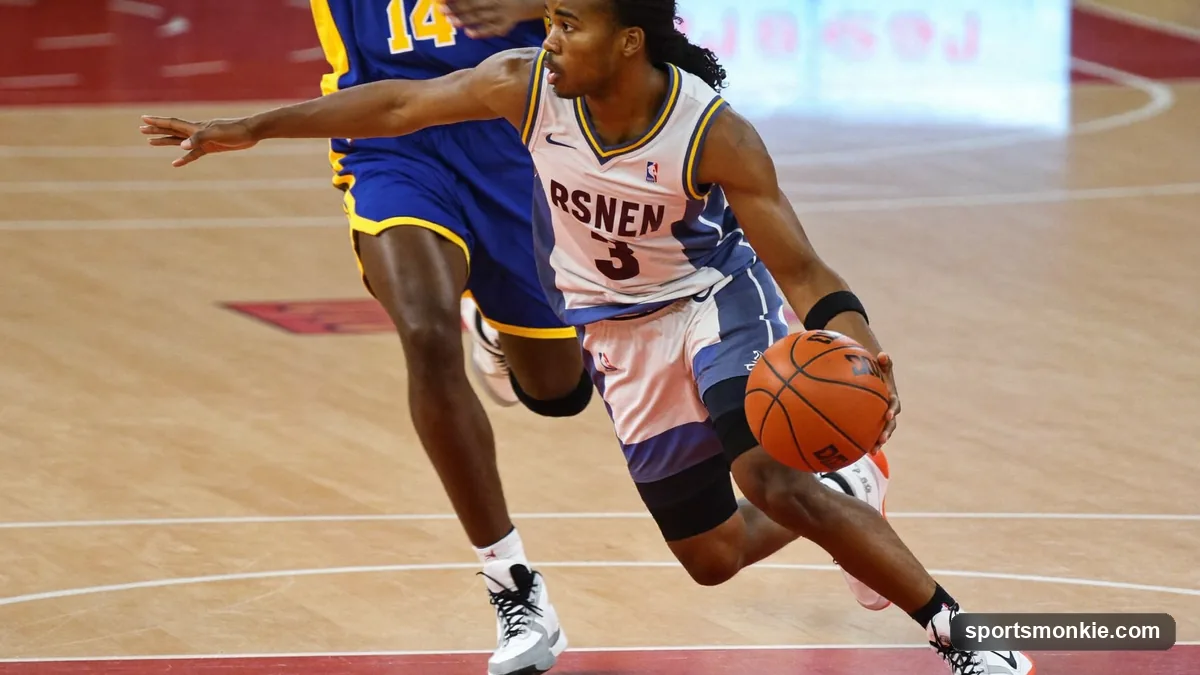
The euro step is a legal two-step basketball move where a driving player picks up their dribble, plants one foot to step in one direction, then plants the other foot to step the opposite direction, changing angle at the last instant to slip past a defender before finishing at the rim. It isn’t a trick or a loophole — it’s simply the standard two-step gather rule used sideways instead of straight ahead, and it has become one of the most common finishing moves in the NBA and WNBA.
How the euro step works
Every basketball player who drives to the basket is allowed two steps after they “gather” the ball — the moment they pick up their dribble and control it with one or both hands. On a normal layup, both of those steps go forward in a straight line toward the rim. The euro step uses the same two-step allowance differently: the first step plants hard to one side, and the second step immediately plants to the opposite side, creating a zigzag path instead of a straight one.
That lateral change of direction is what makes the move so effective. A help defender who has committed to cutting off a straight-line drive is suddenly out of position, because the ball handler has shifted an entire step to the side before releasing a shot or pass. Done well, a euro step turns a contested drive into an open finish without the ball handler ever touching the floor a third time.
Step-by-step footwork breakdown
| Phase | What happens | Key coaching point |
|---|---|---|
| 1. The drive | Player attacks off the dribble toward the paint or a gap in the defense | Build speed early; the move loses effectiveness if it starts too slowly |
| 2. The gather | Player picks up the dribble and secures the ball with one or two hands | This is the “zero step” — it does not count toward the two-step limit |
| 3. First step | Lead foot plants hard in one direction, usually away from the nearest defender | The plant should be explosive and decisive, not tentative |
| 4. Second step | Trail foot plants in the opposite direction, past or around the defender | This step covers the most lateral ground and sets up the finish |
| 5. Release | Ball leaves the hands on a shot, layup, or pass before a third step lands | Timing here is what separates a legal euro step from a travel |
Most players execute the whole sequence in well under a second, which is part of why it reads as a “move” rather than just footwork — the direction change happens almost too fast for a defender to react to.
The legality question: why it isn’t traveling
The euro step gets asked about constantly because it looks, to a casual viewer, like a player is taking more than two steps. It isn’t. The confusion comes from the gather itself, which many fans mentally count as a step even though officials don’t. The NBA formally clarified this in a 2009 rule update: a player is allowed two steps after gathering the ball, and the gathering motion is separate from — not one of — those two steps.
As long as the ball is released on a pass or shot attempt before a third foot touches the floor, the euro step is a completely legal move under NBA, WNBA, FIBA, and NCAA rules. It becomes a traveling violation only when a player takes a third step before releasing the ball, re-plants a pivot foot that has already lifted off the floor, or hides an extra dribble inside the gather. Officials watch the gather point specifically because that’s where illegal versions of the move typically break down. For a look at how this two-step allowance compares to other finishes near the rim, see how it differs from a standard layup or a one-foot floater, both of which rely on the same gather-step rule but use it differently.
Origins: a move born in Europe
The euro step earns its name honestly. The footwork traces back to Eastern European basketball, particularly Yugoslavia, around 1960, long before it ever appeared in an NBA highlight reel. Croatian forward Toni Kukoc helped refine the modern version of the technique through dedicated footwork drills in the 1980s, and Lithuanian guard Šarūnas Marčiulionis is credited with bringing an early version of the move to the NBA when he joined the Golden State Warriors in 1989. American broadcasters and fans coined the nickname “euro step” specifically to credit its European roots, and the name stuck even as the move became a fixture of American basketball.
Famous players who use it
No player did more to popularize the euro step in North America than Manu Ginóbili. After arriving in the NBA from the Italian league in 2002, Ginóbili used the move so frequently and so effectively for the San Antonio Spurs that it became closely identified with him for an entire era — ESPN’s Zach Lowe has credited him directly with making the euro step popular league-wide. That popularity fed a wave of adoption:
- Manu Ginóbili — the player most responsible for the move’s NBA popularity in the 2000s
- Dwyane Wade — paired the euro step with elite first-step burst to become one of the league’s most dangerous slashers
- James Harden — built it into a broader package of gathers and step-backs that helped redefine modern scoring guard play
- Giannis Antetokounmpo — uses his roughly 7-foot-3 wingspan to turn the euro step into a move that can cover an outsized amount of ground in two steps
Where the euro step fits in a scorer’s toolkit
The euro step isn’t a replacement for a straight-line drive — it’s a counter for when a straight line is blocked. Guards and wings typically use it when a help defender rotates into the paint to protect the rim, since the lateral footwork lets the ball handler slide around that help defender rather than driving straight into it. It pairs naturally with other shots covered in a broader look at types of basketball shots, and like most modern finishing moves, it shows up constantly across both the NBA and WNBA, where spacing and athleticism make a two-step direction change especially hard for defenses to account for.
Quick recap
The euro step is nothing more than the sport’s standard two-step gather rule turned sideways: gather, step one way, step the other way, finish before a third step lands. It’s fully legal at every level of organized basketball, it was popularized in the NBA by Manu Ginóbili after arriving from Europe, and today it’s a staple move for everyone from speed-first guards like James Harden to oversized wings like Giannis Antetokounmpo.
Frequently asked questions
What is a euro step in basketball?+
A euro step is an offensive move where a driving player gathers the ball to end their dribble, then takes one step in one direction followed immediately by a second step in the opposite direction before shooting, passing, or landing. The zigzag footwork is designed to change the player's angle at the last moment, making a defender who committed to cutting off a straight-line drive miss the block or contest entirely.
Is the euro step legal in the NBA?+
Yes. The euro step is completely legal in the NBA, WNBA, FIBA, and NCAA. It became explicitly protected under NBA rules in 2009, when the league clarified that a player is allowed two full steps after gathering the ball, and that the gather itself does not count as one of those two steps. As long as the ball leaves the player's hands on a shot or pass before a third step lands, the move is a legal drive, not a violation.
How many steps are allowed for a euro step?+
A player gets two steps total after gathering the ball — the same two-step allowance every player has on any drive to the basket. The euro step doesn't add extra steps; it just uses the two legal steps to move sideways instead of forward. Step one plants in one direction, step two plants in the opposite direction, and the shot or pass must be released before a third foot touches the floor.
Who invented the euro step?+
The move traces back to Eastern European basketball, especially Yugoslavia, around 1960, and was refined by players like Croatian forward Toni Kukoc in the 1980s. Lithuanian guard Šarūnas Marčiulionis brought a version of it to the NBA with the Golden State Warriors in 1989, which is where American fans coined the nickname 'euro step' to credit its European roots.
Who popularized the euro step in the NBA?+
Manu Ginóbili is widely credited with popularizing the euro step in North America during the 2000s after joining the San Antonio Spurs from the Italian league. His frequent, highlight-reel use of the move is what pushed a generation of NBA guards, including James Harden and Dwyane Wade, to add it to their own scoring arsenals.
What's the difference between a euro step and a step-through move?+
A euro step changes direction laterally — the two steps go opposite ways to dodge a defender who is positioned to block a straight drive. A step-through is used closer to the rim, typically in the post, where a player pivots and steps around a defender who is directly in front of them rather than covering ground side to side. Both rely on the same two-step gather rule, but a euro step covers more distance and is used earlier in a drive.
Can a euro step turn into a travel?+
Yes, if the footwork breaks the two-step rule. Common mistakes that turn a euro step into a traveling violation include gathering the ball with an extra dribble hidden in the pickup, taking three steps before the shot or pass is released, or re-planting the pivot foot after it has already lifted. Referees watch the gather point closely because that's where illegal euro steps usually go wrong.
Does the euro step work the same in FIBA and college basketball?+
The core rule is the same everywhere: two steps after the gather, with the gather step not counted separately. FIBA and NCAA rules define the gather slightly differently in wording than the NBA rulebook, but in practice a properly executed euro step is legal at every organized level, from high school through the pros.
Sources
Play & tools
Free browser games and tools — no account, no download.
- Play 82-0 — Draft five, one per position, and see if your lineup can go a flawless NBA season.
- Play Era Ball — Draft an all-time NBA roster from a single era, then simulate a season and chase a perfect run.
- Play 32-0 — Draft five college basketball legends, one per position, and chase a perfect 32-0 national title.
- Explore all our games →
- Get the printable bracket — Download and print a blank tournament bracket to fill out by hand.
- Open the TS% calculator — Calculate TS% from points, field goal attempts and free throw attempts — scoring efficiency in one number.
- Explore all our free sports tools →
Related basketball guides
View all →
Step-Back Jumper in Basketball: Footwork, Travel Rule, and Famous Users
A step-back jumper is a move where a ball-handler dribbles at a defender, then pushes backward to create space for a jump shot. Here's the footwork and rules.
Backdoor Cut in Basketball: Definition, When to Use It, and How to Run It
What a backdoor cut is in basketball, when players use it against overplaying defenders, and how to execute and defend it correctly.
Basketball Defenses and Offenses Explained: Zone, Man-to-Man, and More
Basketball defenses and offenses explained: man-to-man, zone defense in basketball, presses, and the plays teams run to attack each one.
Motion Offense in Basketball Explained: Rules, Alignment & Keys
What is a motion offense in basketball? Learn the rules, spacing, formations (5-out, 4-out 1-in), player roles, strengths, weaknesses, and how to run it.
Off-Ball Screens in Basketball: Types, Alignment & How to Use Them
A basketball screen set away from the ball is an off-ball screen. Learn the down, back, flare, cross, and elevator screens with alignment, roles, and counters.
Pick and Roll in Basketball: How It Works, Types, and How to Defend It
The pick and roll explained: how the screen-and-roll works, its variations, and the defensive coverages teams use to stop it.