
Pick and Roll in Basketball: How It Works, Types, and How to Defend It
On this page5
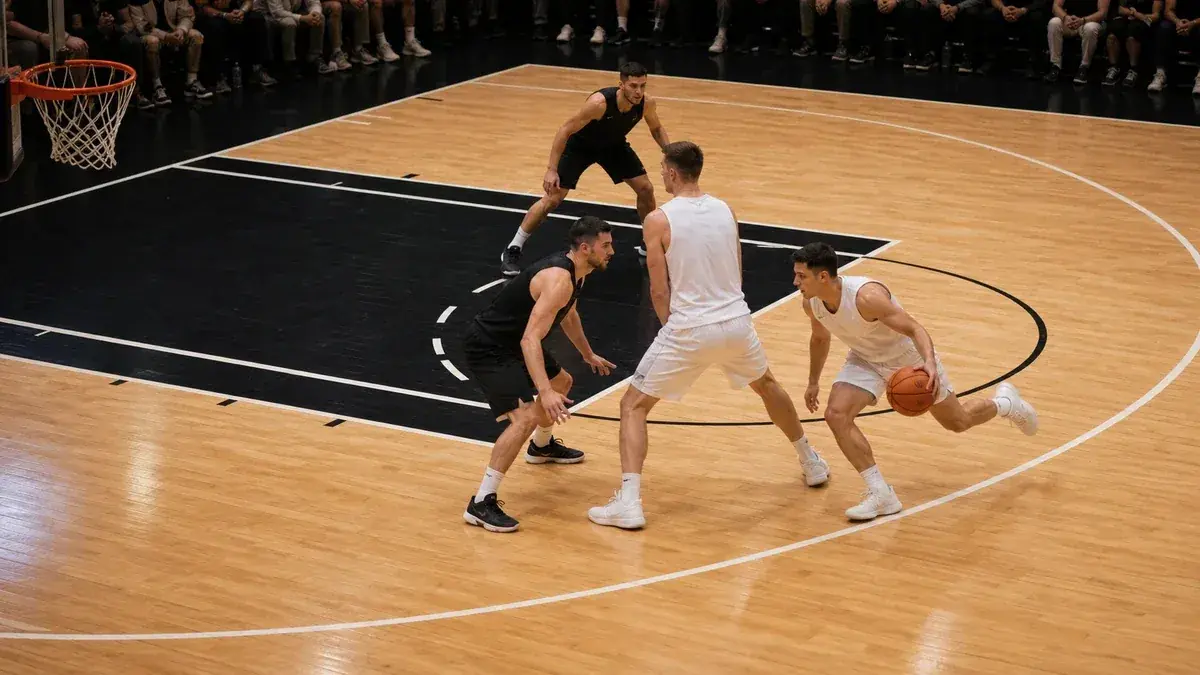
A pick and roll is a two-player offensive action: one player sets a screen (the pick) to free a teammate with the ball, then immediately cuts toward the basket (the roll) looking for a pass. It is the single most common play in basketball because it puts a defense in an impossible spot — help too much and a shooter or roller gets open, help too little and the ball handler drives past a beaten defender. Every team, from middle school to the NBA, runs some version of it every game.
If you’ve read our guide to basketball defenses and offenses explained, the pick and roll is the clearest real-world example of how a single well-timed action can break down an entire defensive scheme. Below is exactly how it works, the variations coaches use, and how defenses try to stop it.
How a Pick and Roll Works, Step by Step
The play unfolds in a predictable sequence, even though the outcome is anything but predictable:
- The ball handler creates space. Before the screen even arrives, the player with the ball jabs or dribbles to get their defender leaning the wrong way.
- The screener sets up. The screener (often a center or power forward) reads the defender’s position and picks an angle — usually around 45 degrees — that will actually block the defender’s path, not just stand nearby.
- The screen is set. The screener plants their feet, stays stationary, and makes solid (but legal) contact with the ball handler’s defender. Setting the screen too early or too late lets the defender slide around it.
- The ball handler uses the screen. The dribbler brushes shoulder-to-shoulder with the screener — “using the screen” — to force the defender to either fight over the top, go under, or get picked off entirely.
- The roll. The instant contact happens, the screener pivots and cuts (“rolls”) toward the basket, sealing whichever defender is nearest.
- The read. The ball handler now has options: drive into the paint, hit the rolling screener for a layup or dunk, or kick the ball to an open shooter if the defense collapsed to help.
This two-on-two action is often called a “pick and roll” or “screen and roll” interchangeably, and it pairs naturally with other two-man games like the give and go, where the passer cuts instead of screening.
Types and Variations
Coaches run several versions of the same basic idea depending on personnel and floor spacing.
| Variation | What Happens | Best Used When |
|---|---|---|
| High pick and roll | Screen set near the top of the key, well above the three-point line | Team wants maximum driving room to the rim |
| Side pick and roll | Screen set near the wing or sideline | Team wants to attack one half of the floor and use the sideline as an extra “defender” against the ball handler |
| Pick and pop | Screener steps out to the perimeter instead of rolling | Screener is a reliable outside shooter (stretch big) |
| Pick and slip | Screener cuts to the rim before contact, faking the screen | Defense is aggressive about jumping or switching screens early |
| Double/stagger screen | Two screeners set picks in sequence for the same ball handler | Team wants to free a shooter or wear down one defender over multiple actions |
How Defenses Guard the Pick and Roll
Because the pick and roll is unavoidable, defenses have built entire schemes just to slow it down. The five main coverages are:
- Switching: The two defenders simply trade assignments, with the screener’s defender picking up the ball handler and vice versa. Fast and simple, but it risks a size mismatch (a small guard stuck on a big man, or a slow big trying to stay in front of a quick guard).
- Hedging (or “showing”): The screener’s defender briefly steps out to bump the ball handler’s momentum, then recovers back to the roller. It slows the drive without fully committing to a switch.
- Dropping: The screener’s defender retreats toward the paint instead of stepping up, conceding a mid-range jumper but protecting the rim against the roll.
- Blitzing (trapping): Two defenders immediately double-team the ball handler at the screen, forcing a quick pass and betting the offense can’t punish the resulting 4-on-3 elsewhere on the floor.
- Icing (or “downing”): The on-ball defender forces the dribbler away from the screen entirely, usually toward the sideline, so the screen never actually gets used.
This is the same broader family of principles covered in our off-ball screens guide, since ball-screen defense and off-ball-screen defense share the same core menu of switch, hedge, and trail options.
Reading the Defense as the Ball Handler
A pick and roll only works if the ball handler reacts correctly to whatever coverage shows up:
- If the defense hedges or traps, split the two defenders or make the extra pass immediately before the trap fully forms.
- If the defender goes under the screen, take the open jump shot rather than forcing a drive into a crowd.
- If the defense switches, look to attack the new, often smaller or slower, defender in single coverage.
- If the screener’s defender drops, take the space that’s given — usually a pull-up jumper before the drop defender recovers.
Common Mistakes and Coaching Tips
The most frequent breakdown is a moving or “illegal” screen — the screener must be completely stationary and give the defender a fair chance to react before contact, or officials will call an offensive foul. Beyond that, most amateur pick and rolls fail for the same three reasons: the screen angle is wrong (screening the defender’s back instead of their path), the ball handler doesn’t actually use the screen (leaving too much space between themselves and the screener), or the screener rolls too early, arriving in the paint before the defense has to make a decision. Good spacing from the other three players on the floor — staying out of the driving lane — matters just as much as the two-man execution itself.
For more on how individual actions like this one fit into a team’s full offensive and defensive identity, see the basketball defenses and offenses explained pillar guide, and browse more explainers in the basketball hub.
Frequently asked questions
What is a pick and roll in basketball?+
A pick and roll is a two-man action where a screener sets a legal, stationary screen on the ball handler's defender, then rolls toward the rim as the ball handler drives off the screen. It creates a mismatch or a scoring window because one defender has to help off their assignment.
What is the difference between a pick and roll and a pick and pop?+
In a pick and roll, the screener dives toward the basket after setting the screen, looking for a lob or a short pass near the rim. In a pick and pop, the screener instead steps back behind the three-point line or into the mid-range, which is common when the screener is a strong outside shooter.
Who sets the screen in a pick and roll?+
Any offensive player can set the screen, but it is most often a big man (center or power forward) screening for a guard. Modern offenses also run guard-guard pick and rolls to create switches that force a smaller defender onto a bigger scorer, or vice versa.
How do you defend a pick and roll?+
Teams defend it with one of five main coverages: switching (defenders trade assignments), hedging (the screener's defender briefly steps out to slow the ball handler), dropping (the big retreats toward the paint), blitzing/trapping (two defenders double the ball handler), or icing (forcing the ball handler away from the screen entirely).
Why is the pick and roll so hard to defend?+
Because it forces a two-on-two decision in a split second. Whatever the defense chooses, a well-run pick and roll usually leaves someone open, either the roller at the rim, the ball handler in space, or a shooter on the weak side once help defenders rotate.
Is a moving screen a foul in a pick and roll?+
Yes. The screener must be stationary and give the defender a normal amount of time and distance to react before contact. If the screener is still moving, leans into the defender, or extends a limb into their path at the moment of contact, officials call an illegal (moving) screen, which is an offensive foul.
What is a slip screen?+
A slip screen, or pick and slip, happens when the screener fakes setting the pick and cuts to the basket early, before contact is made. It punishes defenses that jump the screen in anticipation, since the defender is now guarding empty space.
Which NBA duos are known for running great pick and rolls?+
John Stockton and Karl Malone popularized the modern pick and roll in the 1990s, and pairs like Steve Nash and Amar'e Stoudemire, Chris Paul and DeAndre Jordan, and Nikola Jokic with his guards have kept the action central to NBA offenses ever since.
Sources
Play & tools
Free browser games and tools — no account, no download.
- Play 82-0 — Draft five, one per position, and see if your lineup can go a flawless NBA season.
- Play Era Ball — Draft an all-time NBA roster from a single era, then simulate a season and chase a perfect run.
- Play 32-0 — Draft five college basketball legends, one per position, and chase a perfect 32-0 national title.
- Explore all our games →
- Get the printable bracket — Download and print a blank tournament bracket to fill out by hand.
- Open the TS% calculator — Calculate TS% from points, field goal attempts and free throw attempts — scoring efficiency in one number.
- Explore all our free sports tools →
Related basketball guides
View all →
Man-to-Man Defense in Basketball: Rules, Roles, and How It Works
Man to man defense explained: on-ball, denial, and help roles, stance, closeouts, and how it differs from zone. Full breakdown with drills and FAQs.
8 Best Basketball Offenses for Youth Teams (Ranked)
The best basketball offenses for youth teams are spacing-first systems like 5-out, 4-out 1-in, and Read & React that teach reads instead of memorized plays.
Full Court Press in Basketball: Types, Alignment, and How to Break It
A full court press pressures the ball the entire length of the court. Learn how a full court press works, its formations (2-2-1, 1-2-1-1, 1-3-1), and counters.
Off-Ball Screens in Basketball: Types, Alignment & How to Use Them
A basketball screen set away from the ball is an off-ball screen. Learn the down, back, flare, cross, and elevator screens with alignment, roles, and counters.
1-3-1 Zone Defense in Basketball: Alignment, Roles & How to Attack It
The 1-3-1 zone defense explained: player alignment, roles, traps, strengths, weaknesses, and how offenses beat it. A full coaching breakdown.
2-3 Zone vs Man-to-Man Defense: Full Basketball Comparison
2-3 zone vs man to man defense compared: coverage, pick-and-roll, 3-point defense, rebounding, and when coaches at every level pick each.