
Goaltending in Basketball: The Rule Explained
On this page8
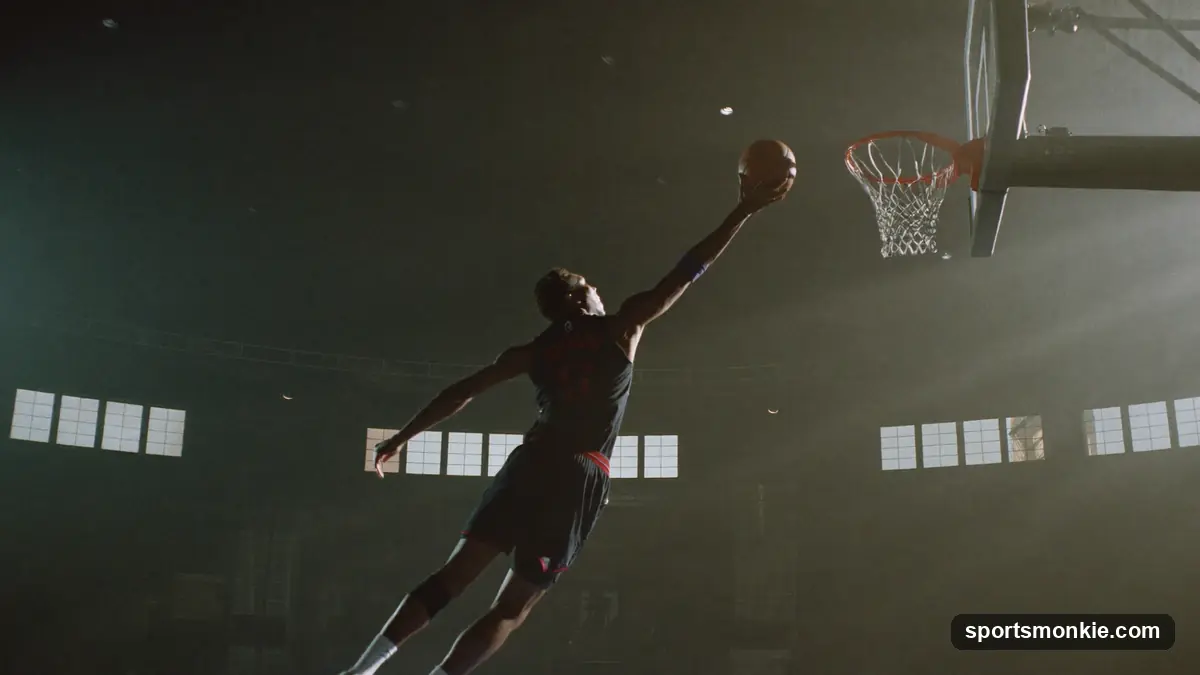
Goaltending in basketball is touching a shot while it is on its way down toward the basket, above the rim, and still has a chance to go in. When the defense commits it, the basket is awarded to the offense as if the shot had fallen; when the offense commits it, the shot is disallowed.
That single downward-flight condition is what separates a highlight block from an illegal swat. Get the timing wrong and a great defensive play becomes free points for the other team. Here is exactly what the rule covers, how it differs from basket interference, and where the block-versus-goaltend line sits.
The rule, condition by condition
Under the NBA rulebook, a defender is guilty of goaltending when a shot attempt meets all of the following:
- The ball is on its downward flight toward the basket.
- The ball is entirely above the level of the ring.
- The ball has a chance to score.
Touch it while all three are true and it is a goaltend. The offense gets the points the shot was worth, whether two or three. The clock and possession proceed as if the shot went in.
There is one extra trigger specific to the NBA: once a shot has struck the backboard and is above the ring with a chance to go in, touching it is goaltending even if it has not yet begun to drop. That backboard clause is stricter than what many pickup players assume.
Goaltending versus basket interference
The two often get lumped together, but they describe different moments. Goaltending is about the ball in flight. Basket interference is about the ball at or in the basket.
| Situation | What happens | Called |
|---|---|---|
| Touching a shot on its downward arc above the rim | Basket awarded (defense) or waved off (offense) | Goaltending |
| Touching the ball while it sits on the rim | Violation | Basket interference |
| Touching the ball inside the imaginary cylinder above the rim | Violation | Basket interference |
| Reaching up through the net to touch the ball | Violation | Basket interference |
| Touching a shot on its way up, below its peak | Legal | Clean block |
The penalties mirror each other: offensive violations wipe out the basket, defensive violations grant it.
Block or goaltend? Reading the arc
A legal block happens before the ball reaches the top of its arc or while it is still below the level of the rim. The defender is stopping the shot on its way up, before gravity takes over.
A goaltend happens after the peak, once the ball is descending toward the rim from above. The clearest mental model: if you pin a shot against the backboard on the way up, it is often a block, but in the NBA that same contact becomes goaltending the instant the ball has touched the backboard above the ring. On a normal jumper with no backboard contact, the dividing line is simply whether the ball is rising (legal) or falling (illegal) when you touch it, provided it is above the rim.
This is why elite shot-blockers time their jumps to meet the ball early. Swatting at the last moment, when the ball is already dropping toward the cylinder, is what turns a block into two given-up points.
Why the rule exists
Before goaltending was outlawed, exceptionally tall players could simply stand under the basket and slap away any shot as it dropped. That made scoring near the rim almost impossible and stripped the shot of its natural finish. The rule protects the descending arc so that a well-aimed shot gets its chance to fall, which keeps offense viable against size.
Offensive goaltending and interference
Goaltending is not only a defensive foul. An offensive player commits a violation by touching the ball in the same protected situations, for example tapping in their own missed shot while it is still above the rim on its downward flight, or guiding it while it sits in the cylinder. When the offense interferes, the basket does not count and possession goes to the defense. This is why a tip-in has to happen after the ball has cleared the rim’s protection or before the shot begins its protected descent. Players attacking the offensive glass learn to time tips just as carefully as defenders time blocks, because a mistimed tap wipes out the points instead of adding them.
Common calls fans debate
Because the rule hinges on judgment, a handful of situations spark arguments in real games. The most common is a hard block near the rim where replay shows the ball had just begun to drop, turning a spectacular swat into two awarded points. Another is a shot that clangs off the backboard and is then touched: legal in some codes on the way up, but goaltending in the NBA once the ball is above the ring after backboard contact. A third is the “cylinder” grab, where a defender or teammate slaps a ball rattling on the rim. Knowing which of these is a goaltend, a basket-interference violation or a clean play is what separates a rules-literate fan from a confused one.
Rule variations across leagues
The core idea is universal, but the details shift by governing body. FIBA and college basketball have their own wording on backboard contact and on when the ball may be legally touched near the rim, and FIBA notably allows players to touch a ball on the rim or in the cylinder once it is no longer possible for it to go in on that attempt. Always check the specific league’s rulebook, because the backboard clause in particular is where the codes diverge.
The bottom line for players and fans
If the ball is going up, you can go get it. Once it starts coming down above the rim with a chance to drop, hands off. Master that timing and you block shots cleanly; misjudge it and you gift the bucket.
For more on the sport’s biggest stages and the teams that dominate them, see the most NBA championships by team and the most NBA championships by player, where rim protection and defensive timing separated the dynasties from the rest.
Frequently asked questions
Why does the shot count when the defense goaltends?+
The rule assumes a goaltended shot would have gone in, so the offense is credited the points it was denied. Awarding the basket removes any incentive to swat down makeable shots at the rim. The value awarded matches the shot's location, so a goaltend on a three-point attempt counts as three.
Can you goaltend a free throw?+
Yes, and it is penalized differently. Interfering with a free throw on its way to the basket is a violation that awards the shooter the point. On the shooter's side, a lane violation or touching the ball before it hits the rim nullifies the attempt. Free-throw goaltending is rare but explicitly covered in the rulebook.
Does goaltending apply to a shot that has no chance of going in?+
No. A ball that is clearly off line, an air ball heading wide, or a pass rather than a shot attempt can be touched legally even above the rim. The judgment of whether the ball had a realistic chance to score is left to the officials, which is why some downward-touch calls are debated.
Is defensive goaltending reviewable by replay?+
In the NBA, officials can use instant replay to review goaltending and basket-interference calls in the final two minutes of the fourth quarter and overtime. Outside that window the call on the floor generally stands, which is why late-game rim contact draws the most scrutiny.
Sources
Play & tools
Free browser games and tools — no account, no download.
- Play 82-0 — Draft five, one per position, and see if your lineup can go a flawless NBA season.
- Play Era Ball — Draft an all-time NBA roster from a single era, then simulate a season and chase a perfect run.
- Play 32-0 — Draft five college basketball legends, one per position, and chase a perfect 32-0 national title.
- Explore all our games →
- Get the printable bracket — Download and print a blank tournament bracket to fill out by hand.
- Open the TS% calculator — Calculate TS% from points, field goal attempts and free throw attempts — scoring efficiency in one number.
- Explore all our free sports tools →
Related basketball guides
View all →
What Is a Technical Foul in Basketball?
A technical foul penalizes unsportsmanlike conduct or rule breaches, not contact, and gives the other team a free throw. Rules, examples and ejections.
Scottie Barnes Gets First Push-Off Call as NBA's New Emphasis Debuts in Preseason Opener
Scottie Barnes was whistled for an off-arm push-off inside two minutes of the Raptors' preseason opener, the first call under the NBA's new point of emphasis.
What Is Goaltending in Basketball? Defensive and Offensive Rules
Goaltending is illegal contact with a shot on its downward flight or near the rim; the rule also covers interference with a ball on the cylinder.
Backdoor Cut in Basketball: Definition, When to Use It, and How to Run It
What a backdoor cut is in basketball, when players use it against overplaying defenders, and how to execute and defend it correctly.
Basketball Defenses and Offenses Explained: Zone, Man-to-Man, and More
Basketball defenses and offenses explained: man-to-man, zone defense in basketball, presses, and the plays teams run to attack each one.
Basketball Referee Signals: The Complete Guide to Every Hand Signal
Basketball referee signals explained: scoring, traveling, double dribble, blocking, charging, holding, shot-clock violations, and technical fouls.