
What Is a Double Dribble in Basketball?
On this page5
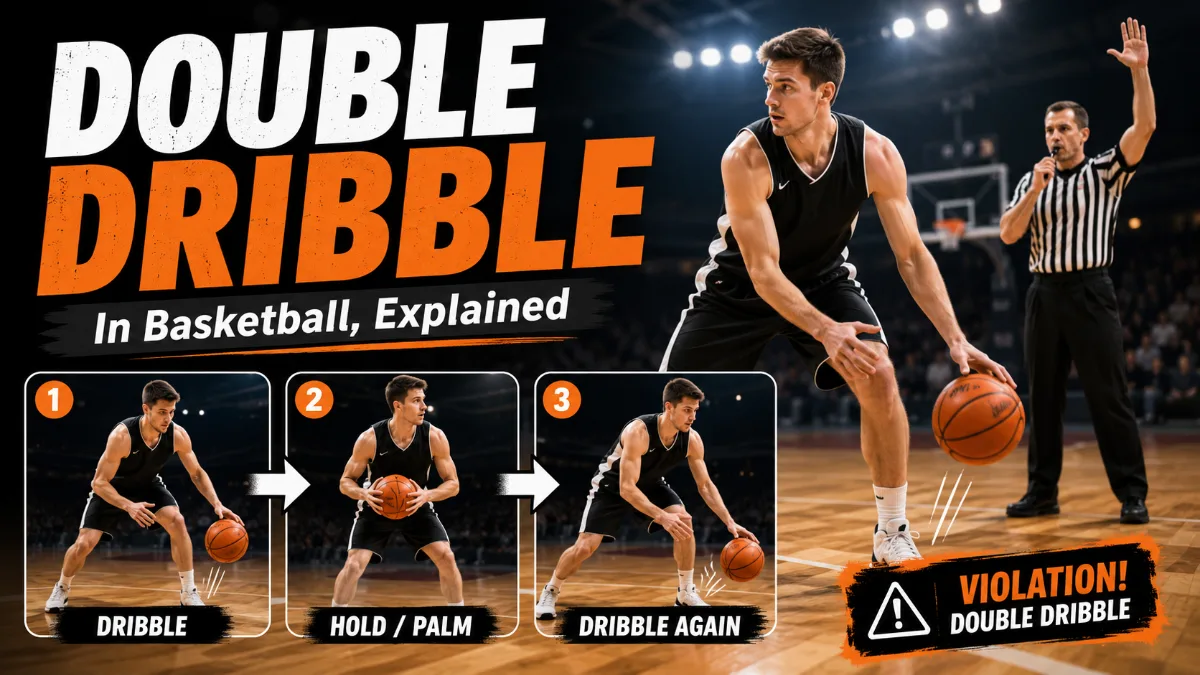
A double dribble is a violation that covers two mistakes: dribbling with both hands at once, or ending your dribble by catching the ball and then dribbling again. Either one stops play immediately and hands possession to the other team. It is not a foul, so no free throws follow.
Dribbling looks simple, but the rules around it are strict, and double dribble is one of the first violations new players get whistled for.
The two kinds of double dribble
A double dribble covers two different mistakes, and it helps to keep them separate.
1. Dribbling with two hands. You can only dribble with one hand at a time. The moment both hands touch the ball while you are dribbling, the dribble is over. Keep bouncing it and that is a double dribble.
2. Dribbling, stopping, then dribbling again. When you catch the ball, or let it settle in your hand, your dribble has ended. From there you can pass or shoot, but you cannot start a new dribble. If you do, that is also a double dribble.
Why it is a violation
Basketball limits dribbling to keep the game moving and fair. If a player could stop, gather the ball, then set off dribbling again, defenders would have almost no chance to strip it or force a decision. Ending the dribble on a catch forces the player to commit to a pass or shot.
What happens when it’s called
A double dribble is a turnover. The referee blows the whistle, play stops, and the ball goes to the opposing team, typically inbounded from the nearest sideline. No free throws, no points, just a change of possession.
When it is not a double dribble
Three situations look like double dribbles and are perfectly legal, and knowing them saves a lot of arguing at the park:
- A defender touches the ball. If an opponent deflects or knocks your dribble away, the dribble is interrupted rather than ended. Regain it and you may dribble on.
- You fumble it. Losing control accidentally is not a dribble, so you can recover and start dribbling. Referees judge intent here, and deliberately tossing the ball ahead to yourself will get whistled.
- A shot hits the rim. Once an attempt touches iron, the ball is live for everyone. Grab your own rebound and you are dribbling from a new possession.
How to avoid it
| Habit | Why it helps |
|---|---|
| Dribble with one hand at a time | Prevents the two-hand violation |
| Don’t pick the ball up too early | Once you gather it, your dribble is done |
| Decide before you stop | Know whether you’re passing or shooting before ending the dribble |
The most common version at every level is the second one: a player picks up their dribble under pressure, panics, and puts the ball back on the floor. Learning to keep the dribble alive, or to commit fully to a pass or shot, is what makes the violation disappear from your game.
Frequently asked questions
What are the two types of double dribble?+
The first is dribbling the ball with both hands at the same time. The second is stopping your dribble by catching or palming the ball, and then starting to dribble again. Both are violations and both result in a turnover.
What happens after a double dribble?+
It is a turnover. Play stops, and the ball is awarded to the other team, usually inbounded from the sideline nearest to where the violation happened. No free throws are awarded and no points change, since a violation is not a foul.
Is carrying the ball the same as a double dribble?+
They are related but not identical. Carrying, also called palming, is when a player lets the ball come to rest in their hand mid-dribble. If they then continue dribbling, it becomes a double dribble. A carry can be whistled on its own without a second dribble.
Can you dribble again after a defender touches the ball?+
Yes. If a defender deflects or knocks the ball away, your dribble is legally interrupted rather than ended, and you may regain the ball and dribble again. The same applies if a shot attempt hits the rim, since a rebound is a new possession for everyone.
Is a fumble a double dribble?+
No. Accidentally losing control of the ball is a fumble, not a dribble, so you may recover it and start or resume dribbling. Referees judge intent: a genuine bobble is fine, but deliberately tossing the ball forward to yourself and dribbling on is a violation.
What is the referee signal for a double dribble?+
The referee mimics dribbling with both hands, patting downward with both palms at waist height, then points toward the team now receiving the ball. It is one of the most recognisable signals in basketball and is used identically in the NBA, FIBA, and NCAA.
Sources
Play & tools
Free browser games and tools — no account, no download.
- Play 82-0 — Draft five, one per position, and see if your lineup can go a flawless NBA season.
- Play Era Ball — Draft an all-time NBA roster from a single era, then simulate a season and chase a perfect run.
- Play 32-0 — Draft five college basketball legends, one per position, and chase a perfect 32-0 national title.
- Explore all our games →
- Get the printable bracket — Download and print a blank tournament bracket to fill out by hand.
- Open the TS% calculator — Calculate TS% from points, field goal attempts and free throw attempts — scoring efficiency in one number.
- Explore all our free sports tools →
Related basketball guides
View all →
What Is Traveling in Basketball? Footwork Rules Explained
Traveling is an illegal movement with the ball caused by taking extra steps or moving the pivot foot beyond what the basketball rules allow.
What Is a 3-Second Violation in Basketball?
A three-second violation prevents an offensive player from staying in the opponent’s restricted area for too long while the team controls the ball.
Technical Foul vs Flagrant Foul in Basketball
Technical fouls punish unsporting or procedural conduct; flagrant fouls involve excessive or unnecessary contact and carry different penalties.
What Is a Charge in Basketball? Charge vs. Block
A charge is an offensive foul called when a ball handler runs into a defender who has established legal guarding position. Here's the charge vs. block rule.
What Is a Flagrant Foul in Basketball?
A flagrant foul is unnecessary or excessive contact against an opponent. Flagrant 1 gives free throws and possession; Flagrant 2 adds an automatic ejection.
What Is the Shot Clock in Basketball?
The shot clock forces a team to attempt a shot within a set time, 24 seconds in the NBA. Learn how it works, the reset rules, and why it changed the game.