
Basketball Referee Signals: The Complete Guide to Every Hand Signal
On this page6
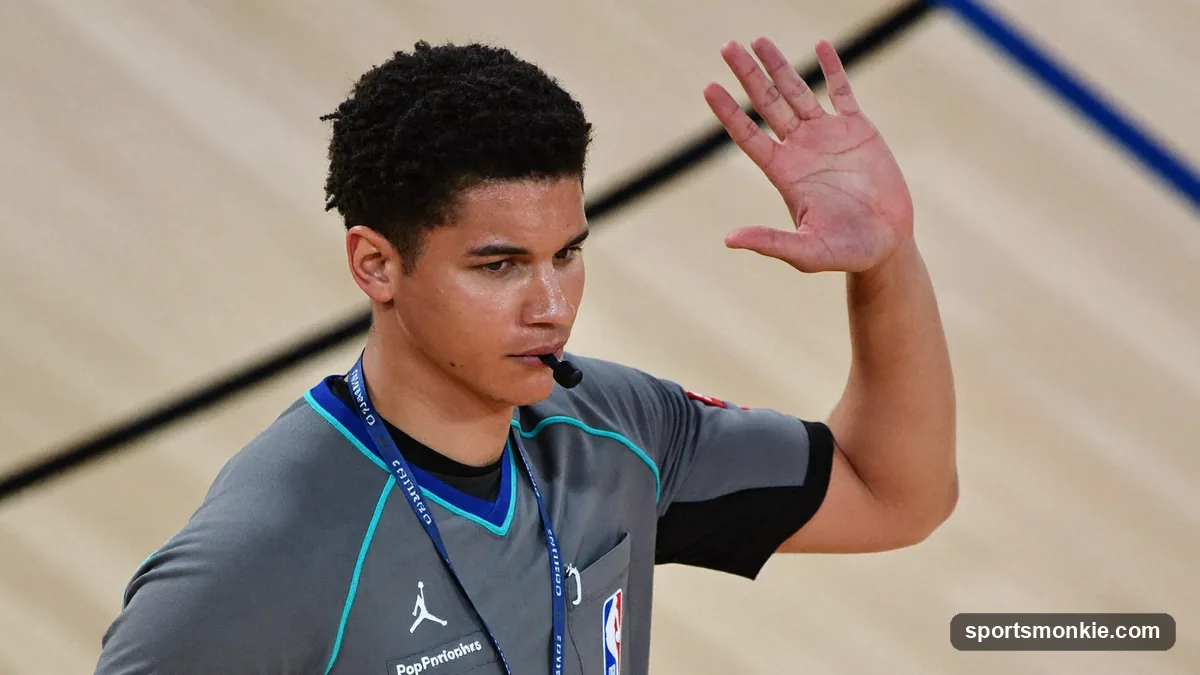
Basketball referee signals are the standardized hand and arm gestures officials use to instantly communicate scoring, violations, and fouls to players, coaches, scorers, and fans. Every whistle is followed by a specific gesture — a circling motion for traveling, hands on hips for blocking, a fist punching a palm for charging — so the entire gym knows the call without a single word being spoken. Learning to read these signals turns a confusing whistle into a clear story about what just happened on the floor.
Why referees use hand signals instead of just talking
Basketball is loud, fast, and played in arenas where a shouted explanation would never reach the back row. Hand signals solve that problem the same way they do in other sports — see our broader breakdown of referee hand signals by sport for how football, baseball, and basketball officials each developed their own signal vocabulary. In basketball specifically, the scorer’s table needs an unambiguous signal to update the book, coaches need to know instantly whether to challenge a call, and broadcast commentators rely on the gestures to narrate the game accurately. The signals used across the NBA, WNBA, NCAA, and high school levels are nearly identical, which is part of why they’re so widely recognized — you’ll see the same gestures whether you’re watching a basketball NBA/WNBA broadcast or a rec-league game at the local gym.
Scoring signals: how points get on the board
Before a referee signals a foul or violation, they first have to communicate how many points a made basket is worth — this happens even before the ball goes through the net, since three-point attempts get flagged the moment the shooter releases the ball.
- One point (free throw): a single raised finger, typically used when confirming a free throw attempt or make.
- Two-point attempt or make: the arm extends parallel to the floor with two fingers pointed toward the basket.
- Three-point attempt: one arm shoots straight up with three fingers extended the instant the shooter releases the ball.
- Three-point make: both arms go straight up once the ball drops through the net, confirming the shot counts.
Common violation signals
Violations are non-foul infractions that result in a turnover rather than free throws. Here’s how officials signal the most frequent ones during a game.
| Signal | Gesture | Meaning |
|---|---|---|
| Traveling | Both forearms rotate in a circular motion in front of the chest | Player took illegal steps without dribbling, passing, or shooting |
| Double dribble | Both hands, palms down, move up and down alternately | Player stopped dribbling and restarted illegally |
| Carrying/palming | One hand flips repeatedly from palm-up to palm-down | Ballhandler illegally turned their hand under the ball while dribbling |
| Three-second violation | Three fingers pointed down at the side, swiped back and forth | Offensive player stayed in the lane too long |
| Shot-clock violation | Tap the top of the same-side shoulder with an open hand | Offense failed to shoot before the shot clock expired |
| Over-and-back | Hand moves side to side, palm down | Offensive team illegally returned the ball to the backcourt |
| Kicked ball | Referee points at their own foot | A player deliberately kicked or blocked the ball with a foot or leg |
| Jump ball | Both thumbs point up above the head | Possession arrow situation or held-ball tie-up |
Common foul signals
Fouls carry more weight than violations because they can put the shooting team at the free-throw line, and repeated fouls foul a player out of the game. The referee typically raises a closed fist first to stop play, then follows with the specific foul signal below.
| Signal | Gesture | Meaning |
|---|---|---|
| Blocking | Both hands placed on the hips | Defender impeded an opponent’s path without legal guarding position |
| Charging | Closed fist punches into the open palm of the other hand | Offensive player ran into a defender already set in legal position |
| Holding | One arm raised, then grabbed at the wrist by the other hand | A player illegally held an opponent to restrict movement |
| Hand-checking | One hand chops across the opposite wrist | Defender used a hand to impede the ballhandler’s progress |
| Pushing | Both arms extend outward in a pushing motion | A player shoved an opponent |
| Illegal use of hands/elbow | Referee mimics the elbow motion near the body | Excessive or dangerous use of an elbow against an opponent |
| Technical foul | Hands form a “T” shape in front of the chest | Unsportsmanlike conduct, bench violation, or arguing a call |
Administrative signals every fan should know
Not every whistle is a foul or violation — plenty of stoppages are just game management. These signals keep the clock, substitutions, and scoring accurate.
| Signal | Gesture | Meaning |
|---|---|---|
| Timeout | Both arms extended sideways with closed fists | A team or official has stopped play for a timeout |
| Substitution | Arms crossed to form an “X” | A player is being replaced at the next stoppage |
| Start the clock | Arm drops sharply after being raised | The game clock should start running |
| No basket / points not counted | Arms wave and cross in front of the body | A made basket does not count |
| Foul on the play, points count | One arm points to the basket while the other signals the foul | A basket is scored despite a foul, awarding an “and-one” free throw |
How these signals compare across sports
Basketball’s signal system shares a lot of DNA with officiating in other sports, even though the specific gestures differ. Football officials rely on a much larger signal vocabulary for things like penalties and measurements — see our guide to football referee signals for the full breakdown — while baseball’s crew leans on a more compact set of calls built around safe/out and fair/foul decisions, covered in our baseball umpire signals explainer. What all three sports share is the same core idea: a clear, repeatable gesture that removes any doubt about what was just called, no matter how loud the crowd gets.
Once you know these signals, watching basketball changes completely. Instead of waiting for a broadcast graphic or a coach’s reaction to explain a whistle, you can read the referee’s hands in real time and know exactly what happened — whether it’s a routine traveling call or a game-defining charge/block decision in the final seconds.
Frequently asked questions
What are basketball referee signals?+
Basketball referee signals are the standardized hand and arm gestures officials use to communicate calls to players, coaches, the scorer's table, and fans. Each signal identifies a specific foul, violation, point value, or administrative stoppage, letting everyone in the arena understand a decision instantly without needing to hear an explanation.
What is the hand signal for traveling in basketball?+
The referee rotates both forearms in a circular motion in front of the chest, as if winding an invisible reel. This signals that a player took too many steps without dribbling, passing, or shooting.
How does a referee signal a double dribble?+
The official holds both hands out with palms facing down and moves them up and down in an alternating pattern, mimicking two hands dribbling a ball. This shows the ballhandler stopped their dribble and started again illegally.
What signal does a referee use for a charging foul?+
The referee makes a closed fist and punches it into the open palm of their other hand. This indicates an offensive player ran into a defender who had already established a legal guarding position.
How is a blocking foul signaled?+
The official places both hands on their hips. This tells everyone a defender illegally impeded the path of an offensive player without being set in legal guarding position first.
What does the technical foul signal look like?+
The referee forms the letter T by placing one hand flat and horizontal and the other hand vertical against it, held in front of the chest. This signals a technical foul for unsportsmanlike conduct, a bench violation, or arguing with an official.
How does a referee signal a shot-clock violation?+
The official taps the top of the same-side shoulder with an open hand while blowing the whistle. This shows the offense failed to attempt a shot before the shot clock expired.
What is the three-second violation signal?+
The referee holds up three fingers pointed downward at their side and swipes the hand back and forth. This signals an offensive player stood in the free-throw lane for more than three seconds without leaving.
Sources
Play & tools
Free browser games and tools — no account, no download.
- Play 82-0 — Draft five, one per position, and see if your lineup can go a flawless NBA season.
- Play Era Ball — Draft an all-time NBA roster from a single era, then simulate a season and chase a perfect run.
- Play 32-0 — Draft five college basketball legends, one per position, and chase a perfect 32-0 national title.
- Explore all our games →
- Get the printable bracket — Download and print a blank tournament bracket to fill out by hand.
- Open the TS% calculator — Calculate TS% from points, field goal attempts and free throw attempts — scoring efficiency in one number.
- Explore all our free sports tools →
Related basketball guides
View all →
Volleyball Referee Signals: Every Official Hand Signal Explained
Volleyball referee signals explained: point, ball in/out, four hits, double contact, net touch, foot fault, ball touched, delay, substitution, and end of set.
What Is Traveling in Basketball? Footwork Rules Explained
Traveling is an illegal movement with the ball caused by taking extra steps or moving the pivot foot beyond what the basketball rules allow.
What Is a 3-Second Violation in Basketball?
A three-second violation prevents an offensive player from staying in the opponent’s restricted area for too long while the team controls the ball.
Technical Foul vs Flagrant Foul in Basketball
Technical fouls punish unsporting or procedural conduct; flagrant fouls involve excessive or unnecessary contact and carry different penalties.
Football Referee Signals: The Complete NFL Hand Signal Chart
Football referee signals explained: touchdown, first down, holding, false start, pass interference, and every hand signal NFL officials use on the field.
Hockey Referee Signals Explained: Every Penalty Arm Signal
Hockey referee signals decoded: the exact arm signal for hooking, tripping, slashing, cross-checking, high-sticking, holding, interference, and more.