
What Is Traveling in Basketball? Footwork Rules Explained

On this page5
TL;DR
A player may move within the permitted gather and two-step sequence, then must shoot, pass or dribble. Moving the pivot foot illegally or taking extra steps creates a traveling violation and a change of possession.
The pivot foot
After establishing a pivot, the player may rotate around that foot. The pivot can lift for a shot or pass, but it cannot return to the floor before the ball is released.
Gather and two steps
Modern rulebooks describe a gather phase followed by permitted steps. The exact wording differs between NBA, FIBA, college and youth rules, so coaching should use the relevant competition’s interpretation.
Common examples
Extra steps on a layup, sliding both feet before beginning a dribble, and hopping while holding the ball can all be called traveling. Officials judge control, foot contact and the action’s timing.
Why calls differ on video
Camera angles often hide the gather moment. A slow-motion replay can make legal rhythm look unusual, while a missing angle can conceal a pivot-foot lift.
Related rules
Read double dribble, the shot clock, three-second violations and pick and roll.
Sources
Play & tools
Free browser games and tools — no account, no download.
- Play 82-0 — Draft five, one per position, and see if your lineup can go a flawless NBA season.
- Play Era Ball — Draft an all-time NBA roster from a single era, then simulate a season and chase a perfect run.
- Play 32-0 — Draft five college basketball legends, one per position, and chase a perfect 32-0 national title.
- Explore all our games →
- Get the printable bracket — Download and print a blank tournament bracket to fill out by hand.
- Open the TS% calculator — Calculate TS% from points, field goal attempts and free throw attempts — scoring efficiency in one number.
- Explore all our free sports tools →
Related basketball guides
View all → What Is a 3-Second Violation in Basketball?
A three-second violation prevents an offensive player from staying in the opponent’s restricted area for too long while the team controls the ball.
Technical Foul vs Flagrant Foul in Basketball
Technical fouls punish unsporting or procedural conduct; flagrant fouls involve excessive or unnecessary contact and carry different penalties.
What Is a Charge in Basketball? Charge vs. Block
A charge is an offensive foul called when a ball handler runs into a defender who has established legal guarding position. Here's the charge vs. block rule.
What Is a Flagrant Foul in Basketball?
A flagrant foul is unnecessary or excessive contact against an opponent. Flagrant 1 gives free throws and possession; Flagrant 2 adds an automatic ejection.
What Is the Shot Clock in Basketball?
The shot clock forces a team to attempt a shot within a set time, 24 seconds in the NBA. Learn how it works, the reset rules, and why it changed the game.
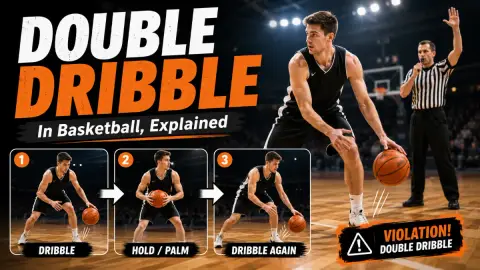
What Is a Double Dribble in Basketball?
A double dribble is a violation: dribbling with two hands at once, or picking the ball up and then dribbling again. It costs your team possession. Here's exactly what counts.