
What Is the Shot Clock in Basketball?
On this page6
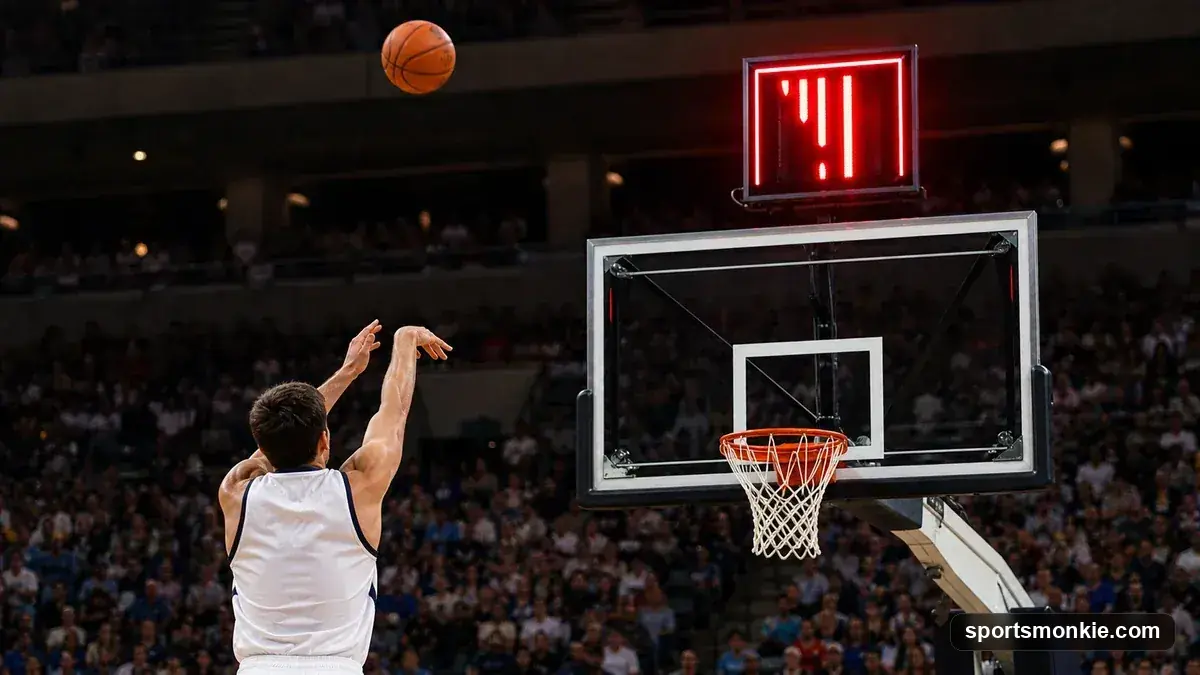
The shot clock is a countdown timer that forces the offense to get a shot attempt to the rim within a set time: 24 seconds in the NBA and FIBA, 30 seconds in NCAA basketball. Miss the deadline and it is a shot-clock violation, and the ball goes to the other team. It resets to 24 on a change of possession and to 14 after an offensive rebound in the NBA.
Before it existed, basketball had a serious problem: a team with the lead could hold the ball and stall, passing it around for minutes while the game died. The clock fixed that in 1954 and turned basketball into the fast, high-scoring sport it is today.
What the shot clock does
The shot clock runs separately from the main game clock and limits how long a team can hold the ball before shooting. To satisfy it, the offense must get an attempt that touches the rim before time expires. Throwing the ball at the backboard as the buzzer sounds does not count; it has to hit iron.
That rim requirement also decides the airborne case. If the buzzer sounds while a shot is in flight and the ball then hits the rim, there is no violation. If it misses everything, the violation stands and any basket is waved off.
Resets: 24 and 14
The clock does not always start from the full amount. The key numbers:
| Event | NBA shot clock resets to |
|---|---|
| New possession (steal, defensive rebound, inbound) | 24 |
| Made shot / change of possession | 24 |
| Offensive rebound after a rim-hitting attempt | 14 |
| Certain defensive fouls or kicked balls | 14 (if less remained) |
The 14-second reset after an offensive rebound keeps the pace up. Grabbing your own miss earns you a fresh chance, but not a full one. The NBA introduced it in 2018, and FIBA had been using it since 2014.
Shot clock by league
The 24-second standard is not universal, and the differences change how each level plays:
| League | Shot clock | After offensive rebound |
|---|---|---|
| NBA | 24 seconds | 14 seconds |
| FIBA (international) | 24 seconds | 14 seconds |
| WNBA | 24 seconds | 14 seconds |
| NCAA men | 30 seconds | 20 seconds |
| NCAA women | 30 seconds | 20 seconds |
| US high school (where used) | 35 seconds | Full reset |
College basketball’s extra six seconds is the single biggest reason the NCAA game looks slower and more set-play driven than the NBA. The men’s clock has been cut twice to close that gap, from 45 seconds to 35 in 1993 and from 35 to 30 in 2015, each time producing an immediate jump in scoring.
Shot-clock violations
If the offense fails to get a shot to the rim in time, the buzzer sounds and it is a shot-clock violation. Possession goes to the other team, and any late basket is waved off.
You will often see a team scramble in the final seconds, a rushed drive, a desperate three, a quick pass to an open shooter, precisely because the clock is about to expire. Those forced looks are the shot clock doing its job.
Where 24 seconds came from
Danny Biasone, who owned the Syracuse Nationals, worked the number out with arithmetic rather than instinct. He looked at games he considered well-paced, counted roughly 120 shot attempts in them, and divided the 48-minute game — 2,880 seconds — by 120. That gives 24 seconds per attempt.
The NBA adopted it for the 1954-55 season, and scoring jumped by about 14 points per team almost immediately. A rule invented by dividing two numbers on a napkin saved the league, which had been bleeding fans to games that ended 19-18.
Why it changed basketball
The shot clock rewards teams that move the ball and attack. It stopped stalling, raised scoring, and made comebacks possible, because a trailing team knows the leader cannot just sit on the ball. It also created a whole layer of strategy: late-clock offense, quick-hitting sets, and defenses trying to run out the clock without fouling.
Combined with the fast pace it forces and the flow it creates for scorers chasing a double-double or triple-double, the shot clock is a big reason modern basketball looks nothing like the plodding game of the pre-clock era. Watch the little glowing number above the backboard and you will start to see how much of a possession is shaped by it.
See also how this compares in What Is an And-One in Basketball?.
Frequently asked questions
How long is the shot clock in the NBA?+
24 seconds. The offense must attempt a shot that touches the rim before the clock hits zero. After an offensive rebound, the clock resets to 14 seconds rather than a full 24. FIBA uses the same 24 and 14 structure in international basketball.
What happens on a shot-clock violation?+
If the offense fails to get a shot to the rim before the clock expires, it is a violation. Play stops, and possession is awarded to the defending team from the sideline. Any basket scored after the buzzer does not count, even if the shot left the hand in time.
When does the shot clock reset?+
It resets to 24 on a change of possession or when a shot hits the rim. After an offensive rebound it resets to 14 in the NBA. A defensive foul or kicked ball also resets it to 14 if less than 14 seconds remained, and leaves it alone if more did.
How long is the shot clock in college basketball?+
30 seconds in both NCAA men's and women's basketball, as of 2026. After an offensive rebound the men's clock resets to 20 seconds rather than the NBA's 14. Most US high school associations that use a shot clock set it at 35 seconds.
Who invented the shot clock?+
Danny Biasone, owner of the Syracuse Nationals, proposed it and the NBA adopted it for the 1954-55 season. He derived 24 seconds by dividing a 48-minute game by the 120 shots a typical good game contained, giving each possession 24 seconds of the clock.
Does the shot clock stop when the ball is in the air?+
It keeps running until the ball touches the rim. If the buzzer sounds while a shot is airborne and the ball then hits the rim, there is no violation and play continues. If it misses the rim entirely, the violation stands and any basket is waved off.
Sources
Play & tools
Free browser games and tools — no account, no download.
- Play 82-0 — Draft five, one per position, and see if your lineup can go a flawless NBA season.
- Play Era Ball — Draft an all-time NBA roster from a single era, then simulate a season and chase a perfect run.
- Play 32-0 — Draft five college basketball legends, one per position, and chase a perfect 32-0 national title.
- Explore all our games →
- Get the printable bracket — Download and print a blank tournament bracket to fill out by hand.
- Open the TS% calculator — Calculate TS% from points, field goal attempts and free throw attempts — scoring efficiency in one number.
- Explore all our free sports tools →
Related basketball guides
View all →
What Is a Charge in Basketball? Charge vs. Block
A charge is an offensive foul called when a ball handler runs into a defender who has established legal guarding position. Here's the charge vs. block rule.
What Is a Flagrant Foul in Basketball?
A flagrant foul is unnecessary or excessive contact against an opponent. Flagrant 1 gives free throws and possession; Flagrant 2 adds an automatic ejection.
What Is a 10-Day Contract in the NBA?
A 10-day contract is a short NBA deal covering up to 10 days or three games. How the pay works, the two-contract limit and why teams use them, explained.
What Is Traveling in Basketball? Footwork Rules Explained
Traveling is an illegal movement with the ball caused by taking extra steps or moving the pivot foot beyond what the basketball rules allow.
What Is a 3-Second Violation in Basketball?
A three-second violation prevents an offensive player from staying in the opponent’s restricted area for too long while the team controls the ball.
Technical Foul vs Flagrant Foul in Basketball
Technical fouls punish unsporting or procedural conduct; flagrant fouls involve excessive or unnecessary contact and carry different penalties.