
What Is a 3-Second Violation in Basketball?
On this page5
TL;DR
An offensive player cannot remain in the opponent’s restricted lane for more than three seconds while the team controls the ball in the frontcourt. The player must leave, begin a scoring move or meet the applicable league exception.
What the lane count protects
The rule stops a large attacker from camping beside the basket and keeps space for movement. It is a positioning rule, not a limit on how many seconds a possession may last.
How officials judge it
Officials watch the player’s feet and the team’s possession status. The count ends when the player leaves the lane, a shot is released, or the team loses control, subject to the competition’s exact wording.
NBA and FIBA differences
The NBA and FIBA use similar ideas but their lane markings, defensive three-second rules and interpretations are not identical. Always check the competition rulebook when coaching or analyzing a specific game.
Penalty for the violation
The opponent receives the restart specified by the rules, normally possession from a designated spot. It is not a personal foul, though repeated violations can change the tactical value of an offense.
Related basketball rules
The lane count is separate from double dribble, the shot clock and a technical versus flagrant foul.
FAQs
Basketball is one of the world’s most popular sports, so learning this lane rule helps new fans follow broadcasts.
Does the count reset on a shot?
In common rule sets, the count ends when a shot is released, but the exact rule and timing standard belongs to the governing competition.
Can a player stand in the lane after catching the ball?
Only within the permitted time or while executing a legal scoring move. Catching the ball does not permanently stop the count.
Is defensive three seconds the same rule?
No. Defensive three seconds is a separate restriction used in some leagues, notably the NBA, with different exceptions and penalties.
Does the rule apply in youth basketball?
It depends on the youth association. Coaches should use the local rulebook rather than assume NBA or FIBA enforcement.
Can two offensive players share the lane time?
Each offensive player is judged separately. One player leaving does not erase another player’s time already spent in the lane.
Is a three-second violation a turnover?
It ends the team’s possession and gives the opponent the prescribed restart, so scorekeepers generally record it as a team turnover.
Sources
Play & tools
Free browser games and tools — no account, no download.
- Play 82-0 — Draft five, one per position, and see if your lineup can go a flawless NBA season.
- Play Era Ball — Draft an all-time NBA roster from a single era, then simulate a season and chase a perfect run.
- Play 32-0 — Draft five college basketball legends, one per position, and chase a perfect 32-0 national title.
- Explore all our games →
- Get the printable bracket — Download and print a blank tournament bracket to fill out by hand.
- Open the TS% calculator — Calculate TS% from points, field goal attempts and free throw attempts — scoring efficiency in one number.
- Explore all our free sports tools →
Related basketball guides
View all → What Is Traveling in Basketball? Footwork Rules Explained
Traveling is an illegal movement with the ball caused by taking extra steps or moving the pivot foot beyond what the basketball rules allow.
Technical Foul vs Flagrant Foul in Basketball
Technical fouls punish unsporting or procedural conduct; flagrant fouls involve excessive or unnecessary contact and carry different penalties.
What Is a Charge in Basketball? Charge vs. Block
A charge is an offensive foul called when a ball handler runs into a defender who has established legal guarding position. Here's the charge vs. block rule.
What Is a Flagrant Foul in Basketball?
A flagrant foul is unnecessary or excessive contact against an opponent. Flagrant 1 gives free throws and possession; Flagrant 2 adds an automatic ejection.
What Is the Shot Clock in Basketball?
The shot clock forces a team to attempt a shot within a set time, 24 seconds in the NBA. Learn how it works, the reset rules, and why it changed the game.
What Is a Double Dribble in Basketball?
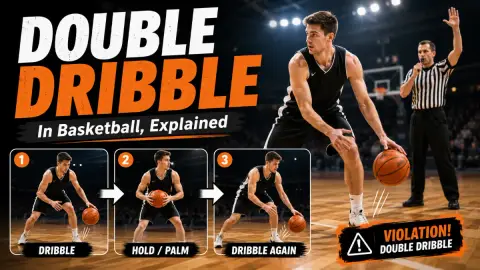
A double dribble is a violation: dribbling with two hands at once, or picking the ball up and then dribbling again. It costs your team possession. Here's exactly what counts.