
Hockey Referee Signals Explained: Every Penalty Arm Signal
On this page7
- 01Why Referees Use Arm Signals Instead of Announcements
- 02The Official Penalty Signals Table
- 03Minor Penalty Signals: Hooking, Tripping, Slashing, and Holding
- 04Contact Penalty Signals: Cross-Checking and High-Sticking
- 05Interference and Roughing: The “Extra Contact” Calls
- 06Procedural Signals: Delayed Penalty, Icing, and Goal
- 07How to Read Signals Like a Broadcast Analyst
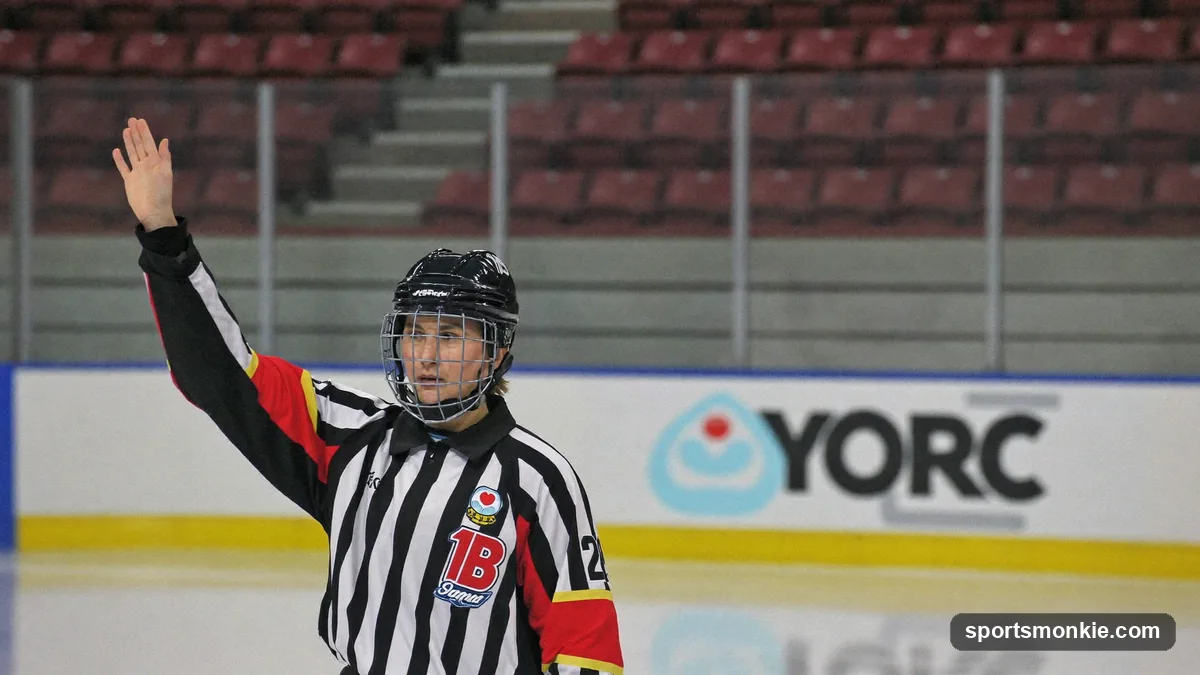
Hockey referee signals are the standardized arm and hand gestures officials use to call penalties and stoppages without a word — a tugging motion means hooking, a chop below the knee means tripping, and a direct point at the net confirms a goal. Because every rink from a youth rec league to the NHL uses the same rulebook signals, learning this visual language lets any fan read a game in real time, right down to which player is headed to the box and why.
Referees rely on signals instead of announcements because whistles and crowd noise make verbal calls unreliable, and a raised arm is visible from every seat in the arena. This guide breaks down the arm signal for every common penalty, plus the procedural calls — delayed penalty, icing, and goal — that shape the flow of a game.
Why Referees Use Arm Signals Instead of Announcements
In ice hockey, the referee and two linesmen work the ice together, but only the referee calls penalties. Since the PA announcer only relays a call after the whistle, players, coaches, and the penalty box need an immediate visual cue the moment play stops. The rulebook standardizes these gestures so a hooking call looks the same in an NHL playoff game or a high school matchup, which is why understanding Ice Hockey (NHL) officiating conventions makes every broadcast easier to follow.
Signals also protect the flow of play. A delayed penalty lets the non-offending team keep possession and even score before the whistle, something a shouted call could never accomplish cleanly. This signal-first approach is common across officiated sports — compare it with soccer referee signals or volleyball referee signals, and the “show, don’t just say” logic holds up everywhere.
The Official Penalty Signals Table
The table below covers the arm signal, exact gesture, and rule meaning for the most common penalties called in ice hockey, based on the official USA Hockey and NCAA signal charts.
| Signal | Gesture | Meaning |
|---|---|---|
| Hooking | Both fists make a tugging or pulling motion in front of the stomach | Using the stick blade to hook and impede an opponent’s body or stick |
| Tripping | One hand chops or sweeps against the side of the leg, below the knee | Using a stick, leg, knee, arm, hand, or foot to cause an opponent to fall |
| Slashing | The edge of one hand chops across the top of the opposite forearm | Swinging the stick at an opponent, whether or not contact is made |
| Cross-checking | Both fists, closed, thrust forward from the chest | Checking an opponent with the shaft of the stick held in both hands, no blade on the ice |
| High-sticking | One arm raised straight above the head | Carrying the stick above the normal height of an opponent’s shoulders |
| Holding | One hand clasps the opposite wrist in front of the chest | Using the hands, arms, or legs to hold or restrain an opponent or their stick |
| Interference | Both arms crossed at the wrists in front of the chest | Impeding or checking a player who does not have the puck |
| Roughing | One fist punches forward, extended out from the side of the body | A minor act of extra physical contact or retaliation after the whistle |
| Delayed penalty | One arm raised straight up above the head, held until the whistle | A penalty has occurred, but the whistle is delayed while the non-offending team has possession |
| Icing | Both arms extended straight out to the sides at shoulder height | The puck was shot the length of the ice without being touched, stopping play for a face-off |
| Goal | One arm points directly into the net | The puck fully crossed the goal line as a legal score |
Referees perform each signal facing the penalty box side of the ice so the timekeeper and scorer’s table can log the call immediately, which keeps the penalty clock accurate to the second.
Minor Penalty Signals: Hooking, Tripping, Slashing, and Holding
These four calls make up the bulk of penalties in any given game, and each has a deliberately distinct motion so officials — and fans — never confuse them.
- Hooking uses a pulling motion because the infraction itself is a pull: the stick blade catches an opponent and drags them off their path.
- Tripping is signaled low, near the knee, mirroring exactly where the stick or leg made contact to cause the fall.
- Slashing is a sharp chop, visually matching the swinging stick motion that caused the penalty.
- Holding clasps the wrist, a direct visual echo of a player grabbing an opponent’s arm or jersey.
Each of these is a minor penalty worth two minutes in the box, and the offending player skates directly to the penalty box once the referee completes the signal and the whistle has already blown.
Contact Penalty Signals: Cross-Checking and High-Sticking
Cross-checking and high-sticking both involve the stick making contact above the ice surface, which is why their signals are performed higher on the body than hooking or tripping.
Cross-checking’s double-fist thrust recreates the stick shaft jamming into an opponent’s back or chest. High-sticking’s raised arm marks where it happened: contact above the shoulders, intentional or not. Both can be upgraded to a major or match penalty if the contact was reckless or caused injury, which changes the penalty length but not the arm signal itself.
Interference and Roughing: The “Extra Contact” Calls
Interference and roughing cover contact away from a clean, puck-focused battle. Interference’s crossed-arm X signals a player being blocked or checked without possession of the puck — a classic pick-play call. Roughing’s punching-motion signal covers shoves, extra hits after the whistle, or retaliation that falls short of a fighting major.
Both are judgment calls more than others on this list, since there’s no stick contact to point to — the referee is reading body positioning and puck possession in real time.
Procedural Signals: Delayed Penalty, Icing, and Goal
Not every signal marks an infraction. Three of the most important gestures in hockey govern the flow of the game itself:
- Delayed penalty — the referee’s arm stays raised the moment they spot a penalty, but the whistle doesn’t blow until the offending team touches the puck, gains clear possession, or the play results in a goal. This gives the non-offending team a scoring chance before the stoppage.
- Icing — called by the linesman, not the referee, when a team shoots the puck from behind the center red line all the way past the opponent’s goal line without a stop, and no opposing skater could reasonably play it first. The linesman’s T-shaped arm extension marks the face-off spot for the restart.
- Goal — the simplest and most decisive signal in hockey: a direct point at the net confirms the puck fully crossed the goal line before time expired, with no prior stoppage or offside washing out the score.
Fans watching for these three signals specifically can follow the rhythm of a game — power plays building, dangerous icing situations, and goal celebrations — even with the sound off.
How to Read Signals Like a Broadcast Analyst
Once you can identify the eleven signals above on sight, watching a broadcast changes completely. You’ll see the delayed penalty arm go up before commentators call it, spot an interference no-call the crowd is booing, and understand why a power play is starting before the graphic appears.
For a side-by-side comparison of how officials across other sports use similar visual shorthand, see the full breakdown of referee hand signals by sport, which maps hockey’s system against basketball, football, and more.
Frequently asked questions
What are hockey referee signals?+
Hockey referee signals are standardized arm and hand gestures that officials use to communicate penalty calls, stoppages, and goals to players, benches, and fans without needing to shout over crowd noise. Every signal is defined in the official rulebook, so a hooking call in an NHL game looks identical to one in a youth league.
What is the referee signal for hooking?+
Hooking is signaled with a tugging or pulling motion made with both fists in front of the body, as if the referee is pulling an invisible object toward their stomach. It mimics the motion of a stick blade dragging or pulling at an opponent.
What is the signal for tripping in hockey?+
Tripping is signaled by a sweeping or chopping motion with one hand against the side of the leg, below the knee, on the side opposite the whistle hand. The referee keeps their head up and both skates on the ice while making the call.
How does a referee signal slashing?+
Slashing is signaled with a chopping motion, using the edge of one open hand to strike across the top of the opposite forearm, mimicking a stick chopping down on an opponent's arm or hands.
What does the delayed penalty signal look like?+
A delayed penalty is signaled by the referee raising one arm straight up above the head, using the hand not holding the whistle. The arm stays raised until the offending team touches the puck or the non-offending team scores.
How does a referee signal icing?+
The linesman signals icing by blowing the whistle, skating to the nearest face-off dot, and extending both arms straight out to the sides at shoulder height, forming a T shape, to stop play for the ensuing face-off.
What is the referee signal for a goal?+
A goal is signaled by the referee pointing directly at the net with one arm while blowing the whistle, confirming the puck fully crossed the goal line before time expired and no infraction occurred.
Are hockey referee signals the same in the NHL, NCAA, and youth leagues?+
Yes. The NHL, USA Hockey, Hockey Canada, and the IIHF all use the same core set of arm signals for standard penalties like hooking, tripping, slashing, and holding, which is why fans can follow officiating calls across any level of organized hockey.
Sources
Play & tools
Free browser games and tools — no account, no download.
- Play 98-0 — Draft a 12-player all-time NHL roster and chase a perfect 98-0 — 82 regular-season wins plus a swept Cup.
- Explore all our games →
Related ice hockey guides
View all →
Volleyball Referee Signals: Every Official Hand Signal Explained
Volleyball referee signals explained: point, ball in/out, four hits, double contact, net touch, foot fault, ball touched, delay, substitution, and end of set.
Football Referee Signals: The Complete NFL Hand Signal Chart
Football referee signals explained: touchdown, first down, holding, false start, pass interference, and every hand signal NFL officials use on the field.
Referee Hand Signals Explained: Every Major Sport's System
Referee hand signals let officials call fouls, scores, and timing decisions silently. See how NFL, NBA, MLB, NHL, and soccer signals compare.
Basketball Referee Signals: The Complete Guide to Every Hand Signal
Basketball referee signals explained: scoring, traveling, double dribble, blocking, charging, holding, shot-clock violations, and technical fouls.
What Is Backchecking in Hockey? Meaning, Purpose & Technique Explained
Backchecking in hockey is when a player skates hard back to their own zone to defend after losing the puck. Learn the rules, technique, and why it matters.
Umpire vs Referee: What's the Difference Across Sports?
Umpires and referees both enforce rules, but the title depends on the sport. Referees officiate football, basketball and boxing; umpires cover cricket.