
Hockey Positions Explained: Every Role
On this page6
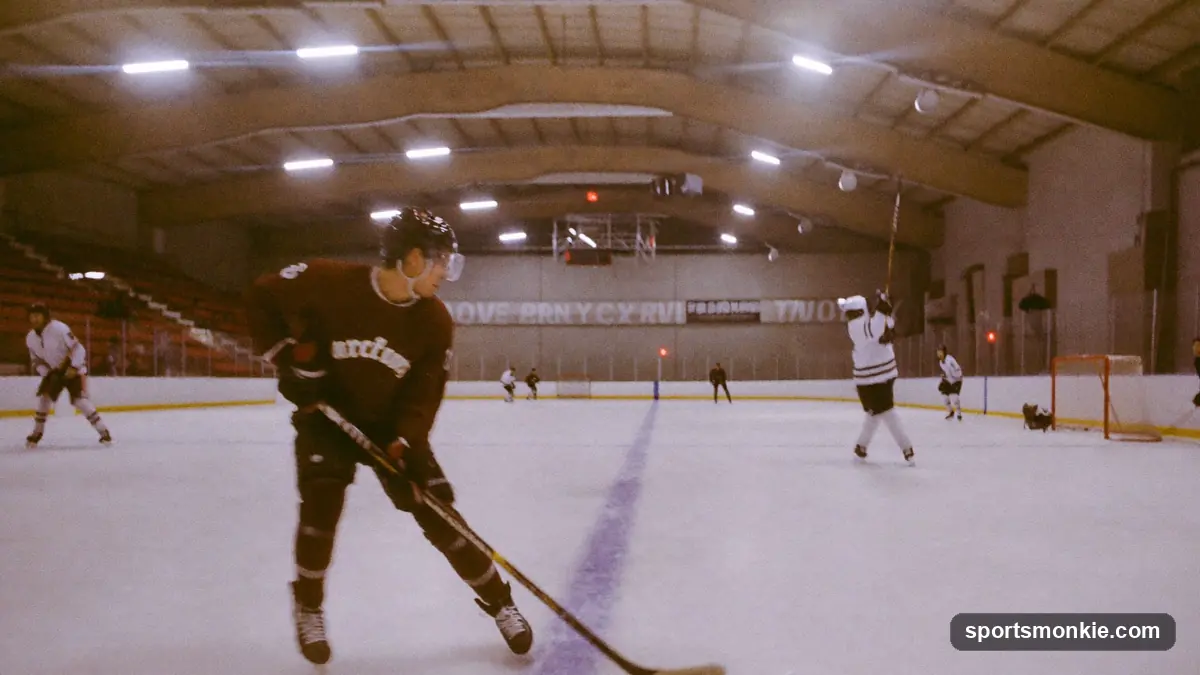
Ice hockey is played with six players per team on the ice at once: three forwards (a center, a left wing and a right wing), two defensemen, and a goaltender. The forwards do most of the attacking and scoring, the defensemen guard their own end and launch the attack, and the goaltender stops shots, with each role blending offense and defense as the play flows up and down the rink.
Unlike some sports, hockey players do not stay glued to a spot. Positions describe responsibilities and starting lanes, but everyone skates all over the ice as possession changes. Here is what each role actually does, governed by the standard rules used by the NHL and the IIHF.
The three forwards
Forwards are the attacking unit and usually the top scorers. They work as a three-player “line” that changes together, and a team rolls several lines through a game to keep fresh legs out there.
- Center (C): the hub of the line. The center covers the most ice, takes faceoffs, supports both the attack and the defense, and is often the best all-round skater and playmaker on the line.
- Left wing (LW): works mainly up the left side, drives to the net, forechecks the puck and covers the opposing defenseman on that flank.
- Right wing (RW): the mirror image on the right side, with the same forechecking and net-front duties.
The defensive unit
Behind the forwards sit two defensemen who play as a “pairing.” Their first job is protecting their own zone, but modern defensemen also start and often join the attack.
- Left defense (LD) and right defense (RD): they hold the blue line on offense, break up rushes, block shots, and move the puck out of danger. A good defenseman reads the play early and rarely gets caught out of position, because a mistake back there can turn into a scoring chance the other way.
The two forward and defensive groups work in tandem. When you understand who is responsible for the blue line, rules like icing in hockey and situations like a power play in hockey make far more sense. The rink markings behind those responsibilities are mapped in our hockey rink dimensions guide.
The goaltender
The goaltender (G), or goalie, is the last line of defense and, many argue, the hardest position in the sport. Wearing specialized padding, the goalie stops shots, controls rebounds and directs teammates in front of the net. Teams almost never change goalies mid-play, so the position carries a unique, constant pressure that skaters do not face.
Positions at a glance
| Position | Abbrev. | Main job |
|---|---|---|
| Center | C | Faceoffs, playmaking, cover both ends |
| Left wing | LW | Attack the left side, forecheck, net front |
| Right wing | RW | Attack the right side, forecheck, net front |
| Left defense | LD | Guard the blue line, break up rushes |
| Right defense | RD | Guard the blue line, block shots |
| Goaltender | G | Stop shots, control rebounds |
Lines, pairings and shifts
Because hockey is played at a sprint, no one stays on the ice for long. Teams organize forwards into lines of three and defensemen into pairings of two, then rotate them in short “shifts” of roughly 45 seconds. This is why a roster carries around a dozen forwards and half a dozen defensemen even though only six players skate at a time.
Coaches match lines to situations: a scoring line against weaker opponents, a checking line to shut down stars, and specialist units for power plays and penalty kills. Understanding positions is the first step to reading those tactics.
How it differs from field hockey
If you have arrived from the field game, note that the position names overlap but the roles differ, and the rink is much smaller and faster than a field. Our guide to field hockey positions lays out that version side by side. And if you want to see these ice-hockey roles played at the highest level, our list of the greatest NHL players shows how the best centers, wingers, defensemen and goalies defined the sport.
The short version: six players, three jobs. Forwards attack, defensemen protect and spring the attack, and the goaltender guards the net, while F, D and G on a lineup are just shorthand for those three groups.
New to the sport? Get up to speed with our hockey terminology glossary, the main types of shots in hockey and the rink layout players use in every shift in hockey rink dimensions.
For the wider context, we break down What Is Icing in Hockey? separately.
Frequently asked questions
What's the hardest position to play in hockey?+
Most players and coaches point to goaltender, because a goalie faces hard, screened shots alone with the game often riding on a single save, and the mental pressure is constant. Center is often called the hardest skater position, since a center covers the most ice, takes faceoffs, and has to think in both offense and defense. Both demand a rare mix of skill, reading of the play and composure.
Where do you put your weakest player in hockey?+
At youth levels, coaches often place a developing player at wing, frequently right wing, because a winger's job is more contained: stay in a lane, support the puck and cover one defenseman. That keeps their mistakes lower-risk than center, which roams everywhere, or defense, where an error can lead directly to a breakaway. The goal is to build confidence in a simpler role first.
Was Wayne Gretzky known for hockey intelligence?+
Yes. Wayne Gretzky was never the biggest or fastest player, but he is widely regarded as the most intelligent to play the game, famous for anticipating where the puck was going rather than where it was. That 'hockey sense', reading plays a step ahead and setting up behind the net in his so-called office, is why he holds the NHL's major scoring records and earned the nickname 'The Great One'.
What is an F in hockey?+
On a lineup card or stat sheet, F stands for forward, the grouping of the three attacking positions: center (C), left wing (LW) and right wing (RW). D stands for defense and G for goaltender. So a roster that lists a player as 'F' simply means they play one of the forward positions rather than defense or in goal.
Sources
Play & tools
Free browser games and tools — no account, no download.
- Play 98-0 — Draft a 12-player all-time NHL roster and chase a perfect 98-0 — 82 regular-season wins plus a swept Cup.
- Explore all our games →
Related ice hockey guides
View all →
What Is a Faceoff in Hockey?
A faceoff starts and restarts play in hockey: an official drops the puck between two opposing players at one of nine faceoff dots, and they battle to win possession.
What Is a Penalty Kill in Hockey?
A penalty kill is when a short-handed team defends against the opponent's power play after taking a penalty, trying to survive the two minutes without conceding.
What Is a Shootout in Hockey?
A hockey shootout decides a tied NHL regular-season game after overtime: teams alternate penalty-shot attempts, best of three, then sudden death, for one standings point.
What Is Offside in Hockey?
Offside in hockey means an attacking player crosses the offensive blue line ahead of the puck. Play stops and a faceoff is held outside the zone.
NHL Pulls 'Hot for Hockey' Romance Audio Series From Spotify Less Than a Week After Launch
The NHL has removed its 'Hot for Hockey' romance-style audio stories from Spotify and will make no more, less than a week after launching the series.
First Saturday Without Hockey Night in Canada on CBC Since 1952 Leaves Fans Fuming
Sportsnet's Saturday Night Hockey debuted on October 3 as CBC aired no NHL game on a Saturday for the first time since 1952, and fans refused the new name.