
Hockey Rink Dimensions: NHL, IIHF and Youth Sizes
On this page13
- 01Hockey rink dimensions at a glance
- 02Hockey rink fit calculator
- 03NHL rink dimensions
- 04IIHF and Olympic rink dimensions
- 05Is Olympic ice different from NHL ice?
- 06Lines, zones and faceoff dots
- 07Goal line, crease and space behind the net
- 08Boards, glass, benches and penalty boxes
- 09Youth and local rink sizes
- 10Hockey rink size vs other sports courts
- 11What most rink guides miss
- 12Quick rink setup checklist
- 13Bottom line
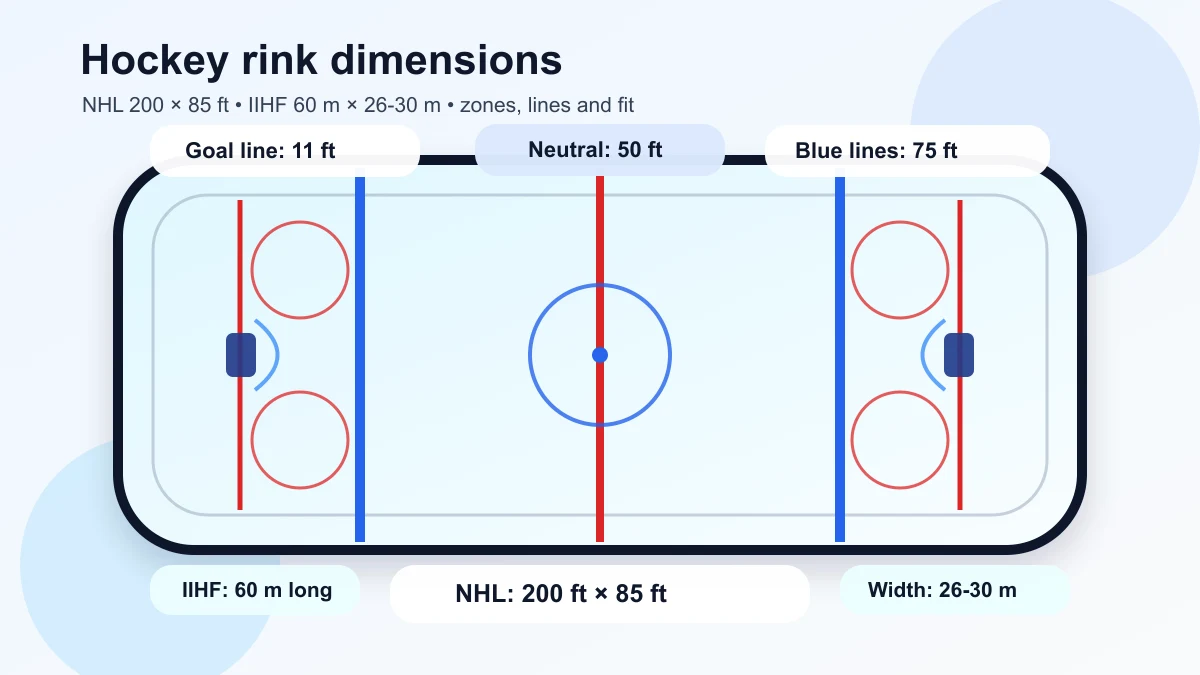
An NHL hockey rink is 200 feet long by 85 feet wide. International ice under current IIHF guidance is 60 metres long and between 26 and 30 metres wide, which works out to about 197 feet long and about 85 to 98 feet wide.
That sounds simple until you try to compare NHL, Olympic, youth and local rink layouts. The playing surface is only one layer. Blue lines, goal lines, corner radius, boards, glass, benches and run-off space all change how the rink feels. Use the quick tables and calculator below to compare the numbers before you plan a backyard sheet, a training surface or a full facility.
Hockey rink dimensions at a glance
| Rink type | Length | Width | Best use |
|---|---|---|---|
| NHL and standard North American pro rink | 200 ft | 85 ft | NHL, many AHL, college and arena rinks |
| IIHF rink range | 60 m, about 197 ft | 26 to 30 m, about 85 to 98 ft | International competitions under IIHF guidance |
| Traditional wide international sheet | 60 m, about 197 ft | 30 m, about 98 ft | Older “Olympic-size” shorthand and many European venues |
| NHL neutral zone | 50 ft | rink width | Space between the two blue lines |
| NHL goal line setback | 11 ft | rink width | Space from end boards to goal line |
| Youth cross-ice layout | varies | one third of rink width | Young-player development and small-area games |
If someone says “Olympic rink size,” ask which event and rulebook they mean. The old shortcut was 200 by 100 feet, or close to 60 by 30 metres. Current IIHF material uses a 60-metre length and a 26-to-30-metre width range, and Olympic venues can have their own confirmed layouts.
Hockey rink fit calculator
Enter the ice or slab space you have. This checker compares it with common hockey-rink targets.
This calculator checks only the ice sheet. A real rink also needs boards, glass, gates, benches, penalty boxes, scorekeeper space, safe circulation and mechanical systems. For a backyard rink, those extras may be simple snow banks and walking room. For a public facility, they become a major part of the footprint.
NHL rink dimensions
The NHL rink is the cleanest answer for most North American fans: 200 feet long and 85 feet wide.
The modern NHL layout also uses these important distances:
| NHL rink marking | Measurement | Why it matters |
|---|---|---|
| Goal line from end boards | 11 ft | Creates the space behind each net |
| Blue line from end boards | 75 ft | Defines each attacking zone boundary |
| Neutral zone length | 50 ft | Space between the two blue lines |
| Blue line width | 12 in | The line itself affects offside position |
| Corner radius | about 28 ft | Shapes puck rims, battles and retrievals |
The goal line location is not trivia. That 11-foot strip behind the net is where wraparounds, rimmed pucks and goalie puck-handling decisions happen. It also explains why the trapezoid exists in NHL play: the league wanted to limit where goalies could handle the puck behind the net after the 2005 rule package changed the flow of the game.
The blue lines are just as important. They divide the rink into two attacking zones and one neutral zone, which is why offside in hockey depends on whether the puck and skaters have legally crossed a blue line.
IIHF and Olympic rink dimensions
The IIHF rules page says the latest rulebook published on the IIHF site is the version to use. In IIHF Olympic explainer material, the rink is described as 60 metres long and between 26 and 30 metres wide.
That range matters because it corrects an old oversimplification. A lot of fan guides say Olympic ice is 200 by 100 feet. That was a useful shorthand for the wide international sheet many fans remember, but it is not a safe universal answer anymore.
For U.S. readers, the rough conversions are:
| IIHF measurement | Feet |
|---|---|
| 60 m length | 196 ft 10 in |
| 26 m width | 85 ft 4 in |
| 30 m width | 98 ft 5 in |
The practical effect is space. Wider ice opens passing lanes and gives attackers a little more room to delay, turn back or change the angle. A narrower NHL rink compresses decisions along the boards and makes forechecking pressure arrive faster.
Is Olympic ice different from NHL ice?
Sometimes, but not always in the way people expect.
The best answer is: Olympic hockey follows the event’s confirmed venue and IIHF competition requirements, not a fan-memory number. NHL.com noted during the Milano Cortina 2026 build-up that the Olympic rink under discussion was not a standard NHL rink and was closer to 197 feet long. IIHF material also uses the 60-metre length and 26-to-30-metre width range.
So if you are comparing Olympic and NHL ice:
- NHL rink: 200 by 85 feet.
- IIHF range: about 197 feet long and about 85 to 98 feet wide.
- Traditional wide international shorthand: about 200 by 100 feet, but check the event.
For current games, the event source should win over generic old charts.
Lines, zones and faceoff dots
A hockey rink is more than a rectangle. The markings tell players where rules start and stop.
| Marking | Basic role |
|---|---|
| Center red line | Splits the rink in half and helps determine icing context |
| Blue lines | Separate the neutral zone from the attacking zones |
| Goal lines | The puck must fully cross this line between the posts for a goal |
| Faceoff dots | Restart locations after stoppages |
| Faceoff circles | Control player positioning around faceoffs |
| Crease | Protected goaltender area in front of each net |
This is why rink dimensions and rules are inseparable. Icing in hockey depends on the red line and far goal line. Offside depends on the blue line. A disputed rebound around the net often turns on what the crease means in hockey.
If you are new to the sport, the quickest way to read the rink is to start at center and move outward: red line, blue line, faceoff dots, goal line, crease.
Goal line, crease and space behind the net
The goal line is the line that matters for scoring. The puck must completely cross it between the goal posts and under the crossbar. In the NHL, that line sits 11 feet from the end boards.
That creates one of hockey’s strangest little theaters: the area behind the net. Players use it to shield the puck, start a cycle, pass to the slot, attempt a wraparound or buy time while teammates change. Goaltenders can also play the puck there, though the NHL trapezoid restricts where they can do it.
The crease sits in front of the goal line. It is not a scoring line. It is the goalie-protection area, and its details matter most when there is contact or traffic in front. Our full hockey crease guide covers that separately.
Boards, glass, benches and penalty boxes
Rink size questions usually focus on the ice, but players experience the boards almost as much as the lines.
Boards surround the playing surface and keep the puck in play. Glass above the boards protects spectators while letting fans see through. Bench gates, penalty-box doors and timekeeper areas interrupt that wall, so facility layout has to handle player movement safely.
For a backyard rink, the same idea applies at a smaller scale. Do not plan only the frozen rectangle. Leave room to step on and off the ice, shovel snow, manage a liner, store a hose, and keep players away from fences, trees, patios or concrete edges.
Youth and local rink sizes
Youth hockey does not always need a full 200-by-85-foot surface. Many programs use station work, half-ice games or cross-ice games for younger players because small-area play gives kids more puck touches and less empty skating.
That does not change the official rink dimensions used at older levels. It changes how the available ice is divided for development.
For parents and coaches, the useful question is not “is this rink regulation?” It is “does this format fit the age group and the drill?” A cross-ice game can be better for beginners than sending five- and six-year-olds across an entire NHL-size rink where the puck disappears into open space.
Hockey rink size vs other sports courts
Hockey rinks are much larger than most indoor court sports, but smaller than field sports.
| Sport surface | Main playing size |
|---|---|
| NHL hockey rink | 200 ft x 85 ft |
| IIHF wide rink | about 197 ft x 98 ft |
| Box lacrosse floor | often hockey-rink-sized |
| Basketball court | 94 ft x 50 ft in the NBA |
| Volleyball court | 59 ft x 29 ft 6 in |
| Pickleball court | 44 ft x 20 ft |
| Tennis doubles court | 78 ft x 36 ft painted lines |
This is why indoor multi-sport buildings often use a hockey rink footprint as a planning anchor. Once you can fit boards, ice, seating and service areas, smaller court sports are easier to arrange. The reverse is not true: a gym built only around basketball or volleyball usually cannot become a full ice rink without a major redesign.
What most rink guides miss
Most rink guides give a correct headline number, then stop too early.
The gaps that matter are:
- NHL and IIHF dimensions are not the same question.
- “Olympic size” can be outdated shorthand if you do not verify the event.
- The blue lines, goal line and neutral zone explain the rules fans are actually trying to understand.
- Youth formats can use smaller playing areas without changing official adult rink dimensions.
- The ice sheet is not the full facility footprint.
That last point is the big one for builders. A 200-by-85-foot rectangle may answer a trivia question, but it does not tell you whether a rink can operate safely.
Quick rink setup checklist
Before you plan or compare a rink, confirm:
- The rule set: NHL, IIHF, USA Hockey, school, recreational or private.
- The playing-surface target: full rink, half rink, cross-ice or training pad.
- The width assumption: North American 85 feet, IIHF minimum-width, or wider international sheet.
- The line package: goal lines, blue lines, red line, faceoff dots and crease.
- The boundary system: boards, glass, gates and safe edge protection.
- The player areas: benches, penalty boxes and scorekeeper space.
- The support space: resurfacing, snow removal, storage, access and spectator circulation.
For a home rink, this checklist keeps the project honest. For a public rink, it tells you why official dimensions are only the first page of the design brief.
Bottom line
An NHL rink is 200 by 85 feet. IIHF international ice is currently described as 60 metres long and 26 to 30 metres wide. Olympic rinks should be checked by event, not by an old one-size-fits-all “Olympic size” answer.
If you are watching hockey, the most useful dimensions are the blue lines, goal line, neutral zone and crease because those markings explain offside, icing, rebounds and goalie interference. If you are building or planning a rink, start with the official ice sheet, then add the space that makes the rink usable: boards, glass, benches, access and safety room. For the language around those markings, keep the hockey terminology glossary handy.
Frequently asked questions
What are official NHL rink dimensions?+
An NHL rink is 200 feet long by 85 feet wide. That is the standard North American pro rink size used by NHL arenas.
How big is an IIHF hockey rink?+
Current IIHF guidance describes the rink as 60 metres long and between 26 and 30 metres wide. That is about 197 feet long, with a width range of about 85 to 98 feet.
Is Olympic hockey played on a wider rink?+
Not always. International ice has often been associated with a wider 60-by-30-metre sheet, but current IIHF guidance allows a 26-to-30-metre width range, and Olympic venue layouts can vary by event.
How far are the blue lines on an NHL rink?+
In the modern NHL layout, each blue line is 75 feet from the end boards, leaving a 50-foot neutral zone between the two blue lines.
How far is the goal line from the end boards in hockey?+
In the NHL, the goal line is 11 feet from the end boards. That space behind the net matters for wraparounds, puck retrieval and goalie puck-handling rules.
Are youth hockey rinks always regulation size?+
No. Many youth programs use standard local rinks when available, but younger age groups can play cross-ice or half-ice formats for development and scheduling.
How much space do you need for a hockey rink?+
For regulation NHL-style lines, plan around the 200-by-85-foot ice sheet first, then add boards, glass, benches, penalty boxes, aisles, mechanical space and safety access. A full facility footprint is much larger than the playing surface.
Sources
Play & tools
Free browser games and tools — no account, no download.
- Play 98-0 — Draft a 12-player all-time NHL roster and chase a perfect 98-0 — 82 regular-season wins plus a swept Cup.
- Explore all our games →
Related ice hockey guides
View all →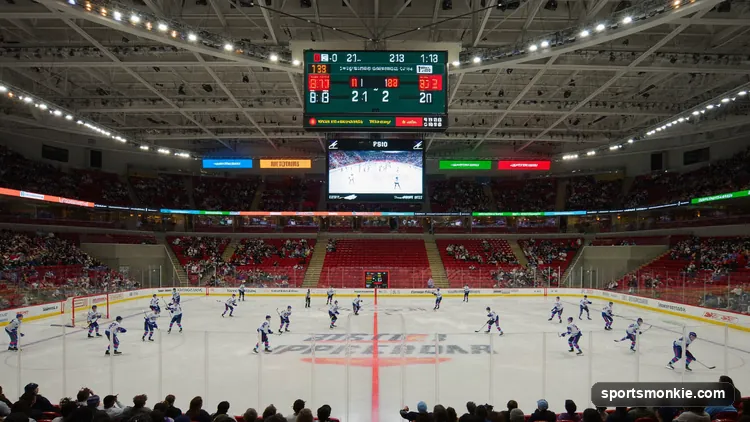
How Many Periods Are in a Hockey Game? NHL Rules Explained
How many periods are in a hockey game: three 20-minute periods, how long intermissions last, and how NHL overtime and shootouts settle ties.
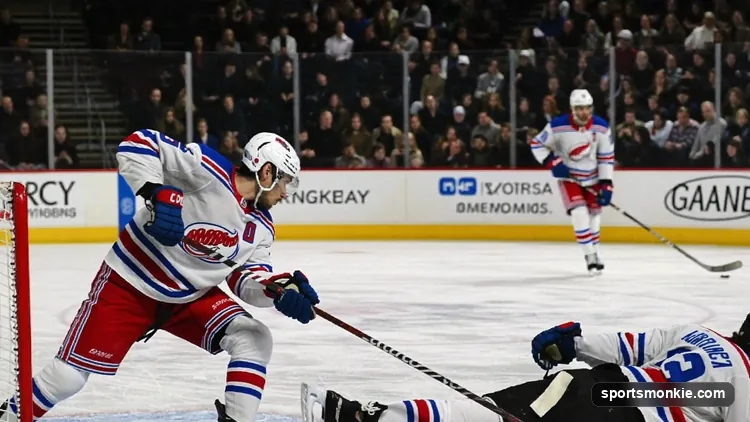
What Is Cross-Checking in Hockey? NHL Rule Explained
Cross-checking in hockey is using the stick shaft with both hands to shove an opponent; learn the NHL rule, penalties, and how it differs from slashing.
NHL Pulls 'Hot for Hockey' Romance Audio Series From Spotify Less Than a Week After Launch
The NHL has removed its 'Hot for Hockey' romance-style audio stories from Spotify and will make no more, less than a week after launching the series.
Hockey Terminology Glossary: 60+ NHL Terms Explained
A complete hockey terminology glossary covering NHL rules, positions, penalties, and slang terms every fan needs to know.
Types of Shots in Ice Hockey: Every Shot Explained
The main types of shots in ice hockey are the wrist shot, slap shot, snap shot, backhand, one-timer, wraparound, and deflection. Full breakdown here.
What Is a Deke in Hockey? Meaning, Types, and Examples
A deke in hockey is a fake move used to skate past a defender or goalie. Learn the term's origin, the main types of dekes, and how they're used.