
What Is the Crease in Hockey? Rules, Size, and Goalie Interference
On this page6
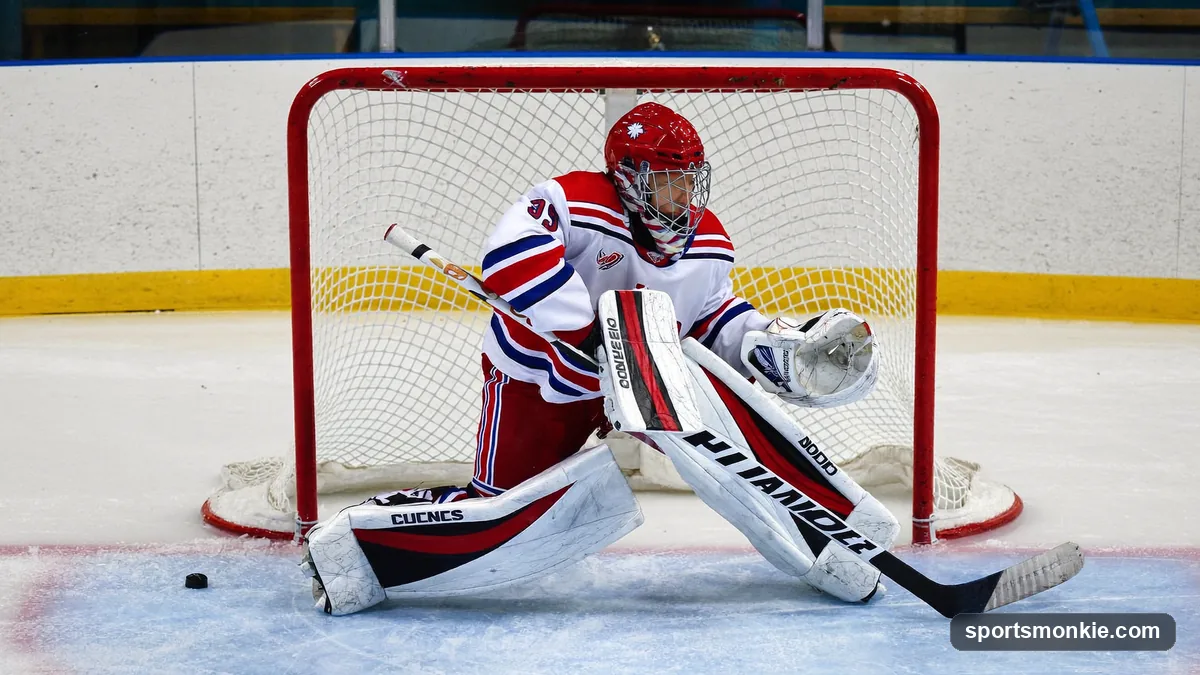
The crease in hockey is the semicircular blue zone with a red border painted directly in front of each net, and it’s reserved for the goaltender’s protection. Opposing skaters can chase a loose puck through it, but they can’t set up camp there or make contact with the goalie without risking a disallowed goal. Understanding the crease is really understanding how the NHL balances two competing goals: letting attackers crash the net for rebounds while giving goaltenders enough clear space to actually do their job.
Where the crease sits and how big it is
The crease is painted directly on the ice in front of each goal, straddling the goal line so that roughly half of it sits in front of the net and half wraps slightly behind the goal line itself. Under the current NHL rulebook, it measures 8 feet wide, 4 feet on either side of the goal posts, and extends 4.5 feet out from the goal line toward center ice. The boundary is a 2-inch-wide red line, with the interior painted light blue.
That size isn’t accidental history. The league has adjusted crease dimensions more than once, most notably widening it briefly in the early 1990s before settling back closer to its current shape by mid-decade, always chasing the same balance: give the goalie room to move laterally and drop into a butterfly without shrinking it so much that traffic in front becomes a free-for-all.
| Dimension | Measurement |
|---|---|
| Width | 8 feet (4 feet each side of the posts) |
| Depth from goal line | 4.5 feet |
| Border | 2-inch red line |
| Interior color | Light blue |
Who is actually allowed to be in the crease
The goaltender can occupy the crease at all times, that’s the entire point of it. For everyone else, the rule is simpler than most fans assume: an attacking player may enter the crease to play a loose puck or one that’s already crossed the goal line, and a defending skater can help clear the puck or protect the goalie without covering it with a hand or body. What nobody is allowed to do is stand in the blue paint without the puck being live there, or use the crease as a screen to block the goaltender’s sightlines and movement.
This is a different standard from the sport’s early decades, when officials watched skate placement almost like a tripwire. Today the question officials ask is whether a player’s presence or contact actually impaired the goalie, not whether a toe grazed the paint.
Goaltender interference: the rule that actually decides most crease disputes
Most controversy around the crease isn’t about the box on the ice, it’s about Rule 69, Interference on the Goalkeeper. A goal gets disallowed when an attacking player, through positioning or contact, impairs the goaltender’s ability to move freely in the crease or defend the net, or when a player initiates intentional or deliberate contact with the goalie anywhere on the ice, inside the crease or out. Incidental contact outside the crease is permitted, provided the attacker made a reasonable effort to avoid it.
That “reasonable effort” language is doing a lot of work, and it’s why goaltender interference reviews remain one of the most argued calls in the sport. A player shoved into the goalie by a defender gets more benefit of the doubt than one who skates straight through the blue paint on his own. The league dropped the old automatic rule, where any attacking skate touching the crease before a puck crossed the line wiped out the goal regardless of contact, after the 1999 Stanley Cup Final controversy involving a Brett Hull overtime winner scored with his skate in the crease. Officials now judge actual impact on the goalie, not foot geometry.
How crease rules connect to the rest of a hockey game
Crease violations rarely happen in isolation. They usually show up during net-front scrambles after a rebound, on power plays when a screen sets up in front of the goalie, or immediately after a shot when bodies are already crashing the blue paint chasing the puck. Officials reviewing a disputed goal under Rule 69 will often look at the same sequence that also determines whether an empty net goal in hockey should count, since both calls hinge on exactly what happened around the crease and goal line in the final seconds before the puck crosses.
The crease also matters across the length of a game, not just on individual plays. A goaltender defending the same net for an entire period, see how many periods are in a hockey game for the full structure, relies on crease protection staying consistent no matter how tired the defense in front of him gets late in a frame.
Crease rules outside the NHL
The crease concept is universal across hockey’s governing bodies, but the exact dimensions and interference standards vary. The IIHF, which governs international and Olympic play, uses broadly similar crease sizing and a comparable goaltender-protection principle, though its interference standard has historically leaned slightly more conservative toward disallowing contact goals than the NHL’s post-1999 approach. USA Hockey youth and amateur leagues generally mirror NHL crease dimensions but often apply stricter no-contact enforcement at lower levels, prioritizing goaltender safety over letting net-front battles play out.
Quick reference: crease dos and don’ts
| Situation | Allowed? |
|---|---|
| Attacker chasing a loose puck through the crease | Yes |
| Attacker standing in the crease without the puck, screening the goalie | No |
| Defender helping the goalie without covering the puck | Yes |
| Intentional contact with the goalie, inside or outside the crease | No |
| Incidental contact outside the crease with a reasonable effort to avoid it | Yes |
| Skate touching the crease line alone, with no goalie impairment | Yes (goal counts) |
The crease will keep generating replay reviews for as long as hockey is played in front of a net, simply because judging “impairment” in real time, at full speed, is inherently subjective. But the core idea hasn’t changed since the blue paint first went down: give the goaltender a protected island to work from, and let officials sort out the gray area when attackers push right up against its edge. For the full vocabulary around plays like this, see our complete hockey terminology glossary, and for the bigger picture of how the position and the game fit together, start at our NHL hub.
Frequently asked questions
What is the crease in hockey?+
The crease is the semicircular area painted in blue with a red outline directly in front of each goal, marking the goaltender's protected zone. It exists so the goalie has room to move, drop, and make saves without opposing skaters camping on top of him or crashing into him.
How big is the hockey crease?+
Under current NHL rules, the crease is 8 feet wide (4 feet on either side of the goal posts) and extends 4.5 feet out from the goal line, bordered by a 2-inch-wide red line. It has been this size since the mid-1990s, after a brief experiment with a wider, more rounded shape.
Can opposing players stand in the goalie's crease?+
Not without the puck. An attacking player can enter the crease to play a loose puck or one that's already crossed the goal line, but camping in the blue paint without the puck, or making contact with the goaltender there, exposes any resulting goal to being disallowed under Rule 69.
What is goaltender interference in hockey?+
Goaltender interference is called under NHL Rule 69 when an attacking player, through positioning or contact, impairs the goalie's ability to move freely in the crease or make a save, or when a player initiates intentional contact with the goalie anywhere on the ice. If a goal results, it's disallowed and the play is reviewable.
Can a goal be scored if a player is standing in the crease?+
Yes, as long as that player isn't interfering with the goaltender. The NHL scrapped the old blanket rule that automatically waved off any goal if an attacking skater's skate was in the crease when the puck went in. Today, officials judge whether real interference happened, not just foot placement.
Can a goalie leave the crease?+
Yes, goaltenders regularly play the puck behind the net or challenge shooters well outside the blue paint, especially to cut down shooting angles. Once outside the crease, a goalie loses some of the extra contact protection, though incidental contact with attacking players is still supposed to be avoidable, not deliberate.
Why is it called a crease?+
The name comes from the era before painted ice markings, when the goal area was carved or scraped into the surface, or marked off by a raised edge, leaving a visible crease in the ice. The term stuck even after rinks switched to painted lines.
Does the puck have to fully cross the crease line for icing?+
No, the crease has nothing to do with icing. Icing is about the puck crossing the far goal line untouched from the shooter's own half of the ice; the crease is purely a goaltender-protection zone tied to interference and rebound rules near the net.
Sources
Play & tools
Free browser games and tools — no account, no download.
- Play 98-0 — Draft a 12-player all-time NHL roster and chase a perfect 98-0 — 82 regular-season wins plus a swept Cup.
- Explore all our games →
Related ice hockey guides
View all →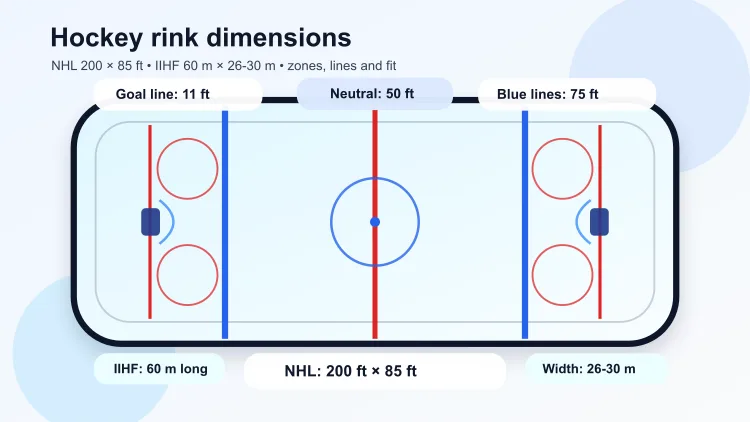
Hockey Rink Dimensions: NHL, IIHF and Youth Sizes
Official hockey rink dimensions for NHL, North American, IIHF and Olympic ice, with rink lines, zones, goal lines, boards and a fit calculator.
How Many Periods Are in a Hockey Game? NHL Rules Explained
How many periods are in a hockey game: three 20-minute periods, how long intermissions last, and how NHL overtime and shootouts settle ties.
Types of Shots in Ice Hockey: Every Shot Explained
The main types of shots in ice hockey are the wrist shot, slap shot, snap shot, backhand, one-timer, wraparound, and deflection. Full breakdown here.
What Is a Deke in Hockey? Meaning, Types, and Examples
A deke in hockey is a fake move used to skate past a defender or goalie. Learn the term's origin, the main types of dekes, and how they're used.
What Is a One-Timer in Hockey? Definition & How It Works
A one-timer in hockey is a shot fired directly off a teammate's pass with no puck control first. How it works, why it's hard to stop, and how to practice one.
What Is a Slap Shot in Hockey? Mechanics, Speed & Records
A slap shot in hockey is a full wind-up shot built for maximum puck speed. Learn the technique, how it compares to a wrist shot, and NHL speed records.