
What Is High Sticking in Hockey? The Rule Explained
On this page7
- 01The official rule: contact above the shoulders
- 02Minor penalty vs. double minor: how severity is decided
- 03The two exceptions: when a high stick isn’t a penalty
- 04The other high-stick rule: playing the puck too high
- 05High-stick goals: why they get waved off
- 06How high sticking fits into hockey’s stick-infraction family
- 07Quick reference: high sticking at a glance
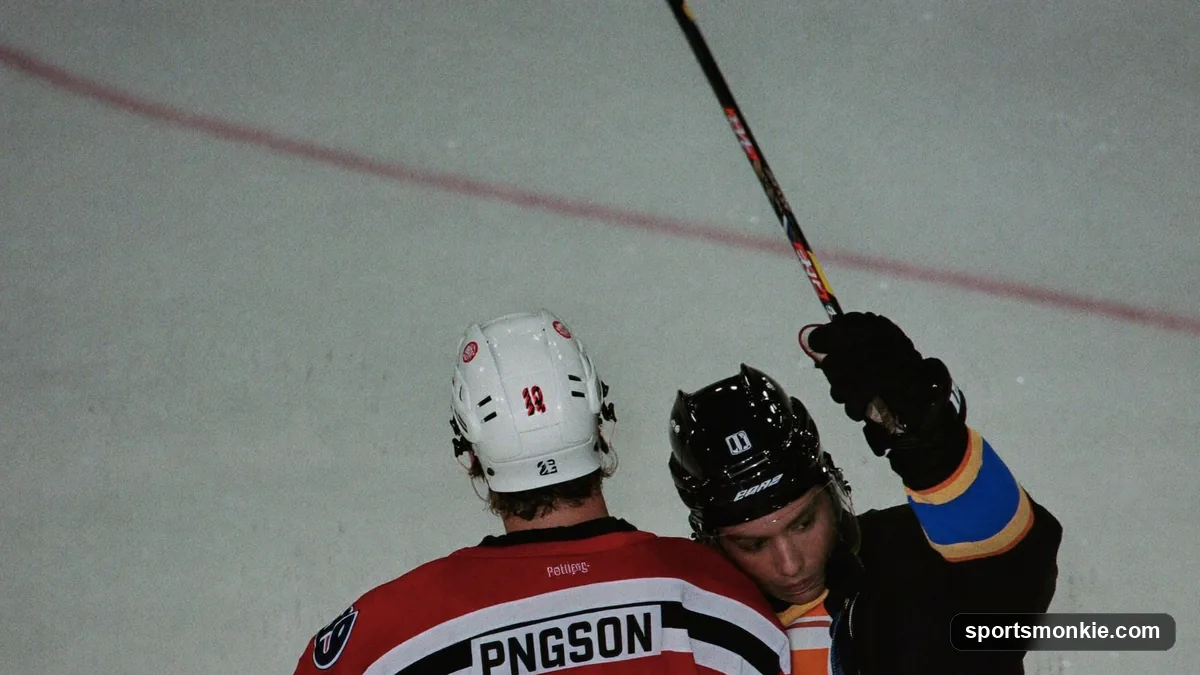
High sticking in hockey is when a player’s stick blade makes contact with an opponent above the shoulders. It’s one of the most frequently called penalties in the sport, precisely because a stick only has to ride a few inches too high during a battle for the puck to trigger it. The rule, and its stricter cousin for drawing blood, is worth knowing cold if you’re trying to follow a broadcast or make sense of a referee’s arm signal.
The official rule: contact above the shoulders
Under NHL Rule 60, a “high stick” is defined as one carried above the height of the opponent’s shoulders. The rule doesn’t care whether the stick was raised deliberately or came up by accident during a battle along the boards. If the blade or shaft strikes an opposing player above shoulder level, it’s a penalty, full stop, unless one of the two narrow exceptions below applies.
This is a contact-with-a-player rule, which puts it in the same broad family as a hit thrown with the stick rather than the body. It’s worth comparing directly to what cross-checking is in hockey, since both are stick infractions officials call constantly, but they’re judged on completely different criteria: cross-checking is about how the stick is used, a two-handed shove; high sticking is about where it lands.
Minor penalty vs. double minor: how severity is decided
Every high-sticking penalty starts as a two-minute minor. From there, the severity climbs based on what happens to the player who got hit:
| Outcome | Penalty | Time |
|---|---|---|
| Contact above shoulders, no injury | Minor | 2 minutes |
| Contact draws blood or causes visible injury | Double minor | 4 minutes |
| Referee judges contact deliberate, intent to injure | Match penalty | Ejection, remainder of game |
A double minor is served as two consecutive two-minute penalties. If the penalized team allows a power-play goal during the first two minutes, that block ends early and the team returns to full strength for the second two minutes, which must still be served in full. That’s the same clock structure used for other double-minor infractions like cross-checking when it draws blood.
Referees can request a video review specifically to confirm a high-sticking double minor, since the difference between “drew blood” and “no visible injury” directly changes how many minutes the offending team spends shorthanded.
The two exceptions: when a high stick isn’t a penalty
The rulebook carves out exactly two situations where contact above the shoulders is not penalized:
- Normal shooting motion. If a player’s stick comes up during the natural windup or follow-through of a shot and incidentally strikes an opponent, no penalty is called. This only covers a genuine shooting motion, though. A wild, uncontrolled swing at a bouncing or rolling puck does not qualify, and officials are instructed to penalize that kind of hack even if the player claims they were “just shooting.”
- Faceoff contact. Incidental contact with an opposing center who is bent over in the faceoff circle, waiting for the puck to drop, is also excused.
Outside those two scenarios, height is height. A stick that clips a player’s face or neck while battling for position along the boards draws the call the same as one that comes up during a slash.
The other high-stick rule: playing the puck too high
There’s a second, less punitive rule that trips people up because it shares the same name. If a player bats, redirects, or otherwise plays the puck with their stick blade above the shoulders and their own team ends up with possession, the referee stops play for a faceoff. No penalty is assessed in that case. It’s simply not allowed to control the puck with a stick that high, so the whistle resets the play.
If the puck deflects off a high stick and an opposing player touches it next, though, play continues uninterrupted. The stoppage only kicks in when the team that played it high keeps the puck.
High-stick goals: why they get waved off
A goal scored by a stick above the height of the crossbar doesn’t count, even if no opposing player was touched in the process. The Situation Room in Toronto reviews close calls specifically to check stick height at the moment of the redirect, since a few inches of blade height is often the entire question. One quirk worth knowing: if a player accidentally knocks the puck into their own net with a high stick, that goal does count against them, the “too high to score” protection only applies to the attacking team’s own net.
How high sticking fits into hockey’s stick-infraction family
High sticking is one entry in a broader group of penalties built around what a stick does rather than what the body does. For a full reference on where it sits alongside slashing, hooking, and the rest, the hockey terminology glossary breaks down every infraction and on-ice term in one place. And because most high-sticking penalties happen in tight spaces near the net or along the boards, it’s worth also understanding what the crease is in hockey, since goaltender-interference and high-stick calls frequently overlap in that same real estate.
For the bigger picture on how these penalties shape an actual NHL game, from power plays to line changes, the Ice Hockey / NHL hub rounds up SportsMonkie’s full library of rules explainers.
Quick reference: high sticking at a glance
- Definition: Stick contact with an opponent above the shoulders
- Standard penalty: 2-minute minor
- Injury/blood: 4-minute double minor
- Deliberate intent to injure: Match penalty, ejection
- Exceptions: Normal shooting follow-through; incidental faceoff contact
- Playing the puck too high (no contact): Stoppage of play, faceoff, no penalty
- Goal scored with a high stick: Disallowed if reviewed and confirmed above crossbar height
High sticking looks simple from the stands, a stick came up, someone got hit, but the rule actually runs on two separate tracks: one for contact with a player, judged by severity of injury, and one for contact with the puck, judged only by who ends up with it. Knowing which track a given whistle falls on is most of what it takes to read the call correctly in real time.
Frequently asked questions
What is high sticking in hockey?+
High sticking in hockey is when a player's stick blade makes contact with an opponent above the shoulders. It draws a two-minute minor penalty, or a four-minute double minor if the contact draws blood.
What is the penalty for high sticking in the NHL?+
The base penalty is a two-minute minor. If the struck player is injured, including drawing blood, the call becomes a double minor worth four minutes. If a referee judges the contact deliberate and intended to injure, it can escalate to a match penalty, which ejects the player from the game.
Is high sticking always a penalty?+
No. Accidental contact during the normal windup or follow-through of a shooting motion is not penalized, and neither is incidental contact with an opposing center bent over at a faceoff. A wild, uncontrolled swing at a bouncing puck does not qualify for either exception.
What happens if you play the puck with a high stick?+
That is a separate situation from hitting a player. If a player bats or directs the puck with the blade above shoulder height and their team keeps possession, the whistle blows for a faceoff, no penalty assessed. If the puck deflects off an opponent first, play continues normally.
Does a goal count if it was scored with a high stick?+
No. A goal is disallowed if the attacking player's stick was above the crossbar height when it redirected the puck into the net. The NHL's Situation Room can review high-stick goals to confirm stick height at the moment of contact. A high-sticked puck that goes into the shooter's own net still counts against them.
What is the difference between high sticking and cross-checking?+
High sticking is about where contact happens, above an opponent's shoulders with the blade, regardless of how the stick got there. Cross-checking is about how contact happens, a two-handed shove with the shaft held horizontally. See our guide on what cross-checking is in hockey for the full breakdown.
Can high sticking result in a major penalty?+
Yes, though it is less common than the double minor. If a referee decides the stick contact was reckless enough to cause injury but not a deliberate attempt to injure, a five-minute major can be assessed instead of the double minor, often paired with a game misconduct.
Does high sticking apply below the NHL, like in youth or beer league hockey?+
Yes. USA Hockey, the IIHF, and NCAA rulebooks all carry a version of the same shoulder-height standard, though some amateur leagues assess it more strictly given the lower average skill level and closer quarters play.
Sources
Play & tools
Free browser games and tools — no account, no download.
- Play 98-0 — Draft a 12-player all-time NHL roster and chase a perfect 98-0 — 82 regular-season wins plus a swept Cup.
- Explore all our games →
Related ice hockey guides
View all →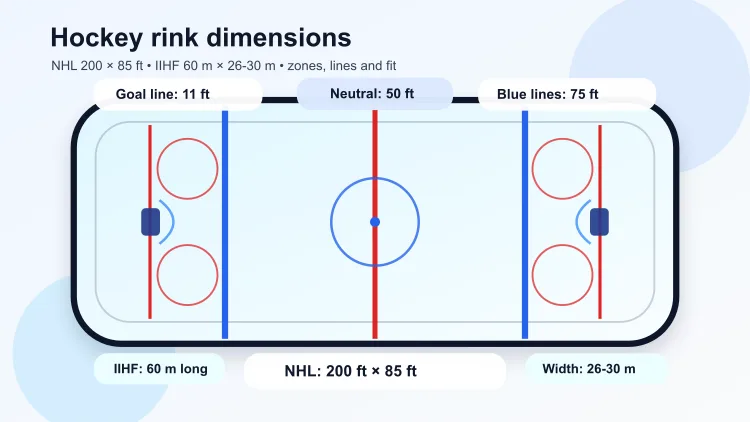
Hockey Rink Dimensions: NHL, IIHF and Youth Sizes
Official hockey rink dimensions for NHL, North American, IIHF and Olympic ice, with rink lines, zones, goal lines, boards and a fit calculator.
How Many Periods Are in a Hockey Game? NHL Rules Explained
How many periods are in a hockey game: three 20-minute periods, how long intermissions last, and how NHL overtime and shootouts settle ties.
Types of Shots in Ice Hockey: Every Shot Explained
The main types of shots in ice hockey are the wrist shot, slap shot, snap shot, backhand, one-timer, wraparound, and deflection. Full breakdown here.
What Is a Deke in Hockey? Meaning, Types, and Examples
A deke in hockey is a fake move used to skate past a defender or goalie. Learn the term's origin, the main types of dekes, and how they're used.
What Is a One-Timer in Hockey? Definition & How It Works
A one-timer in hockey is a shot fired directly off a teammate's pass with no puck control first. How it works, why it's hard to stop, and how to practice one.
What Is a Slap Shot in Hockey? Mechanics, Speed & Records
A slap shot in hockey is a full wind-up shot built for maximum puck speed. Learn the technique, how it compares to a wrist shot, and NHL speed records.