
What Is Cross-Checking in Hockey? NHL Rule Explained
On this page6
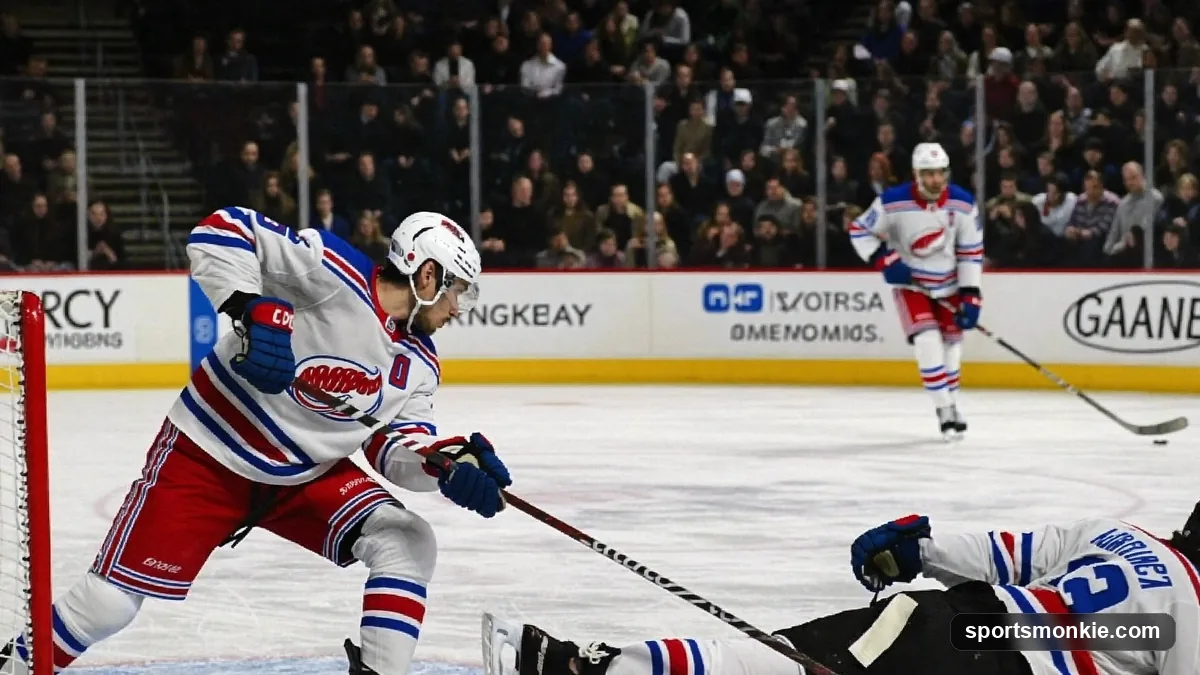
Cross-checking in hockey is when a player holds their stick horizontally with both hands off the ice and shoves or jabs the shaft into an opponent’s body. It’s illegal at every level of the sport because the stick multiplies the force of the hit and raises the risk of injury compared to a standard body check. Officials call it constantly around the net front, after whistles, and after goals, where players jostle for position and tempers run hottest.
What Counts as Cross-Checking?
The move gets its name from how the stick is held: one hand near the top of the shaft, the other roughly halfway down, so the stick sits across the body like a bar. The player then extends their arms and pushes or jabs that bar into an opponent, usually into the back, chest, or shoulders. The NHL’s official rulebook defines it as “the action of using the shaft of the stick between the two hands to forcefully check an opponent.”
The key details that separate a legal battle for position from an illegal cross-check are contact point and force. If the initial point of contact is a player’s shoulder, hip, or torso, and the stick just happens to be between them, officials usually let it go as incidental contact. Once a player visibly extends the stick and drives it into an opponent with force, especially in the back or from behind, it’s a penalty. This is the same category of infraction covered in what is high-sticking in hockey, where stick position above the shoulders is the deciding factor instead.
The Official NHL Rule (Rule 59)
NHL Rule 59 governs cross-checking and gives referees discretion to match the penalty to the severity of the contact rather than applying one fixed punishment. The IIHF’s equivalent, Rule 127, is stricter and guarantees at least a minor penalty any time the infraction is called, with no lesser option. USA Hockey and the PWHL both use nearly identical language to the NHL’s rule, which means the definition of a cross-check doesn’t change much as players move between levels; only the enforcement discretion does.
Penalties for Cross-Checking
| Penalty | Length | When it’s called |
|---|---|---|
| Minor | 2 minutes | Standard cross-check with moderate force, the most common call |
| Major + game misconduct | 5 minutes, offender ejected for the rest of the game | Forceful or reckless contact, often to a vulnerable player or from behind |
| Match penalty | 5 minutes served by a teammate, offender ejected and reviewed by the league | Referee judges the player intended to injure the opponent |
A minor penalty is the routine call and puts the team on the penalty kill for two minutes, the same mechanic covered in SportsMonkie’s power play in hockey explained guide. A major penalty carries an automatic game misconduct, meaning the offending player is done for the night even though a teammate only serves five minutes in the box. A match penalty goes further: the player is ejected immediately, a substitute serves the time, and the league’s hockey operations department reviews the hit for possible supplemental discipline, including a suspension.
Cross-Checking vs. Slashing, High-Sticking, and Boarding
Cross-checking often gets confused with other stick fouls because they all involve illegal stick contact, but each targets a different action:
- Slashing is a chopping or swinging motion, usually aimed at an opponent’s hands, wrists, or legs, rather than a straight-on shove.
- High-sticking happens when a player’s stick makes contact above the opponent’s shoulders, which is a separate rule regardless of how many hands are on the stick. See what is high-sticking in hockey for the full breakdown.
- Boarding is checking an opponent violently into the boards, with or without a stick involved, and is judged by the danger of the impact rather than the stick position.
- Charging involves taking multiple strides or extra momentum before delivering a body check, unrelated to stick use at all.
Cross-checking is the only one of these four defined specifically by the two-handed stick position, which is why it has its own dedicated rule number in every major rulebook. It also shows up most often in situations that have nothing to do with the forecheck pressure covered in what is forechecking in hockey; most cross-checks happen in stationary net-front battles, not while chasing the puck into the offensive zone.
Why the NHL Cracked Down on Cross-Checking
Starting in the 2021-22 season, the NHL directed officials to call cross-checks more consistently, especially around the net front, after goals, and to the head, neck, or back. The change followed several high-profile injuries and mounting criticism that stick fouls in scrums were going unpunished simply because they happened away from the puck. Referees were told to treat those extracurricular cross-checks the same as ones during active play, which noticeably raised minor-penalty totals in the seasons that followed. Coaches and players still debate where the line sits between a normal net-front battle and a punishable shove, but the emphasis on protecting players from behind hasn’t reversed.
How to Avoid a Cross-Checking Penalty
Players are taught to keep their stick blade on the ice and their hands apart rather than stacked together, since the two-hands-together grip is what triggers the call in the first place. Coaches also teach body positioning, using shoulders and hips to establish position in front of the net instead of the stick, and to release pressure the moment a whistle blows rather than continuing to jostle. Discipline matters most in the highest-traffic areas of the rink: the crease and immediately after a goal, where retaliatory cross-checks are the single most common way this penalty gets called.
For the full rundown of stick fouls, body-position rules, and other terms used throughout the sport, see the hockey terminology glossary, and for a wider look at how the NHL structures its game, visit the ice hockey (NHL) hub.
Frequently asked questions
What is cross-checking in hockey?+
Cross-checking in hockey is when a player holds their stick horizontally with both hands, one near the top of the shaft and the other roughly halfway down, and shoves or jabs it into an opponent's body to check them. Because both hands are on the stick and no part of it touches the ice, it's classified separately from slashing or a normal body check, and it's illegal in every major hockey league.
Is cross-checking always a penalty in the NHL?+
Yes, cross-checking is always penalized when called, but the severity varies. Under NHL Rule 59, the referee assesses at minimum a two-minute minor penalty. If the contact is more forceful or reckless, it becomes a five-minute major with an automatic game misconduct, and if the referee judges the player intended to injure, it's a match penalty and the player is ejected.
What is the difference between cross-checking and slashing?+
Cross-checking uses the stick shaft held with both hands, pushed straight into an opponent's body in a shoving motion. Slashing is a chopping or swinging motion with the stick, usually aimed at an opponent's hands, arms, or legs. Both are stick-infraction penalties under NHL Rule 61 (slashing) and Rule 59 (cross-checking), but the motion and typical target area are different.
Why did the NHL crack down on cross-checking?+
The NHL and its officials tightened enforcement of cross-checking, particularly around the net front and after goals, starting in the 2021-22 season after several high-profile injuries and complaints that stick fouls near the crease were going uncalled. The league instructed referees to call cross-checks to the head, neck, and back more consistently, even away from the play.
Can you cross-check in youth or women's hockey?+
No. Cross-checking is illegal at every level of organized hockey, including youth, high school, college, and all women's leagues, regardless of whether that level allows full body checking. USA Hockey and the IIHF both treat cross-checking as a stick-fouls violation independent of a league's body-checking rules.
Does cross-checking after the whistle get a bigger penalty?+
Referees generally treat cross-checks delivered after the whistle, after a goal, or from behind more seriously than ones during live play, often upgrading a borderline minor to a major or adding an unsportsmanlike-conduct penalty on top. The extra severity reflects that the recipient usually isn't braced for contact in those moments.
What is the referee's hand signal for cross-checking?+
Officials signal a cross-checking penalty by extending both fists forward from the chest in a pushing motion, mimicking the two-handed shove that defines the foul. It's one of the more recognizable calls on ice because the gesture directly mirrors the illegal action.
Sources
Play & tools
Free browser games and tools — no account, no download.
- Play 98-0 — Draft a 12-player all-time NHL roster and chase a perfect 98-0 — 82 regular-season wins plus a swept Cup.
- Explore all our games →
Related ice hockey guides
View all →
Hockey Terminology Glossary: 60+ NHL Terms Explained
A complete hockey terminology glossary covering NHL rules, positions, penalties, and slang terms every fan needs to know.
What Is a Deke in Hockey? Meaning, Types, and Examples
A deke in hockey is a fake move used to skate past a defender or goalie. Learn the term's origin, the main types of dekes, and how they're used.
What Is an Empty Net Goal in Hockey? Rules, Strategy, and Records
An empty net goal in hockey is scored when the net has no goaltender in it. Learn when teams pull the goalie, the delayed-penalty rule, and NHL records.
What Is Backchecking in Hockey? Meaning, Purpose & Technique Explained
Backchecking in hockey is when a player skates hard back to their own zone to defend after losing the puck. Learn the rules, technique, and why it matters.
Hockey Rink Dimensions: NHL, IIHF and Youth Sizes
Official hockey rink dimensions for NHL, North American, IIHF and Olympic ice, with rink lines, zones, goal lines, boards and a fit calculator.
How Many Periods Are in a Hockey Game? NHL Rules Explained
How many periods are in a hockey game: three 20-minute periods, how long intermissions last, and how NHL overtime and shootouts settle ties.