
What Is Forechecking in Hockey? Systems and Roles Explained
On this page5
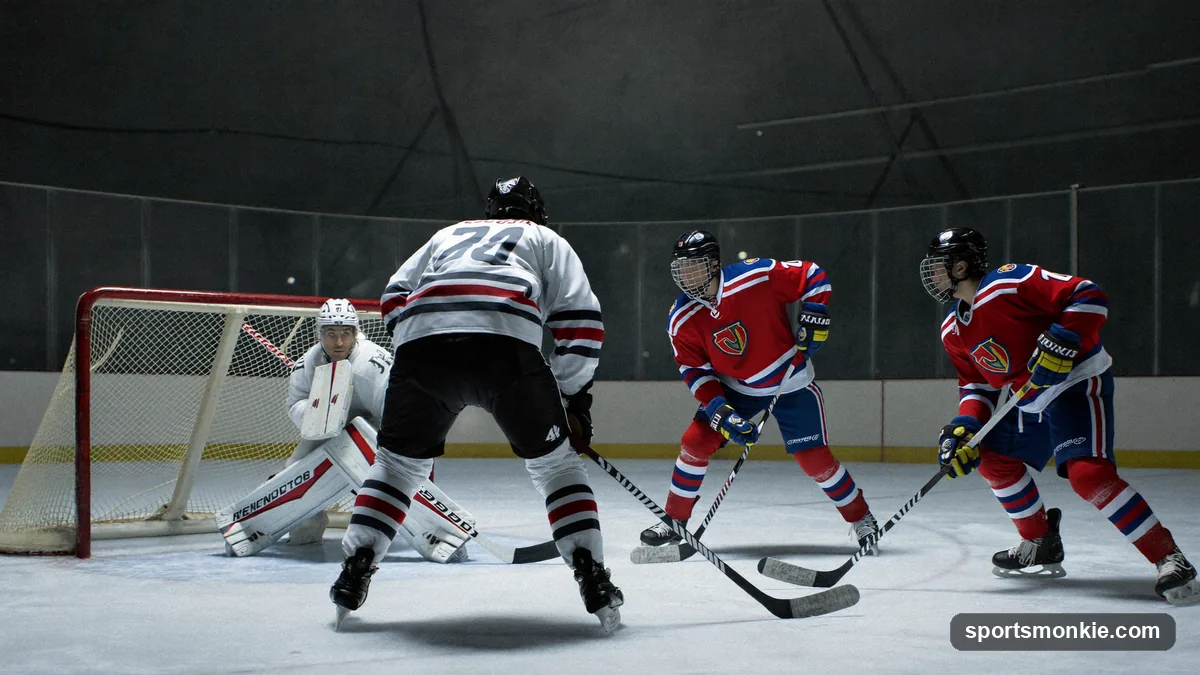
Forechecking is when the team without the puck pressures the opponent in the offensive zone, usually right after a dump-in or a lost puck battle, to force a turnover before the other team can skate the puck out cleanly. It is one of the core defensive-into-offensive systems in ice hockey, and understanding it is a big step toward reading the game like a coach instead of just watching the puck. For the full glossary of terms like this one, see the hockey terminology glossary.
What is forechecking in hockey?
Forechecking is a team tactic used when a player or line does not have possession of the puck but is still in, or entering, the offensive zone. Rather than retreating to set up defense, the forwards chase the puck aggressively, aiming to disrupt the opponent’s breakout, win a loose puck, or force a rushed pass that turns into a giveaway.
It typically kicks in during three moments in a game: right after a team dumps the puck into the corner instead of carrying it across the blue line, right after a shot rebounds off the goaltender or the boards, and immediately after any turnover deep in the offensive zone. In every case, the forechecking team does not have clean possession, so the goal is to win it back before the opponent can organize.
Forechecking is technically a defensive action, since it happens while a team is without the puck, but its entire purpose is offensive: create a turnover close to the net, and a scoring chance often follows within a second or two.
The F1, F2, F3 forward roles
Every forecheck system, no matter how aggressive or conservative, is built around three labeled forward roles. Coaches and analysts refer to them constantly, so knowing the shorthand makes any breakdown of a system easy to follow.
| Role | Job |
|---|---|
| F1 | The first forward to reach the puck carrier; applies direct pressure and tries to force a bad pass or a turnover |
| F2 | Supports F1 by covering the nearest passing lane or jumping on the next loose puck if F1’s pressure creates one |
| F3 | Stays higher in the zone, protects the middle of the ice, and guards against an odd-man rush if the forecheck gets beaten |
These roles rotate constantly within a shift. Whichever forward is closest to the puck when it changes hands becomes F1 for that sequence, not necessarily the same player each time.
Types of forecheck systems
Coaches choose a system based on their team’s speed, the score, and how much risk they are willing to take. The three most common systems differ in how many players commit deep versus how many stay back for safety.
1-2-2 forecheck
The 1-2-2 is the most widely used system in modern hockey. One forward (F1) pressures the puck deep in the zone, two players (F2 and F3) sit in the middle of the ice covering the boards and center lane, and the two defensemen hold the blue line. It balances pressure with defensive coverage, which is why teams lean on it when protecting a lead or playing an even game. The Tampa Bay Lightning ran a disciplined version of it through both of their Stanley Cup championship runs.
2-1-2 forecheck
The 2-1-2 sends two forwards (F1 and F2) deep together to attack the puck carrier and the first passing option at the same time, with the third forward (F3) higher and the defensemen pinched closer to the blue line. It creates turnovers faster than the 1-2-2 because it doubles up on the puck, but it leaves fewer players positioned to defend a quick counterattack if the pressure fails. High-tempo teams like the Carolina Hurricanes and Vegas Golden Knights favor it.
1-3-1 forecheck
The 1-3-1 sends one forward deep to pressure the puck while three players form a flat line across the middle of the ice, clogging passing lanes side to side rather than chasing the puck carrier directly, and one player stays high. It is built to take away the width of the rink and force the puck into a predictable outlet, where the middle three can pounce.
Forechecking vs. backchecking
Forechecking and backchecking apply the same principle, pressure the puck carrier before they can set up, at opposite ends of the ice. Forechecking happens in the offensive zone, when the forwards chase down the puck near the opponent’s net. Backchecking is the reverse: forwards sprint back into their own defensive zone to disrupt the opponent’s rush after losing the puck further up the ice. A team that forechecks well but backchecks poorly tends to give up odd-man rushes the moment its own forecheck breaks down, which is why coaches drill both as a single, connected habit rather than two separate skills.
Forechecking is also distinct from the neutral zone trap, a conservative system that gives up on chasing the puck in the offensive zone entirely and instead sets up a wall of defenders in the neutral zone to clog the middle of the ice.
Why forechecking matters
A good forecheck does more than force one turnover. It tires out opposing defensemen over the course of a game, cuts down the time and space they have to make a clean first pass, and creates the kind of high-danger scoring chances, off a turnover right next to the net, that are hard to generate through a set offensive-zone play. It is also one of the clearest ways to see team identity on TV: a physical, forechecking-heavy team like the Boston Bruins plays a visibly different style than a puck-possession team that prefers to carry it in clean every time.
For more on how these systems fit into the bigger picture of team strategy and terminology, check the full ice hockey / NHL hub and the hockey terminology glossary.
Frequently asked questions
What is forechecking in hockey?+
Forechecking is when the team that just lost the puck immediately pressures the opponent in the offensive zone or neutral zone to win it back before the other team can complete a clean breakout. It usually starts right after a dump-in, a rebounded shot, or a turnover, and it is one of the main ways teams create scoring chances without controlled possession.
What do F1, F2, and F3 mean in forechecking?+
They label the three forwards' jobs in a forecheck, numbered by how close each is to the puck. F1 is the first forward to pressure the puck carrier directly. F2 supports F1 by covering the nearest passing lane or winning the next puck battle. F3 stays higher, guarding the middle of the ice and preventing an odd-man rush if the forecheck breaks down.
What is the difference between the 1-2-2 and 2-1-2 forecheck?+
The 1-2-2 sends one forward deep to pressure the puck while two forwards hold the middle of the offensive zone and the defensemen sit at the blue line; it is the more conservative, widely used system. The 2-1-2 sends two forwards deep to attack the puck carrier and the first passing option together, with one forward high and the defensemen pinched near the blue line; it forces turnovers faster but leaves fewer players back if it fails.
What is the 1-3-1 forecheck?+
The 1-3-1 is a structured system with one forward pressuring the puck deep, three players (typically two forwards and a defenseman, or a forward and both defensemen depending on the coach) spread across the middle of the ice in a flat line, and one player staying high near the blue line. It is built to clog passing lanes across the width of the rink rather than chase the puck carrier directly.
Is forechecking offense or defense?+
Both. Forechecking happens while a team does not have the puck, which technically makes it a defensive action, but it takes place in the offensive zone with the goal of creating a scoring chance off the turnover. Coaches often describe good forechecking as the fastest way to generate offense without ever running a set offensive-zone play.
What is the difference between forechecking and backchecking?+
Forechecking happens in the offensive zone, when a team without the puck pressures the opponent near their own net to force a turnover before a breakout. Backchecking happens in reverse: forwards skate hard back into their own defensive zone to break up the opponent's rush after losing possession further up the ice. They are the same principle, pressure the puck carrier, applied on opposite ends of the rink.
Which NHL teams are known for strong forechecking?+
Teams built around speed and physicality tend to lean on aggressive forechecks. The Tampa Bay Lightning ran a disciplined 1-2-2 during their back-to-back Stanley Cup wins, the Carolina Hurricanes and Vegas Golden Knights favor high-tempo 2-1-2 pressure, and the Boston Bruins are regularly cited for a physical forecheck that wears opponents down over a full game.
Does forechecking work on the power play?+
Rarely in the traditional sense. Forechecking systems assume the forechecking team does not have the puck, which is the opposite of a power play, where the extra skater already controls possession most of the time. Forechecking pressure matters most at even strength and on the penalty kill, where regaining the puck quickly is the entire point of the defensive structure.
Sources
Play & tools
Free browser games and tools — no account, no download.
- Play 98-0 — Draft a 12-player all-time NHL roster and chase a perfect 98-0 — 82 regular-season wins plus a swept Cup.
- Explore all our games →
Related ice hockey guides
View all →
What Is the Neutral Zone Trap in Hockey? Rule and Strategy Explained
The neutral zone trap in hockey is a defensive system that clogs the neutral zone to force turnovers, run as a 1-2-2 or 1-3-1 formation.
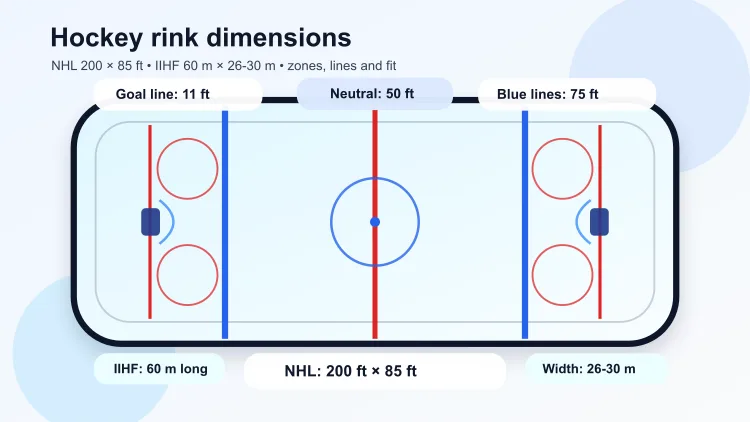
Hockey Rink Dimensions: NHL, IIHF and Youth Sizes
Official hockey rink dimensions for NHL, North American, IIHF and Olympic ice, with rink lines, zones, goal lines, boards and a fit calculator.
How Many Periods Are in a Hockey Game? NHL Rules Explained
How many periods are in a hockey game: three 20-minute periods, how long intermissions last, and how NHL overtime and shootouts settle ties.
Types of Shots in Ice Hockey: Every Shot Explained
The main types of shots in ice hockey are the wrist shot, slap shot, snap shot, backhand, one-timer, wraparound, and deflection. Full breakdown here.
What Is a Deke in Hockey? Meaning, Types, and Examples
A deke in hockey is a fake move used to skate past a defender or goalie. Learn the term's origin, the main types of dekes, and how they're used.
What Is a One-Timer in Hockey? Definition & How It Works
A one-timer in hockey is a shot fired directly off a teammate's pass with no puck control first. How it works, why it's hard to stop, and how to practice one.