
What Is a One-Timer in Hockey? Definition & How It Works
On this page6
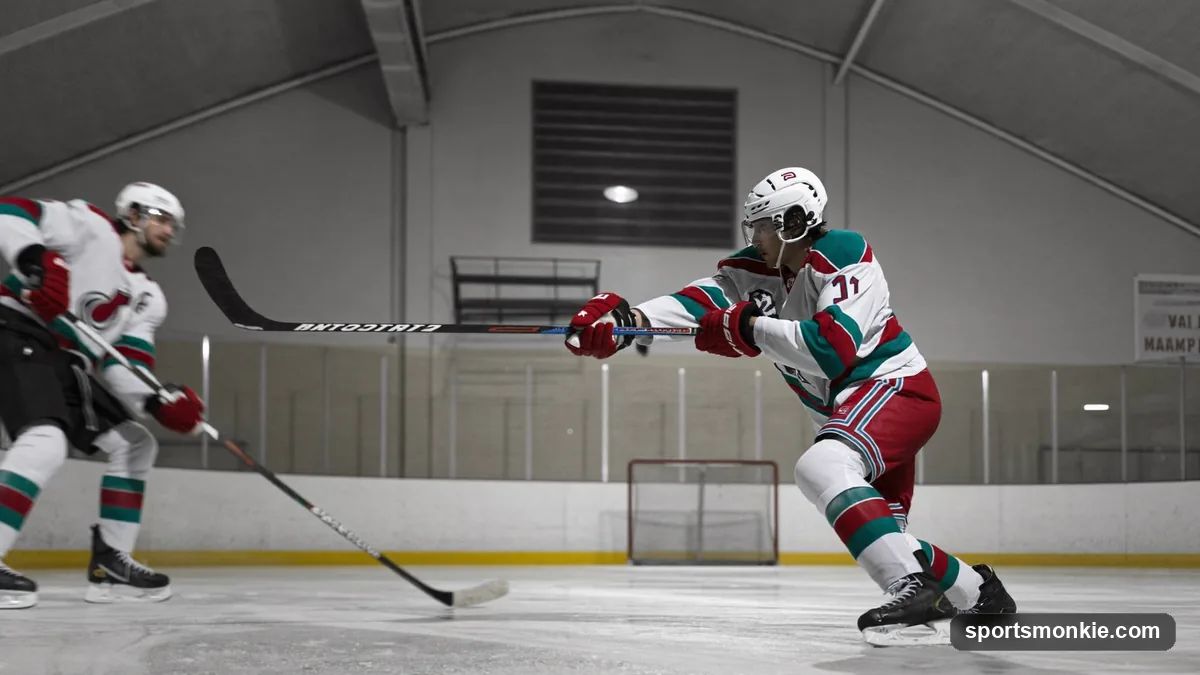
A one-timer in hockey is a shot a player fires the instant a teammate’s pass arrives, striking the puck in motion instead of stopping it on their stick first. The name comes from the shooter getting one touch and one chance to connect cleanly. It’s one of the fastest, hardest shots to stop in the sport, and it’s a staple of nearly every NHL power play.
What is a one-timer, exactly?
Picture a defenseman at the point sliding a pass across the ice toward a winger stationed in the faceoff circle. A normal play has that winger cushion the pass, settle the puck, then shoot. A one-timer skips the middle step entirely: the winger swings through the puck the moment it’s still gliding toward them, redirecting it on goal in a single motion.
That single motion is the whole point. Every extra half-second a shooter spends controlling the puck is a half-second the goaltender and defense get to react, close a passing lane, or block the shot. A one-timer compresses all of that reaction time into almost nothing.
Most one-timers are hit with a slap shot, since a full swing generates the most power off a moving puck. But a player can also one-time a wrist shot, trading some velocity for a quicker, tighter release that’s harder for a defender to disrupt before it gets off.
How a one-timer works, step by step
Executing a clean one-timer takes coordination between two players, not just one.
- The passer reads the shooter’s stick. A good feed leads the puck to where the shooter’s blade will be, not where it currently is, so the shooter doesn’t have to reach or adjust.
- The shooter opens their stance early. Hips and shoulders rotate toward the pass before it even arrives, loading the swing in advance.
- The shooter times the swing to the puck, not the pass. Swinging too early misses the puck entirely; swinging too late turns it into a rushed, weak shot.
- Contact happens on the puck’s leading edge, redirecting its speed and the shooter’s stick speed into one combined shot.
- The follow-through aims the shot, since there’s no time to look up and pick a corner mid-shot the way a shooter can with a held puck.
Because so much depends on timing between two players, most one-timers are practiced as a set play, run over and over until the passer and shooter can read each other automatically.
One-timer vs. other hockey shots
A one-timer isn’t a shot type on its own so much as a way of releasing an existing shot. Here’s how it compares to the shots it’s usually built from, for a full rundown, see our guide to the different types of shots in ice hockey.
| Shot | Puck starts | Power | Release speed | Best used for |
|---|---|---|---|---|
| One-timer (slap shot) | Already moving on a pass | Highest | Fastest release relative to setup | Power play, cross-ice feeds |
| One-timer (wrist shot) | Already moving on a pass | Moderate | Very fast, less windup needed | Tight-space redirects |
| Standard slap shot | Stationary on the shooter’s stick | Highest | Slower to load | Point shots, open ice |
| Wrist shot | Stationary on the shooter’s stick | Moderate | Quick, but goalie has more read time | In-close, quick-release scoring chances |
For the full mechanics of the swing itself, see our breakdown of what a slap shot in hockey actually is.
Why one-timers are so effective
Three things stack together to make a one-timer so dangerous for a goaltender:
- Angle change. The puck is traveling in one direction on the pass, then instantly redirected toward the net, forcing the goalie to track a new trajectory with almost no warning.
- Speed. Slap-shot one-timers routinely exceed 90 mph in the NHL, leaving a goaltender a fraction of a second to react once the shot is released.
- No windup tell. A held slap shot gives the goalie a visible backswing to read. A one-timer’s windup happens while the shooter is watching the pass, not squaring up to shoot, which hides the cue goalies normally rely on.
That combination is why one-timers succeed at a noticeably higher rate than a plain shot on a set goaltender, and why teams design entire plays specifically to create one.
Where one-timers show up most
The power play is the one-timer’s natural home. With the penalty-killing team down a skater, the man-advantage unit has extra time and space to move the puck cross-ice before shooting, exactly the setup a one-timer needs. Alexander Ovechkin turned the left faceoff circle on the power play into a personal weapon so associated with him that fans and broadcasters now call it the “Ovi spot.”
But one-timers aren’t exclusive to the power play. At even strength, they show up off a give-and-go through the neutral zone, a cross-crease feed in front of the net, or a quick give-up-and-shoot on a rush. Anywhere a passer can find a shooter with a clean lane, a one-timer is on the table.
How to practice a one-timer
Coaches typically build the skill in stages. Players start with a stationary feeder sliding pucks to a fixed spot, focusing purely on timing the weight transfer and stick lift to make clean contact. Most start with the wrist-shot version first, since the shorter swing is easier to time consistently, before progressing to a full slap-shot one-timer. Once contact is reliable, coaches add a moving feed, then game-speed pressure, so the timing holds up when a real defender is closing the passing lane.
For more on how shots, checks, and other hockey plays fit together, visit the hockey terminology glossary or browse the full Ice Hockey hub for rules, stats, and league coverage.
Frequently asked questions
What is a one-timer in hockey?+
A one-timer in hockey is a shot a player fires directly off a teammate's pass, striking the puck on the fly with one continuous motion instead of stopping it on their stick first. The name comes from the shooter getting exactly one touch to connect, no setup, no second chance.
Why is a one-timer so hard for a goalie to stop?+
A one-timer changes the puck's angle, direction, and speed all at once. The goaltender has to read the pass, guess where the shot will go, and react before the puck arrives, all in a fraction of a second. A held shot lets a goalie square up and track the release; a one-timer removes that read time almost entirely.
Is a one-timer always a slap shot?+
No, though slap shots are the most common way to hit one. A player can also one-time a wrist shot off a pass, which releases slower and with less power than a slap shot one-timer but sacrifices some accuracy and reaction time for the defense to close in less on.
Why do you see so many one-timers on the power play?+
With the penalty-killing team down a skater, the man-advantage unit has more room to move the puck cross-ice before a shot. That extra space lets a team set up a one-timer from the faceoff circle or slot, which is exactly why the play is a staple of nearly every NHL power play unit.
What is the difference between a one-timer and a regular slap shot?+
A regular slap shot starts with the puck already sitting still on the shooter's own stick. A one-timer starts with the puck already moving toward the shooter on a pass, and the shooter strikes it in transit. The mechanics of the swing are similar, but the timing and puck speed at contact are very different.
Who is known for having a great one-timer in the NHL?+
Alexander Ovechkin built his career largely off one-timers from the left faceoff circle on the power play, a spot hockey fans now simply call the 'Ovi spot.' Players like Alex Tuch, Mikko Rantanen, and other power-play specialists are also frequently praised for their one-timer setups.
How do you practice a one-timer?+
Start with a stationary feeder passing pucks to a fixed spot while you work on timing your weight transfer and stick lift to meet the puck cleanly, then add movement, a moving feed, and finally live pressure. Most coaches start players with a wrist-shot one-timer before progressing to the slap-shot version, since the shorter swing is easier to time consistently.
Can a one-timer be taken off the rush, not just the power play?+
Yes. While the power play is where one-timers show up most because of the extra space, they also happen at even strength off a give-and-go, a stretch pass on a breakaway, or a cross-crease feed in front of the net. Any situation with a clean pass and an open shooting lane can produce one.
Sources
Play & tools
Free browser games and tools — no account, no download.
- Play 98-0 — Draft a 12-player all-time NHL roster and chase a perfect 98-0 — 82 regular-season wins plus a swept Cup.
- Explore all our games →
Related ice hockey guides
View all →
Hockey Terminology Glossary: 60+ NHL Terms Explained
A complete hockey terminology glossary covering NHL rules, positions, penalties, and slang terms every fan needs to know.
What Is a Hat Trick in Hockey? Rules & Types
A hat trick in hockey is three goals by one player in a single game. Why fans throw hats, the natural and Gordie Howe variations, and how rare it is.
Hockey Rink Dimensions: NHL, IIHF and Youth Sizes
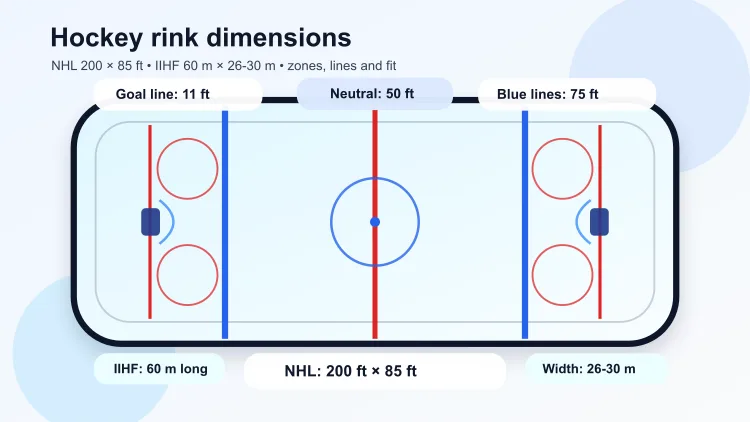
Official hockey rink dimensions for NHL, North American, IIHF and Olympic ice, with rink lines, zones, goal lines, boards and a fit calculator.
How Many Periods Are in a Hockey Game? NHL Rules Explained
How many periods are in a hockey game: three 20-minute periods, how long intermissions last, and how NHL overtime and shootouts settle ties.
Types of Shots in Ice Hockey: Every Shot Explained
The main types of shots in ice hockey are the wrist shot, slap shot, snap shot, backhand, one-timer, wraparound, and deflection. Full breakdown here.
What Is a Deke in Hockey? Meaning, Types, and Examples
A deke in hockey is a fake move used to skate past a defender or goalie. Learn the term's origin, the main types of dekes, and how they're used.