
What Does Power Play Mean in Hockey?
On this page6
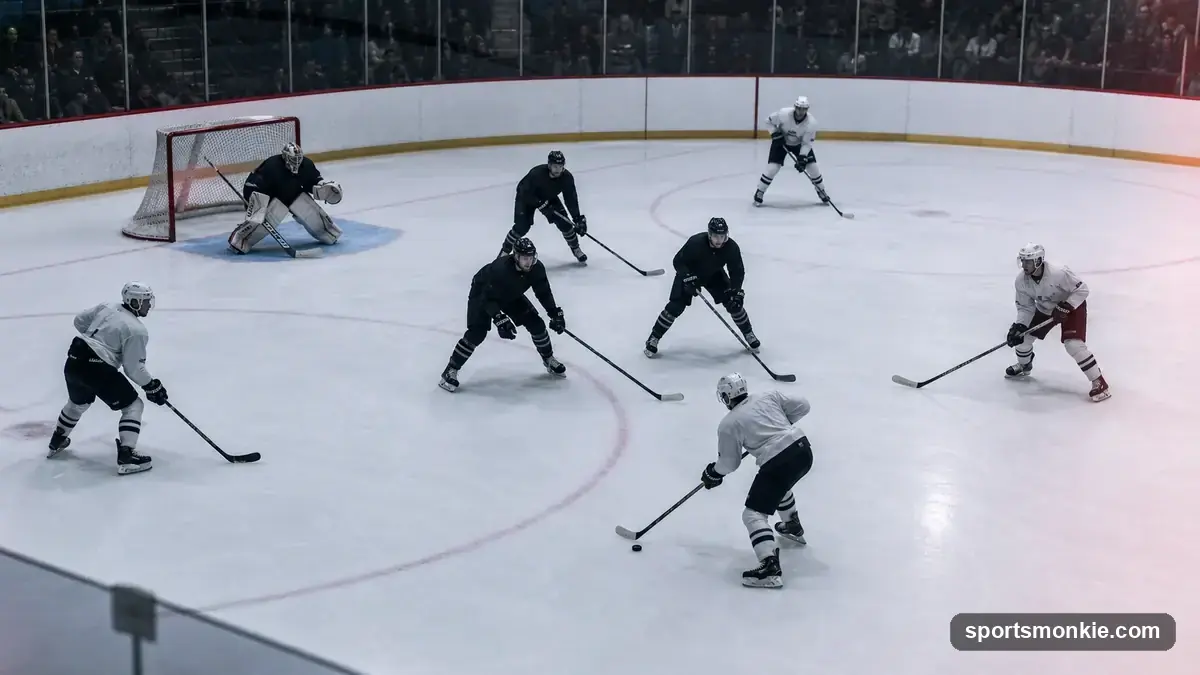
A hockey power play is the man advantage created when an opponent is sent to the penalty box. The team with extra skaters attacks while the other team tries to kill the penalty. In the common case, four skaters defend against five attackers for two minutes.
How a power play starts
The referee calls an infraction such as tripping, hooking or holding. The offender serves the prescribed penalty, and the teams resume at the next appropriate faceoff. A delayed penalty may allow the offended team to keep attacking before play stops.
What the numbers mean
The scorekeeper describes the advantage by skater count: five-on-four, five-on-three or four-on-four. Goalkeepers are included in the normal team count but are not counted as ordinary attacking skaters in these descriptions.
How teams attack
Most power plays use a controlled entry, a puck-retrieval pattern and a set formation. One player often works at the top, two operate near the goal line or circles, and a net-front player screens the goalie. The objective is not simply to shoot; it is to move the penalty-killing box until a lane opens.
How the penalty kill works
The shorthanded team protects the middle, blocks passing lanes and clears the puck down the ice. A successful clear forces the power-play unit to regroup and spend time re-entering the zone.
Power play versus penalty kill
These are two sides of the same sequence. A power play is the attacking advantage; a penalty kill is the defensive response. Our guide to icing in hockey explains another stoppage that can affect a team trying to clear pressure, while what is a faceoff in hockey covers the restart.
Why the advantage matters
Power-play efficiency is measured by goals or conversion rate, but context matters: opponent quality, zone entries, penalties drawn and time remaining all affect the number. A team can dominate possession without scoring, while one clean screen and rebound can decide the game.
For another equipment-focused sport guide, compare ski boot flex. You can also review false starts in track and field.
Frequently asked questions
How long is a hockey power play?+
A minor penalty normally creates a two-minute power play. A major penalty is five minutes and is not automatically cancelled when the advantaged team scores.
What is five on four in hockey?+
Five on four means the attacking team has five skaters against four opposing skaters because one opponent is serving a minor penalty.
Does a goal end a power play?+
A goal usually ends a minor power play, but major and misconduct penalties follow different timing rules. The penalty itself is not always erased by a goal.
Can a team have two power plays at once?+
Yes. If two opponents are serving penalties, the attacking team can have a five-on-three advantage, subject to the penalty-timing rules.
What is a short-handed goal?+
A short-handed goal is scored by the team killing a penalty while it has fewer skaters. It counts normally and ends a minor penalty only if the other team scored.
What is a penalty kill?+
The penalty kill is the shorthanded team's defensive effort to prevent a power-play goal until its player returns or the penalty ends.
Sources
Play & tools
Free browser games and tools — no account, no download.
- Play today's Sports Connections — Today's Sports Connections — daily hints, answers, and play the grid.
- Play Guess the NFL Player — A new mystery NFL player every day. Eight guesses, with a clue on each — plus free unlimited mode.
- Explore all our games →
Related guides
What Is a Check in Hockey? Body Check and Legal Contact
A hockey check is legal contact used to separate an opponent from the puck, but league rules limit where, how, and when contact is allowed.
Hockey Terminology Glossary: 60+ NHL Terms Explained
A complete hockey terminology glossary covering NHL rules, positions, penalties, and slang terms every fan needs to know.

What Does MVP Mean in Sports?
MVP means Most Valuable Player, an award for the athlete judged to have the greatest value to a team or competition under its voting rules.
What Does Rookie Mean in Sports?
A rookie is a first-year or newly eligible player, with the exact definition set by the sport, league or competition.
What Is a One-Timer in Hockey? Definition & How It Works
A one-timer in hockey is a shot fired directly off a teammate's pass with no puck control first. How it works, why it's hard to stop, and how to practice one.
Handicapping in Horse Racing, Explained
Handicapping has two meanings in horse racing: assigning weights to level the field, and the bettor's craft of picking winners. Both explained.