
What Is a Faceoff in Hockey?
On this page5
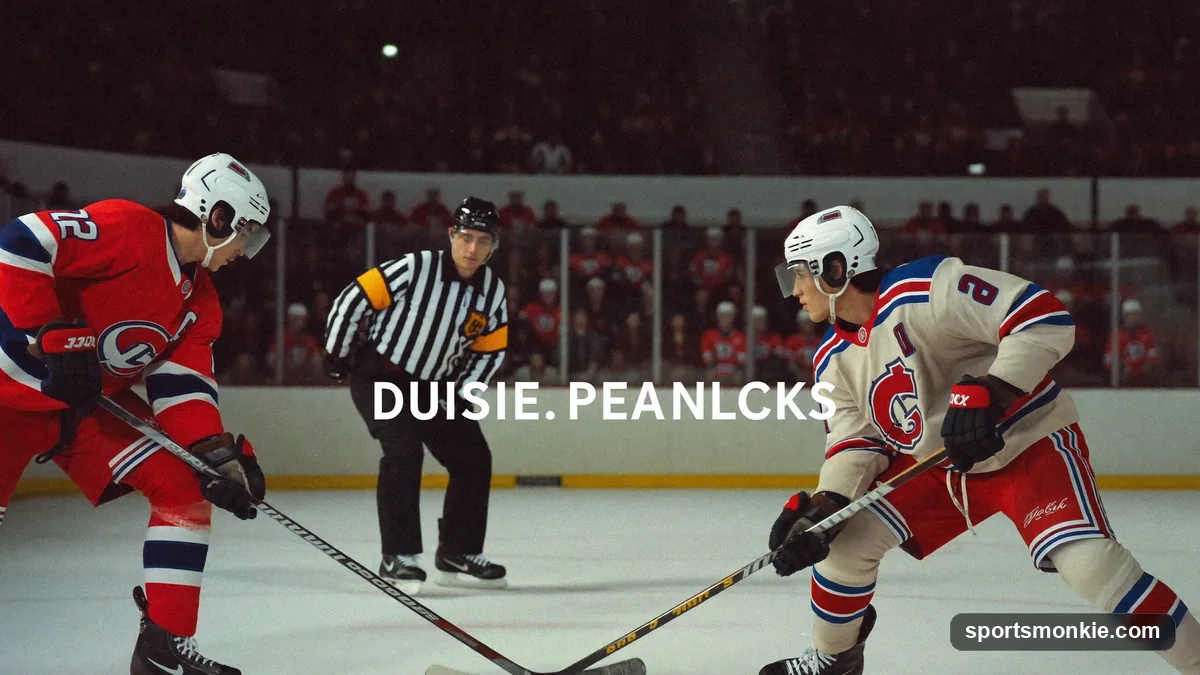
A faceoff is how hockey starts and restarts play: an official drops the puck between two opposing players at one of the rink’s nine faceoff dots, and they battle to win possession. Faceoffs happen at the start of each period, after every goal, and following every stoppage — and winning key ones is a prized skill.
How a faceoff works
Two players, usually the centers, line up opposite each other at a dot. A linesman drops the puck between their sticks, and both try to win it back to a teammate. Whoever gains control gives their team possession to begin the next sequence.
Where they happen
There are nine dots: one at center, two in each neutral zone, and two in each end zone. The spot depends on why play stopped — an icing call sends the draw to the offending team’s zone, while an offside results in a neutral-zone faceoff.
Winning the draw
Players win faceoffs with fast hands, timing, positioning, and technique — tying up the opponent’s stick or pulling the puck back to a defenseman. Jumping before the drop gets a player waved out of the circle. Elite centers win well over half their draws, a real edge over a full game.
Why they matter
| Situation | Why the faceoff matters |
|---|---|
| Offensive zone | A win can create an instant scoring chance |
| Defensive zone | A win helps clear danger |
| Power play | Winning the draw sets up the man advantage |
| Penalty kill | Winning it helps ice the puck and burn time |
An offensive-zone win on the power play or a defensive win on the penalty kill can swing a game.
Keeping it fair
Faceoff violations — moving early, bad stick placement, encroachment — get a player waved out, and repeated ones can draw a penalty. The rules keep the drop neutral so neither team gets a free start. For more, see our ice hockey guides.
Frequently asked questions
What is a faceoff in hockey?+
A faceoff is the method for putting the puck in play after any stoppage. Two players, usually the centers, line up opposite each other at a faceoff dot, and a linesman drops the puck between their sticks. Both try to win it — often by pulling it back to a teammate — and whoever gains control gives their team possession to start the next sequence of play.
Where do faceoffs take place?+
There are nine faceoff dots on the ice: one at center, two in the neutral zone near each blue line, and two in each end zone beside the goals. The location depends on why play stopped. For example, an [icing](/icing-in-hockey-rules-explained/) call sends the faceoff to the offending team's defensive zone, while an [offside](/what-is-offside-in-hockey/) results in a neutral-zone faceoff outside the blue line.
Who takes faceoffs?+
Usually the center, whose job includes winning draws, but any skater can take one. Teams often have a faceoff specialist for crucial situations, and a player can be waved out of the circle for a violation — jumping early, poor stick placement — forcing a teammate to step in. Coaches match their best faceoff man against key opponents in important defensive- or offensive-zone draws.
How do you win a faceoff?+
Players win faceoffs with quick hands, timing, body positioning, and technique — tying up the opponent's stick, using their skates, or pulling the puck back to a defenseman. Anticipating the drop is key, but jumping before the puck lands gets a player thrown out of the circle. Elite centers win well over half their draws, a meaningful edge over a full game.
Why are faceoffs important?+
Every faceoff decides which team begins the next play with the puck, so winning them controls possession and momentum. Offensive-zone faceoff wins can lead directly to scoring chances, especially on the [power play](/power-play-in-hockey-explained/), while defensive-zone wins help clear danger on the [penalty kill](/what-is-a-penalty-kill-in-hockey/). Over a game, faceoff percentage adds up to a real possession advantage.
What is a faceoff violation?+
A faceoff violation is a minor infraction in the circle — a player moving too soon, a center not placing his stick correctly, or teammates encroaching. The first violation results in the offending team's player being waved out and replaced; repeated violations by the same team can draw a minor penalty. The rules exist to keep the drop fair and prevent players from timing their jump.
How is a hockey faceoff different from a lacrosse faceoff?+
Both start play with a battle for the ball or puck, but the mechanics differ. A hockey faceoff is a quick stick battle over a dropped puck at a fixed dot, taken many times a game. A lacrosse faceoff is a crouched clamp-and-rake contest at midfield after each goal. The shared idea is a neutral restart that gives neither team automatic possession.
Sources
Play & tools
Free browser games and tools — no account, no download.
- Play 98-0 — Draft a 12-player all-time NHL roster and chase a perfect 98-0 — 82 regular-season wins plus a swept Cup.
- Explore all our games →
Related ice hockey guides
View all →
What Is Offside in Hockey?
Offside in hockey means an attacking player crosses the offensive blue line ahead of the puck. Play stops and a faceoff is held outside the zone.
What Is a Penalty Kill in Hockey?
A penalty kill is when a short-handed team defends against the opponent's power play after taking a penalty, trying to survive the two minutes without conceding.
What Is a Shootout in Hockey?
A hockey shootout decides a tied NHL regular-season game after overtime: teams alternate penalty-shot attempts, best of three, then sudden death, for one standings point.

NHL Pulls 'Hot for Hockey' Romance Audio Series From Spotify Less Than a Week After Launch
The NHL has removed its 'Hot for Hockey' romance-style audio stories from Spotify and will make no more, less than a week after launching the series.
First Saturday Without Hockey Night in Canada on CBC Since 1952 Leaves Fans Fuming
Sportsnet's Saturday Night Hockey debuted on October 3 as CBC aired no NHL game on a Saturday for the first time since 1952, and fans refused the new name.
How Do the NHL Playoffs Work?
The NHL playoffs are a 16-team, best-of-seven bracket: three division-based rounds plus wild cards lead to the conference finals and the Stanley Cup Final.