
How Do the NHL Playoffs Work?
On this page5
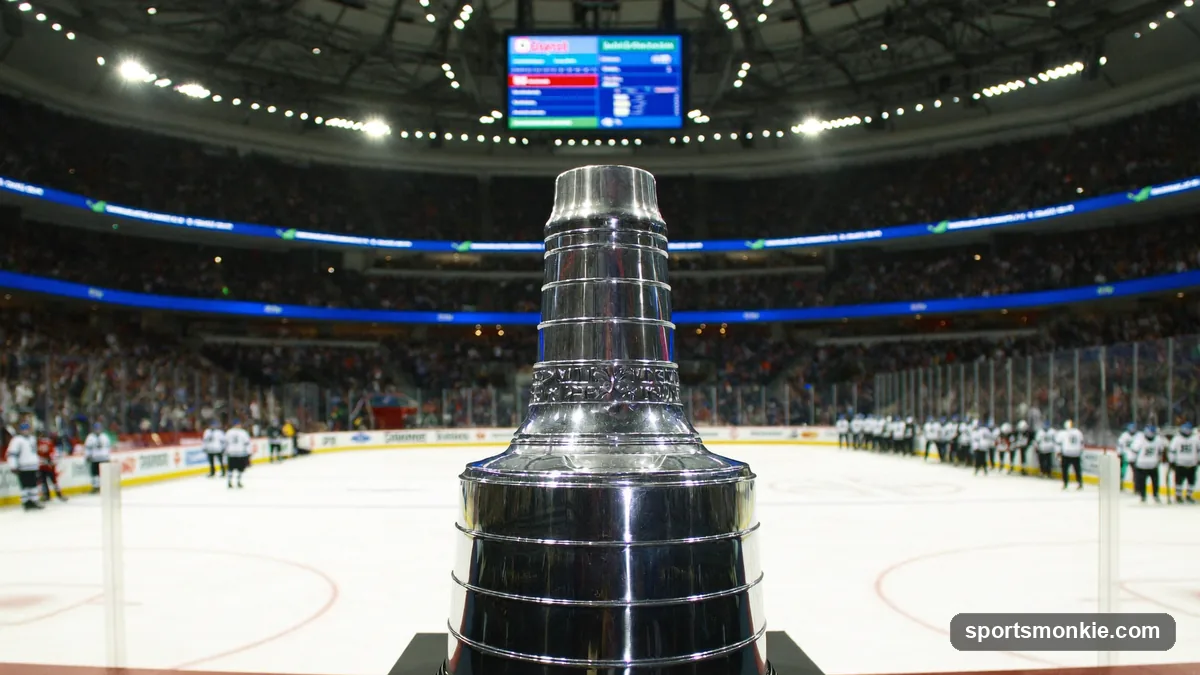
The NHL playoffs are a 16-team, best-of-seven bracket: the top three teams from each of the four divisions qualify automatically, plus two wild cards per conference. Every round is best-of-seven, so a team must win four games to advance, running through three rounds to the conference finals and the Stanley Cup Final.
Who qualifies
Sixteen teams reach the playoffs — eight per conference. In each conference, the top three in each division qualify (six teams), and the last two spots are the wild cards: the next-best two teams by points, regardless of division.
| Berth type | How you get it |
|---|---|
| Division seeds | Top 3 in each division |
| Wild cards | Next 2 by points in the conference |
Best-of-seven, every round
Each series is best-of-seven — first to four wins advances. There are four rounds: first round, second round, conference final, and the Stanley Cup Final. A champion must win 16 games across up to 28.
The bracket
The bracket is largely division-based: top seeds meet wild cards, and second and third seeds meet, so early rounds are often heated intra-division matchups. Winners advance to the conference final, and the two conference champions meet for the Cup.
No ties, no shootouts
Playoff games level after regulation go to continuous five-on-five sudden-death overtime — full 20-minute periods until someone scores. There is no shootout, which is why games can reach double or triple overtime.
Why seeding matters
Finishing higher earns home-ice advantage and generally an easier matchup. Regular-season strength — built partly on special teams like the power play and penalty kill — tilts the bracket a team’s way. The reward at the end is the Stanley Cup. For more, see our ice hockey guides.
Frequently asked questions
How many teams make the NHL playoffs?+
Sixteen teams — eight from each conference. In each conference, the top three teams in each of the two divisions qualify automatically (six teams), and the final two spots go to the wild cards: the next two teams by points regardless of division. That makes eight per conference, sixteen in total, out of the league's 32 clubs.
What is a wild card in the NHL?+
A wild card is one of the two playoff berths per conference awarded to the highest-point teams that did not finish in the top three of their division. The two wild cards cross over into the bracket against the division winners. This gives a strong team stuck in a tough division a path to the playoffs even if it finishes fourth or lower in its own division.
How long are NHL playoff series?+
Every playoff series is best-of-seven, meaning the first team to win four games advances and the loser is eliminated. A series can last anywhere from four games (a sweep) to seven. Four best-of-seven rounds — first round, second round, conference final, and Stanley Cup Final — mean a champion must win 16 games across up to 28 to lift the Cup.
How is the NHL playoff bracket set?+
The bracket is largely division-based. Within each division, the top seed plays the lower wild card and the second and third seeds meet, so early rounds are often intra-division. Winners advance through their side of the bracket to the conference final, and the two conference champions meet in the Stanley Cup Final. The format keeps divisional rivalries at the heart of the early rounds.
How are ties broken in the NHL playoffs?+
There are no ties and no shootouts in the playoffs. A game level after regulation goes to continuous five-on-five sudden-death [overtime](/overtime-rules-in-the-nhl/), with full 20-minute periods played until someone scores. This is why playoff games can run to double or triple overtime, and it is one of the most grueling and dramatic formats in all of sports.
What is the Stanley Cup Final?+
The Stanley Cup Final is the championship round, a best-of-seven series between the two conference champions. The winner is awarded the Stanley Cup, the oldest trophy competed for by professional athletes in North America. Reaching it requires winning three prior best-of-seven rounds, and lifting the Cup is the ultimate goal of the entire NHL season.
Does regular-season position matter in the playoffs?+
Yes. Finishing higher earns home-ice advantage — hosting four of the seven games in a series — and generally a matchup against a lower seed. Division winners and top seeds get the most favorable early paths. While upsets happen, a better regular-season record, built partly on special teams like the [power play](/power-play-in-hockey-explained/) and [penalty kill](/what-is-a-penalty-kill-in-hockey/), tilts the bracket in a team's favor.
Sources
Play & tools
Free browser games and tools — no account, no download.
- Play 98-0 — Draft a 12-player all-time NHL roster and chase a perfect 98-0 — 82 regular-season wins plus a swept Cup.
- Explore all our games →
Related ice hockey guides
View all →
Overtime Rules in the NHL: How OT Works (2026)
NHL regular-season overtime is a 5-minute, 3-on-3 sudden-death period; if still tied it goes to a shootout. Playoff overtime is full 5-on-5 sudden death until a goal.

NHL Pulls 'Hot for Hockey' Romance Audio Series From Spotify Less Than a Week After Launch
The NHL has removed its 'Hot for Hockey' romance-style audio stories from Spotify and will make no more, less than a week after launching the series.

Alex Ovechkin Says 2026-27 Will Be His Final NHL Season After 22 Years in Washington
Alex Ovechkin told his Capitals teammates on Monday that the 2026-27 season will be his last in the NHL. The all-time goals leader starts his farewell year on 929 goals.

What Is a Faceoff in Hockey?
A faceoff starts and restarts play in hockey: an official drops the puck between two opposing players at one of nine faceoff dots, and they battle to win possession.
What Is a Penalty Kill in Hockey?
A penalty kill is when a short-handed team defends against the opponent's power play after taking a penalty, trying to survive the two minutes without conceding.

What Is a Shootout in Hockey?
A hockey shootout decides a tied NHL regular-season game after overtime: teams alternate penalty-shot attempts, best of three, then sudden death, for one standings point.