
What Is a Penalty Kill in Hockey?
On this page5
A penalty kill is the defensive effort by a short-handed team after one of its players is sent to the box, leaving it a skater down while the opponent has a power play. The killing team tries to survive the penalty — usually two minutes — without conceding, using tactics like the box formation, clears, and shot-blocking.
What the penalty kill is
When a player takes a penalty, his team plays a skater short and must defend the opponent’s power play. Getting through the penalty without allowing a goal is “killing” it. It is the flip side of the power play — one team up a man, the other down.
How long it lasts
| Penalty | Time to kill |
|---|---|
| Minor | 2 minutes (ends early if PP scores) |
| Double minor | 4 minutes |
| Major | 5 minutes (full time regardless) |
Overlapping penalties can leave a team two men down on a five-on-three — the hardest situation in hockey to defend.
The tactics
Penalty-killers pack the middle in a box or diamond, pressure the puck, block shots, and win defensive-zone faceoffs. Crucially, a short-handed team can fire the puck the length of the ice to clear its zone without being called for icing, letting it relieve pressure and burn time — something it cannot do at even strength.
Measuring the kill
Penalty-kill percentage — the share of opponent power plays a team stops — usually sits around 78–82% league-wide, so consistently topping ~82% marks a strong unit. A short-handed team can even score a short-handed goal by forcing a turnover, one of the game’s biggest momentum swings.
Two sides of special teams
The penalty kill and the power play are the same situation from opposite benches, and together they form “special teams” — often the difference in tight games. For more, see our ice hockey guides.
Frequently asked questions
What is a penalty kill in hockey?+
A penalty kill is what a team does when it is short-handed — down a skater because a player is serving a penalty — and must defend against the opponent's [power play](/power-play-in-hockey-explained/). The goal is to get through the penalty without allowing a goal. It is the mirror image of the power play: one team has the man advantage, the other is 'killing' the penalty.
How long is a penalty kill?+
It matches the penalty being served. A minor penalty is two minutes, a double minor is four, and a major is five. A team may have to kill overlapping penalties, leaving it two players down on a five-on-three, the most dangerous situation to defend. On a minor penalty, the kill ends early if the power-play team scores; on a major, it runs the full five minutes regardless.
What tactics are used on the penalty kill?+
Penalty-killers commonly use a compact 'box' or diamond formation to protect the middle and take away shooting lanes, pressure the puck to force turnovers, and clear it down the ice whenever possible to burn time. Blocking shots and winning defensive-zone [faceoffs](/what-is-a-faceoff-in-hockey/) are crucial. The aim is to deny the dangerous chances a power play is designed to create.
Can you clear the puck on a penalty kill?+
Yes, and it is a core tactic. A short-handed team is allowed to shoot the puck the length of the ice to clear its zone without being called for [icing](/icing-in-hockey-rules-explained/) — icing is waved off for the short-handed team. This lets penalty-killers relieve pressure and run time off the penalty by firing the puck down the ice repeatedly, which they cannot do at even strength.
What is a good penalty-kill percentage?+
Penalty-kill percentage is the share of opponent power plays a team prevents from scoring. League-wide it typically sits around 78–82%, so a team consistently above roughly 82% has a strong penalty kill, and one below the high 70s is struggling. It is one of the two special-teams numbers — alongside power-play percentage — that analysts use to judge a team's structure and goaltending.
Can a short-handed team score?+
Yes. A goal scored by the penalty-killing team is called a short-handed goal, and it is one of the most demoralizing plays for the team on the power play. Penalty-killers who aggressively pressure the puck sometimes force a turnover and break away the other direction. Short-handed goals are relatively rare but hugely momentum-shifting.
What is the difference between a penalty kill and a power play?+
They are the same situation from opposite sides. The team with the extra skater is on the [power play](/power-play-in-hockey-explained/), trying to score; the short-handed team is on the penalty kill, trying to prevent it. One is about creating chances with a man advantage, the other about defending a man down. Together they make up 'special teams,' a major factor in who wins hockey games.
Sources
Play & tools
Free browser games and tools — no account, no download.
- Play 98-0 — Draft a 12-player all-time NHL roster and chase a perfect 98-0 — 82 regular-season wins plus a swept Cup.
- Explore all our games →
Related ice hockey guides
View all →
What Is a Faceoff in Hockey?
A faceoff starts and restarts play in hockey: an official drops the puck between two opposing players at one of nine faceoff dots, and they battle to win possession.
What Is a Shootout in Hockey?
A hockey shootout decides a tied NHL regular-season game after overtime: teams alternate penalty-shot attempts, best of three, then sudden death, for one standings point.
What Is Offside in Hockey?
Offside in hockey means an attacking player crosses the offensive blue line ahead of the puck. Play stops and a faceoff is held outside the zone.
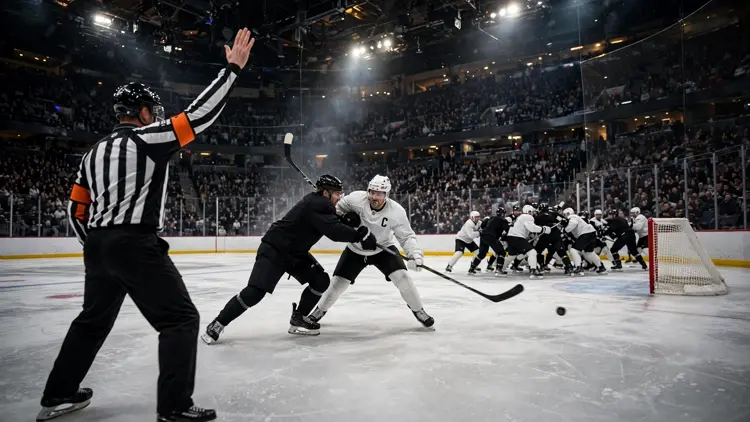
Frank Nazar Gets a Match Penalty for a High Hit on Bo Horvat as the Islanders Captain Is Evaluated
Frank Nazar was given a match penalty for a shoulder to Bo Horvat's head on an empty-net goal, and Horvat was evaluated for a possible concussion.
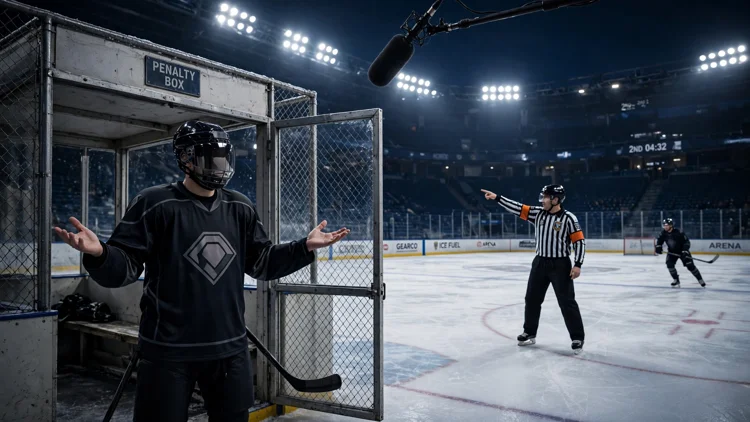
Fraser Minten Sent to the Box for a Teammate's Slash, Then Talks the Referee Out of It
Bruins forward Fraser Minten was given a slashing penalty committed by James Hagens, told the referee on a hot mic, and watched the officials reverse it.
NHL Pulls 'Hot for Hockey' Romance Audio Series From Spotify Less Than a Week After Launch
The NHL has removed its 'Hot for Hockey' romance-style audio stories from Spotify and will make no more, less than a week after launching the series.