
Power Play in Hockey Explained: The Rule, Simply

On this page6
A power play is what happens when one team has more skaters on the ice than its opponent because the opponent is serving a penalty. The short-handed team is meanwhile on the penalty kill, trying to survive the disadvantage. It is also called a man advantage, and it is the single biggest scoring opportunity in hockey: NHL teams convert somewhere between one in five and nearly one in three power plays depending on the season and the team. How long it lasts, and whether a goal ends it early, depends entirely on which penalty caused it.
What does a power play mean in hockey?
When a player is sent to the penalty box, their team must play with one fewer skater until the penalty expires. The opposing team gets extra space, extra time with the puck, and usually pulls an extra forward onto the ice to attack with five skaters against four defenders and a goalie. That situation is the power play. The team serving the penalty is “shorthanded” or “on the penalty kill,” the exact mirror image of the same two minutes.
Officials signal a penalty, play stops (or continues briefly under a delayed-penalty signal until the penalized team touches the puck), and the clock starts on the power play the moment the penalized player sits down. The NHL’s video rulebook walks through how each call is signaled on ice. Everything else, how long it runs and what ends it, is decided by penalty type.
How long does a power play last? Minor, double-minor, and major penalties compared
Not every penalty buys the same amount of power-play time, and that difference is the part most explainers skip. The NHL’s official rulebook sets four separate categories, and each behaves differently when the power-play team scores.
| Penalty type | Time served | Does a power-play goal end it early? |
|---|---|---|
| Minor (Rule 16) | 2 minutes | Yes: penalty ends the instant the power-play team scores |
| Double-minor (Rule 18) | 4 minutes (two 2-minute blocks) | Only the current block is canceled; the second block still starts |
| Major (Rule 20) | 5 minutes, in full | No: the full 5 minutes plays out regardless of goals scored |
| Match penalty (Rule 21) | 5 minutes, served by a substitute; offender ejected | No: same as a major, goals do not shorten it (except in overtime) |
Minor penalties are the routine ones: hooking, tripping, holding, interference. They run two minutes and, per the NHL rulebook, end the moment the power-play team scores, sending the penalized player straight back onto the ice.
Double-minors are typically high-sticking that draws blood or a similar penalty treated as two stacked minors. A goal in the first two minutes only cancels that block; the penalized player still owes the second two minutes. Score again in that second block and the power play ends there.
Majors are five-minute penalties for things like fighting or boarding that injures an opponent, and they do not shorten no matter how many goals go in. A team can, in theory, score three or four times on a single major power play, and the shorthanded team still serves every second. Match penalties work the same way: the offending player is ejected from the game entirely, a teammate serves the five minutes in the box, and goals do not shorten it either. The only exception across the board is overtime, where any power-play goal ends the game immediately, penalty or not.
What is a 5-on-3 in hockey?
A 5-on-3 happens when two players from the same team are serving penalties simultaneously, so their opponent attacks with five skaters against three defenders and a goaltender. It is the rarest and most dangerous power play in the sport because the shorthanded team has almost no way to cover passing lanes.
The rulebook caps how few skaters a team can have on the ice at three, not counting the goalie, so a team can never be forced below a 5-on-3. If the power-play team scores during a 5-on-3, only one penalty clears (the one closer to expiring), and the situation drops to a standard 5-on-4 rather than clearing both players at once. A second goal is needed to fully kill both penalties before their clocks expire.
Current NHL power-play numbers: what “good” looks like
Power-play efficiency swings hard by team and by year. Historically, NHL teams converted under 19% of power plays for more than two decades between the mid-1990s and mid-2010s, and only 18 seasons since 1963-64 have topped a 20% league-wide success rate, most of them in the high-scoring 1970s and ’80s, according to NHL.com’s own facts-and-figures reporting. The league sat at 17.8% as recently as 2007-08 before climbing back above 19% in the late 2010s.
The spread between teams is where it gets extreme. Per Covers.com’s team power-play tracker, Edmonton’s power play converted at roughly 30.6% this season, while the league’s weakest unit sat closer to 15.7%, a gap of nearly 15 percentage points on the same rule set. That gap is coaching and personnel, not officiating. A top-five power play scores on roughly one of every three tries; a bottom-five unit needs six or seven chances for one goal.
How power-play units are set up: umbrella vs. overload
Once you understand the clock, the strategy layer is short. Coaches build a five-man unit around one of two base formations, and most NHL teams run a version of both depending on personnel.
The umbrella spreads three players across the top of the offensive zone (two defensemen at the points and a center or winger at the top of the circle), with two forwards planted on the goal line. It is built for a heavy point shot with traffic and rebounds in front, and it is the standard shape when a team has a genuine one-timer threat at the left circle (think a right-handed shooter catching a pass from the point).
The overload, sometimes called the “1-3-1” in its modern form, stacks four players to one side of the ice (corner, half-wall, slot, and point), with a single forward parked on the weak side for cross-ice passes and backdoor tap-ins. It creates a numbers advantage in one small area and forces the penalty kill to constantly shift and re-cover, which is why most modern power plays default to it.
Neither formation is “correct.” Teams with a true shooting threat at the top lean umbrella; teams built around puck movement and a net-front presence lean overload or 1-3-1. Either way, the two-minute clock is the same, and the formation exists to beat it before it expires.
Related hockey rules worth knowing
A power play only exists because a penalty was called, so the rest of the rulebook matters just as much. If you want to know why a play got whistled dead before the penalty ever mattered, see our breakdown of icing in hockey rules explained. If the rink geography is the confusing part, our hockey rink dimensions guide shows the blue lines, faceoff circles and goal crease where power-play structure takes shape. And if a big power-play moment is what got you into the sport, our guide to Eastern Conference Finals tickets covers what it costs to see one live.
For the full picture of how a hockey game is officiated and scored beyond penalties, visit our Ice Hockey hub for rules, stats, and player coverage across the league.
The bottom line on power plays
A power play is simple at its core: one team has more skaters because the other is being punished. But the clock behind it is not one-size-fits-all. Minors reward a fast goal by ending early; majors and match penalties do not care how many times you score. Know which penalty is on the clock and you know exactly how much time your team’s power play, or its penalty kill, actually has left.
Frequently asked questions
What is a power play goal in hockey?+
A power play goal is any goal scored by the team with more skaters on the ice because the other team is serving a penalty. It counts as a normal goal on the scoreboard, but it is tracked separately in stats, and on a minor penalty it also ends that penalty early, sending the penalized player back onto the ice immediately.
How long does a power play last?+
It lasts as long as the penalty that caused it. A minor penalty gives a two-minute power play, a double-minor gives four minutes split into two two-minute blocks, and a major penalty gives a full five minutes. A power play also ends immediately if the shorthanded team's penalty time expires first.
Does a power play end if the power-play team scores?+
Only on a minor penalty. Score during a two-minute minor and the penalty ends instantly, even if a minute is left. On a major or match penalty, the power play runs the full five minutes no matter how many goals go in, unless it happens in overtime, which ends the game outright.
What is a 5-on-3 in hockey?+
A 5-on-3 happens when two players from the same team are in the penalty box at once, so their opponent skates with five players against three. Only one of the two penalties can be canceled by a power-play goal; scoring during the 5-on-3 knocks it down to a normal 5-on-4, it does not clear both penalties.
Can a shorthanded team score during a power play?+
Yes. A goal scored by the penalized team while shorthanded is called a shorthanded goal, and it does not end the penalty or return the penalized player early. The power play continues at full strength for the penalized team's remaining time, same as if no goal had been scored.
What is the difference between a power play and a man advantage?+
None in practice. 'Power play' and 'man advantage' describe the exact same situation from the same team's point of view: they have more skaters on the ice than their opponent because of a penalty. Broadcasters use both terms interchangeably, and neither refers to a different rule.
Sources
Play & tools
Free browser games and tools — no account, no download.
- Play 98-0 — Draft a 12-player all-time NHL roster and chase a perfect 98-0 — 82 regular-season wins plus a swept Cup.
- Explore all our games →
Related ice hockey guides
View all →
Icing in Hockey Explained: The Rule, Simply
What icing in hockey means, how the NHL's hybrid icing race-to-the-dot call really works, when it's waved off, and how NHL, IIHF, and NCAA rules differ.
Brady Tkachuk Scores on a First-Period Power Play in His First Game Back in Ottawa
Brady Tkachuk's first game in Ottawa as a visitor brought boos, a Brady sucks chant, a booed tribute video and a first-period power-play goal. The reception, the goal, and the night Ottawa answered with a 5-1 win.
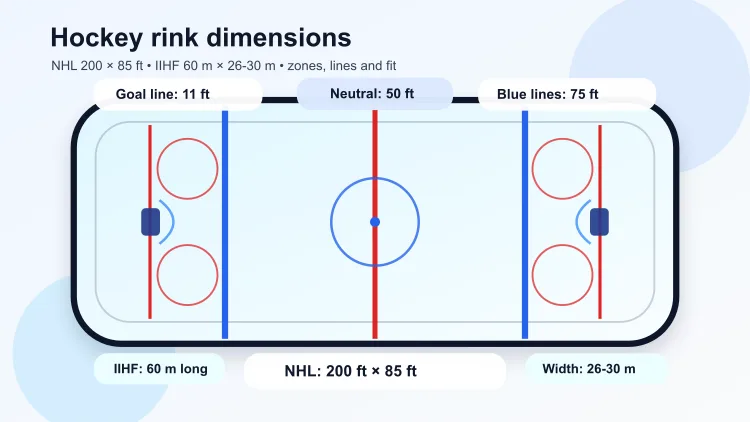
Hockey Rink Dimensions: NHL, IIHF and Youth Sizes
Official hockey rink dimensions for NHL, North American, IIHF and Olympic ice, with rink lines, zones, goal lines, boards and a fit calculator.
How Many Periods Are in a Hockey Game? NHL Rules Explained
How many periods are in a hockey game: three 20-minute periods, how long intermissions last, and how NHL overtime and shootouts settle ties.
Types of Shots in Ice Hockey: Every Shot Explained
The main types of shots in ice hockey are the wrist shot, slap shot, snap shot, backhand, one-timer, wraparound, and deflection. Full breakdown here.
What Is a Deke in Hockey? Meaning, Types, and Examples
A deke in hockey is a fake move used to skate past a defender or goalie. Learn the term's origin, the main types of dekes, and how they're used.