
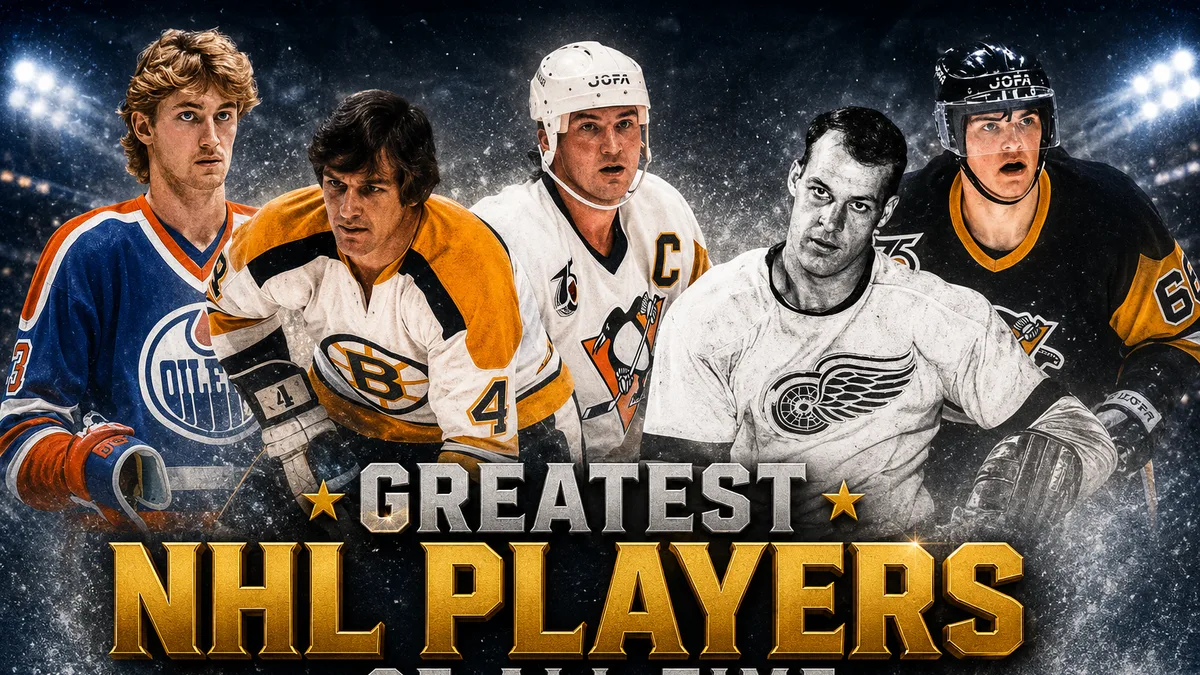
Greatest NHL Players of All Time: The Definitive Ranked List
On this page13
- 01Greatest NHL players of all time at a glance
- 02Wayne Gretzky
- 03Bobby Orr
- 04Mario Lemieux
- 05Gordie Howe
- 06Maurice Richard
- 07Bobby Hull
- 08Steve Yzerman
- 09Sidney Crosby
- 10How We Ranked the Greatest NHL Players
- 11Why Era Adjustment Matters in Hockey
- 12Greatest NHL Players: Quick Comparison
- 13The Modern Chase and What’s Still Unsettled
Rank rises with peak dominance over the field, then career production, Stanley Cups and major individual awards, and how much a player forced the sport to change. Longevity breaks ties; era-adjusted scoring stops raw totals from favoring high-scoring decades.
Greatest NHL players of all time at a glance
| Rank | Player | Position | Strongest ranking argument |
|---|---|---|---|
| 1 | Wayne Gretzky | Centre | 2,857 points and nine Hart Trophies |
| 2 | Bobby Orr | Defense | Eight straight Norris wins; transformed the position |
| 3 | Mario Lemieux | Centre | Extraordinary 1.88 career points per game |
| 4 | Gordie Howe | Right wing | Elite production and longevity across decades |
| 5 | Maurice Richard | Right wing | First player to score 50 goals in 50 games |
| 6 | Bobby Hull | Left wing | Led the NHL in goals seven times |
- The Great One
Wayne Gretzky
Strip every one of Gretzky's 894 career goals off his record and his 1,963 assists alone still outscore every other player's total points — Jaromir Jagr, second all-time, finished with 1,921. No one else on this list survives that test, which is why Gretzky gets a placement no debate touches. He retired in 1999 with 2,857 points, roughly 1,000 clear of the field.
The trophy case matches the math: four Stanley Cups with Edmonton and nine Hart Trophies as league MVP, eight of them in a row. His 92-goal 1981-82 season and 215-point 1985-86 season remain the two highest single-season marks in NHL history.
Position: C · Era: 1979–1999 · Cups: 4 · Awards: 9x Hart, 10x Art Ross · Defining feat: 2,857 career points
- Best defenseman ever
Bobby Orr
Orr ranks this high because he broke what a defenseman was allowed to be. He won the Norris Trophy as top blueliner eight straight years (1968–1975) and is still the only defenseman to win the NHL scoring title, doing it twice. In 1970-71 he posted 139 points — a number no defenseman has approached since.
He edges the per-game brilliance of the next man because he paired that offense with three Hart Trophies and two Stanley Cups in Boston while defending at an elite level. Chronic knee injuries ended his prime by his mid-20s, capping the career but not the ceiling.
Position: D · Era: 1966–1979 · Cups: 2 · Awards: 8x Norris, 3x Hart · Defining feat: only defenseman to win a scoring title
- Peak rival to Gretzky
Mario Lemieux
On raw per-game output, Lemieux is the closest anyone came to Gretzky: his 1.88 career points per game trails only Gretzky among players with long careers. He won two Stanley Cups, three Hart Trophies, and led Pittsburgh's back-to-back titles in 1991 and 1992 as the best player on the ice.
He sits below Orr here because injuries and a 1993 Hodgkin's lymphoma diagnosis cost him large chunks of his prime and full seasons of games. That he returned from cancer treatment and still won scoring titles is the argument that he belongs even higher.
Position: C · Era: 1984–2006 · Cups: 2 · Awards: 3x Hart, 6x Art Ross · Defining feat: 1.88 career points per game
- Mr. Hockey
Gordie Howe
Howe's case is durability at a dominant level, not merely a long stay. He won six Hart Trophies and four Stanley Cups with Detroit and finished top-five in league scoring for 20 straight seasons — a run of sustained excellence no one has matched.
He played professional hockey into his 50s, including a WHA stint alongside his sons, and logged more than 800 NHL goals across 26 seasons. The combination of physical toughness, scoring, and staying power keeps him ahead of the pure scorers below.
Position: RW · Era: 1946–1980 · Cups: 4 · Awards: 6x Hart · Defining feat: 20 straight top-five scoring finishes
- The Rocket
Maurice Richard
Richard was the first player to score 50 goals in 50 games, hitting the mark in 1944-45 when a 50-game schedule made it a genuine ceiling. He was the finishing threat at the center of a Montreal Canadiens dynasty that won eight Stanley Cups during his career.
He ranks on impact and winning rather than career length or assist totals, which trail the modern scorers. His playoff scoring in a rough, low-scoring era, plus the passion that made him a national figure in Quebec, cements the placement.
Position: RW · Era: 1942–1960 · Cups: 8 · Awards: 1x Hart · Defining feat: first to 50 goals in 50 games
- The Golden Jet
Bobby Hull
Hull weaponized the slap shot and the curved stick blade, and his skating speed made him the most feared left wing of the 1960s. He led the NHL in goals seven times and won two Hart Trophies, powering Chicago to the 1961 Stanley Cup.
He lands below Richard because his one NHL title trails the Rocket's dynasty haul, but his 1972 jump to the WHA also reshaped hockey's labor market and helped force salaries upward across both leagues.
Position: LW · Era: 1957–1980 · Cups: 1 · Awards: 2x Hart · Defining feat: 7x NHL goal-scoring leader
- The Captain
Steve Yzerman
Yzerman ranks on transformation as much as production. He started as a pure scorer with 155 points in 1988-89, then remade himself into a two-way defensive center to win, captaining Detroit to three Stanley Cups between 1997 and 2002.
He sits just behind the older scorers because his individual-award shelf is lighter — one Conn Smythe as playoff MVP — but few stars in the cap-era rebuilt their game this successfully mid-career while staying elite.
Position: C · Era: 1983–2006 · Cups: 3 · Awards: 1x Conn Smythe · Defining feat: 155-point season, then a defensive-captain title run
- Modern face of the sport
Sidney Crosby
Crosby has anchored the modern top tier since 2005: two Hart Trophies, two Art Ross scoring titles, and three Stanley Cups with Pittsburgh, including back-to-back Conn Smythe wins in 2016 and 2017. He is the rare superstar who also won two Olympic golds for Canada.
He rounds out the eight rather than climbing higher because his career overlaps a deeper, more even league than the Original Six greats faced, and he is still adding to a résumé that hasn't fully closed. Compare his hardware with the field on our most hat tricks in NHL history breakdown.
Position: C · Era: 2005–present · Cups: 3 · Awards: 2x Hart, 2x Conn Smythe · Defining feat: back-to-back Cups and Conn Smythes, 2016–17
Reader interaction
Build your ranking
Drag the names into the order you think is right — or use the arrows — then submit to see how your list compares with everyone else's.
- Wayne Gretzky
- Bobby Orr
- Mario Lemieux
- Gordie Howe
- Maurice Richard
- Bobby Hull
- Steve Yzerman
- Sidney Crosby
Audience ranking
How everyone ranked them
Built from reader rankings using position-based points.
Wayne Gretzky’s assists alone outscore every other player’s career point total. That single fact settles first place and reframes everything below it: the real argument on this list is for second, and it turns on how you weigh a defenseman’s revolution against a scorer’s per-game peak. The ranked cards above give each player’s case; the sections here explain how we weighed them and where the era comparisons get tricky.
How We Ranked the Greatest NHL Players
We started with peak dominance — how far a player stood above the rest of the league at his best — because that travels across eras better than any counting stat. Career production came next, then Stanley Cups and major individual awards (Hart, Norris, Art Ross, Conn Smythe), and finally how much a player forced the sport itself to change. Longevity broke ties.
That order is why Bobby Orr outranks higher raw scorers: no one else changed a position’s job description. It is also why a modern star with gaudy totals doesn’t automatically leap the Original Six greats — a bigger, faster, 32-team league inflates numbers that a 50-game Original Six schedule never allowed.
Why Era Adjustment Matters in Hockey
Hockey’s scoring environment has swung wildly. The 1980s were a goal-scoring boom; the “dead puck” era of the late 1990s and early 2000s suppressed offense with clutching and trap systems; today’s game sits somewhere between. A raw goal or point total means very different things depending on when it was scored.
The cleaner signal is where a player finished relative to his peers — league scoring titles, top-five placements, and MVP voting — because that compares him against the exact competition he faced. Modern analytics push the same idea further; our explainer on what Corsi is in hockey covers how shot-attempt differential tries to measure two-way value the box score misses.
Greatest NHL Players: Quick Comparison
| Player | Position | Era | Stanley Cups | Signature marker |
|---|---|---|---|---|
| Wayne Gretzky | C | 1979–1999 | 4 | 2,857 points; 9x Hart |
| Bobby Orr | D | 1966–1979 | 2 | 8x Norris; only D to win a scoring title |
| Mario Lemieux | C | 1984–2006 | 2 | 1.88 points per game |
| Gordie Howe | RW | 1946–1980 | 4 | 20 straight top-five scoring finishes |
| Maurice Richard | RW | 1942–1960 | 8 | First to 50 goals in 50 games |
| Bobby Hull | LW | 1957–1980 | 1 | 7x NHL goal-scoring leader |
| Steve Yzerman | C | 1983–2006 | 3 | Scorer turned two-way title captain |
| Sidney Crosby | C | 2005–present | 3 | Back-to-back Cups and Conn Smythes |
The Modern Chase and What’s Still Unsettled
Two active players are actively moving the goalposts. Alexander Ovechkin passed Gretzky’s career goals record in April 2025 and keeps extending it, a chase that looked impossible a decade ago. Connor McDavid, the most skilled skater of his generation, is still assembling the résumé — scoring titles and a Conn Smythe already in hand — that will decide how high he climbs.
Both cases are reminders that an all-time list is a snapshot, not a verdict. For related deep dives, see our guides to the most Stanley Cups won by a player and the most Stanley Cups by a team.
Frequently asked questions
Who is the greatest NHL player of all time?+
Wayne Gretzky is the near-universal pick. His 2,857 career points sit about 1,000 ahead of anyone else, and his 1,963 assists alone would top the all-time points list even if you erased every goal he scored. No other player's résumé holds up to that thought experiment, which is why his No. 1 ranking draws essentially no serious argument among historians and former players.
Is Bobby Orr or Mario Lemieux the second-greatest NHL player?+
It is the closest debate on this list. Orr is the greatest defenseman ever and the only one to win a scoring title, with eight straight Norris Trophies and three Hart Trophies. Lemieux has the higher per-game scoring rate at 1.88 points per game. Most rankings give Orr the edge for defending elite while producing elite, but either pick is defensible depending on how you weigh position.
Who has scored the most goals in NHL history?+
Alexander Ovechkin holds the record. On April 6, 2025 he scored his 895th career goal to pass Wayne Gretzky's long-standing mark of 894, and he has kept adding to the total since. Gretzky still owns the all-time record for career points, 2,857, which is considered far harder to break because it rewards both goals and playmaking over a full career.
Why isn't Connor McDavid on the top-eight list yet?+
McDavid is arguably the most skilled skater the league has ever seen and has already won multiple Art Ross scoring titles, Hart Trophies, and a Conn Smythe. He is left off the settled top eight because an all-time ranking rewards a finished body of work — total production, longevity, and championships. McDavid is still early enough in his career that his final placement remains open; on peak talent he is already knocking on the door.
How do you compare players across different NHL eras?+
Raw totals favor high-scoring decades, so era matters. A 50-goal season in the 1940s came against a 50-game schedule and Original Six competition; a 50-goal season today comes over 82 games against 32 teams and modern goaltending. Useful adjustments include a player's finish relative to the league (scoring titles, top-five placements) and dominance over peers, rather than counting stats alone. That is why Richard and Howe rank on impact, not just numbers.
Where do modern stars like Ovechkin and McDavid rank all-time?+
Ovechkin's case is built on volume: he is now the all-time leading goal scorer and a former Hart winner and Cup champion, which puts him firmly in the broader top 15 and rising. McDavid's is built on peak brilliance and scoring titles. Neither has the finished, decades-long résumé of the top four yet, but both are actively reshaping where the historical lines get drawn.
Sources
Play & tools
Free browser games and tools — no account, no download.
- Play 98-0 — Draft a 12-player all-time NHL roster and chase a perfect 98-0 — 82 regular-season wins plus a swept Cup.
- Explore all our games →
Related ice hockey guides
View all →
Biggest Hockey Hits in NHL History
The biggest hockey hits in NHL history, ranked: from Scott Stevens on Lindros and Kariya to Cam Neely and Denis Potvin, plus how Rule 48 changed the game.
Most Dangerous NHL Players of All Time: Feared on the Ice
The most dangerous NHL players ranked: lethal snipers, punishing power forwards, and feared enforcers, judged by how many ways they threatened opponents.

11 Greatest Field Hockey Players of All Time, Ranked
Meet the 11 greatest field hockey players ever, ranked by Olympic and World Cup success, individual honors, scoring records, and sustained dominance.

Best NHL Season Ever: Ranking the Greatest Regular Seasons
No NHL team has ever finished undefeated, but the 2022-23 Boston Bruins came closest to perfection with a record 65-12-5, 135-point season. Here is the full ranked leaderboard.

Highest-Paid NHL Players: Ranked by Cap Hit (2025-26)
The 12 highest-paid NHL players by cap hit for 2025-26, ranked and verified: Leon Draisaitl, Auston Matthews, Nathan MacKinnon, Connor McDavid and more, plus why Kirill Kaprizov's record deal isn't #1 yet.
Greatest Female Baseball Players in History
The greatest female baseball players, from All-American Girls League pioneers to modern standouts like Marti Sementelli and international stars.