
Soccer Referee Hand Signals: The Complete Guide
On this page7
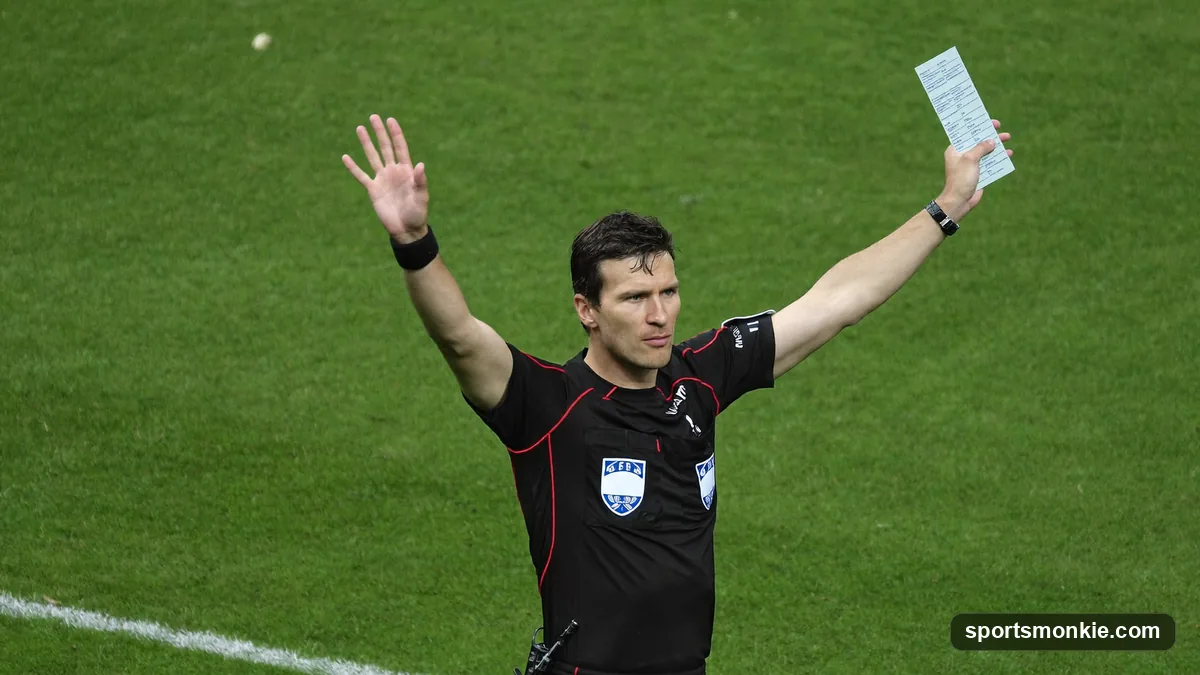
A horizontal arm means direct free kick, a straight arm raised overhead means indirect free kick, and a raised, angled flag from the sideline means offside — soccer referees and their assistants rely on a fixed set of hand and flag signals defined in the Laws of the Game so every decision is instantly readable by players, coaches, and fans, even from the far side of the stadium.
Because a referee’s whistle can get lost in crowd noise, the visual signal is often the only cue 22 players and two benches actually see. Learning to read them turns a confusing stoppage into a clear, predictable moment — whether you’re playing, coaching, or watching from football / soccer coverage on SportsMonkie.
Why referee signals exist
The Laws of the Game, maintained by the International Football Association Board (IFAB), require the center referee to indicate certain decisions with an arm signal in addition to the whistle. This isn’t optional flair — it’s how officiating stays consistent across every language and stadium in the world. A referee in Buenos Aires and a referee in Seoul use the exact same arm position for a penalty kick, which is part of why the sport travels so well. That same logic — a small, memorized vocabulary of gestures instead of shouted explanation — shows up across sports; see our broader referee hand signals by sport breakdown for how football’s system compares to basketball, American football, and hockey.
The core referee signal table
This table covers the signals a center referee gives directly, plus the assistant referee’s flag work. Memorize the arm position first — the meaning follows naturally.
| Signal | Gesture | Meaning |
|---|---|---|
| Direct free kick | One arm extended horizontally, pointing toward the attacking goal | A penal foul occurred; a goal can be scored directly from the kick |
| Indirect free kick | One arm raised straight up above the head, held until the ball is touched twice | A non-penal offense (e.g., offside, dangerous play, technical foul) occurred; the ball must touch a second player before a goal counts |
| Penalty kick | Arm extended, finger pointing directly at the penalty mark | A direct free kick offense occurred inside the offending team’s own penalty area |
| Advantage | Both arms swept forward from the chest, no whistle | A foul happened, but stopping play would benefit the offending team, so play continues |
| Yellow card | Card raised straight overhead, referee facing the cautioned player | A cautionable offense (unsporting behavior, dissent, persistent infringement, etc.) |
| Red card | Card raised straight overhead, referee facing the dismissed player | A sending-off offense; the player must leave the field and match immediately |
| Goal | Referee turns and jogs back to the center circle, arm pointing to the halfway line | The ball fully crossed the goal line between the posts and under the crossbar |
| Corner kick (assistant) | Flag pointed diagonally into the corner arc from the goal line | The ball went out over the goal line off a defender last |
| Goal kick (assistant) | Flag pointed toward the goal area | The ball went out over the goal line off an attacker last |
| Throw-in direction (assistant) | Flag pointed horizontally toward the attacking goal of the team taking the throw | Shows which team gets the throw-in and which way play restarts |
| Offside (assistant) | Flag raised vertically, then angled down/level/up for near, middle, or far third of the pitch | An attacking player was in an offside position when the ball was played to them |
| Substitution | Both arms raised overhead in an X, or an electronic/flag board showing player numbers | A team is changing a player; play stops at the next natural break |
Free kick signals: direct vs. indirect
The two most-confused signals belong right next to each other for a reason. A direct free kick — for fouls like tripping, holding, or handball — gets one arm held flat, pointing at the goal the attacking team is facing. It’s a quick, decisive gesture; the referee usually drops the arm once the kick is set up.
An indirect free kick — for offenses like offside, dangerous play, or a goalkeeper handling a deliberate back-pass — gets one arm raised straight overhead, and the referee must keep it raised until the ball has been kicked and either touches another player, goes out of play, or a goal is otherwise ruled out. If the arm drops before contact and the ball goes straight in, the goal doesn’t count — the most common detail referees get quizzed on, and it’s covered in more depth in our football referee signals guide.
Penalty, advantage, and card signals
A penalty kick signal has to be unmistakable, since it’s the most consequential call a referee makes. The arm points straight and low at the penalty mark itself, not just “toward the box,” and referees typically pair it with a sharp whistle blast and a moment of eye contact with both captains before restart.
Advantage is the opposite of a hard stop — both arms sweep forward from the chest without a whistle, telling everyone “yes, that was a foul, but we’re playing on because it favors the team fouled against.” Cards need no separate arm gesture beyond holding the card itself directly overhead, facing the player being disciplined, so the dugout, the crowd, and broadcast cameras all get an unambiguous view of yellow versus red.
Assistant referee flag signals
Assistant referees (still often called linesmen informally) work the touchlines with a flag instead of a whistle, and their signals govern the flow of the game just as much as the center referee’s. Corner kicks get the flag pointed diagonally into the arc; goal kicks get the flag pointed toward the six-yard area; throw-ins get the flag pointed flat along the touchline in the direction of the restart. All three tell you not just what happened, but which team benefits, since the flag direction always points toward the attacking side that gets the ball.
The offside flag is the most technical of the group. The assistant first raises the flag straight up to freeze the referee’s attention, then angles it to show where on the pitch the offside offense occurred: down toward the ground for the third of the field closest to the assistant’s own goal line, held flat and horizontal for the middle third, and up toward the sky for the far third, nearest the opponent’s goal. Pinpointing location matters for the restart, not just the call itself. For a look at how another fast-moving sport handles similar line-judge duties, see our hockey referee signals breakdown.
Substitution and other stoppage signals
Substitutions are typically flagged by the fourth official holding an electronic board (in professional matches) or, at grassroots level, an assistant referee raising both arms overhead in an X shape to alert the center referee that a change is waiting. The center referee then stops play at the next natural break — not mid-attack — waves the outgoing player off, and confirms the incoming player before restart.
Quick recap for spectators
You don’t need the whole rulebook to follow a match confidently. Watch the referee’s arm height first: flat and horizontal means direct free kick, straight up means indirect free kick, and a point at the ground inside the box means penalty. Then check the sideline — the assistant referee’s flag will usually confirm what just happened before the whistle even finishes. Once those habits click, stoppages that used to look chaotic start reading like a second language, whether you’re at the stadium or catching highlights through SportsMonkie’s football / soccer coverage.
Frequently asked questions
What are soccer referee hand signals?+
Soccer referee hand signals are the standardized arm and flag gestures officials use to communicate decisions without needing to shout over crowd noise. The center referee uses arm signals for free kicks, penalties, advantage, and cards, while the assistant referee (linesman) uses a flag for offside, throw-ins, corners, and goal kicks.
How do you tell a direct free kick from an indirect free kick signal?+
A direct free kick is signaled with one arm extended horizontally, pointing toward the goal the attacking team is facing. An indirect free kick is signaled with one arm raised straight up above the head, and the referee must keep it raised until the ball touches a second player, goes out of play, or the kick clearly cannot result in a direct goal.
What is the referee's advantage signal?+
The referee swings both arms forward from the chest, palms facing the play, without blowing the whistle. This tells players a foul occurred but the disadvantaged team has a better opportunity by continuing, per Law 5 of the Laws of the Game.
How does the assistant referee signal offside?+
The assistant referee raises the flag straight up to freeze play, then angles it to show where the offside offense happened: flag angled down for the near third of the pitch, flag held horizontal across the body for the middle third, and flag angled up for the far third, nearest the opposite goal.
Which arm does the referee raise for a penalty kick?+
The referee points a straight arm directly at the penalty mark, making firm eye contact or a verbal call to remove any doubt, then blows the whistle sharply once to restart with the kick.
How does the assistant referee signal a throw-in?+
The assistant referee points the flag horizontally in the direction the throw-in should go — toward the goal the throwing team is attacking — mirroring the direction of a corner or free-kick flag signal but held level with the touchline.
Do referees use different signals for yellow and red cards?+
No single gesture differs beyond the card color itself. In both cases the referee stops play, approaches the player, and raises the card straight overhead so it is visible to players, benches, and broadcast cameras. Yellow cautions; red sends the player off for the remainder of the match.
How does a referee signal a substitution?+
The fourth official or assistant referee raises both arms overhead in an X, or raises an electronic board/flag showing the numbers of the players leaving and entering, then the center referee stops play at the next opportunity to allow the change.
Sources
Play & tools
Free browser games and tools — no account, no download.
- Play 38-0 — Sign a 4-4-2 of all-time football legends and chase a perfect 38-0 league season — perfect, not just unbeaten.
- Explore all our games →
Related football guides
View all →
Volleyball Referee Signals: Every Official Hand Signal Explained
Volleyball referee signals explained: point, ball in/out, four hits, double contact, net touch, foot fault, ball touched, delay, substitution, and end of set.
Basketball Referee Signals: The Complete Guide to Every Hand Signal
Basketball referee signals explained: scoring, traveling, double dribble, blocking, charging, holding, shot-clock violations, and technical fouls.
Football Referee Signals: The Complete NFL Hand Signal Chart
Football referee signals explained: touchdown, first down, holding, false start, pass interference, and every hand signal NFL officials use on the field.
Referee Hand Signals Explained: Every Major Sport's System
Referee hand signals let officials call fouls, scores, and timing decisions silently. See how NFL, NBA, MLB, NHL, and soccer signals compare.
11v11 Soccer Formations: The Full-Sided Guide to Every Shape
11v11 soccer formations explained: how full-sided lineups work, the most common shapes (4-4-2, 4-3-3, 4-2-3-1, 3-5-2, 5-3-2), and how to pick one.
7v7 Soccer Formations: Best Youth Shapes for U9/U10 Explained
The best 7v7 soccer formations for youth teams are 2-3-1, 3-2-1, 2-1-2-1, 3-1-2, and 1-3-2 — each suited to a different style of U9/U10 play.