
Football Referee Signals: The Complete NFL Hand Signal Chart
On this page6
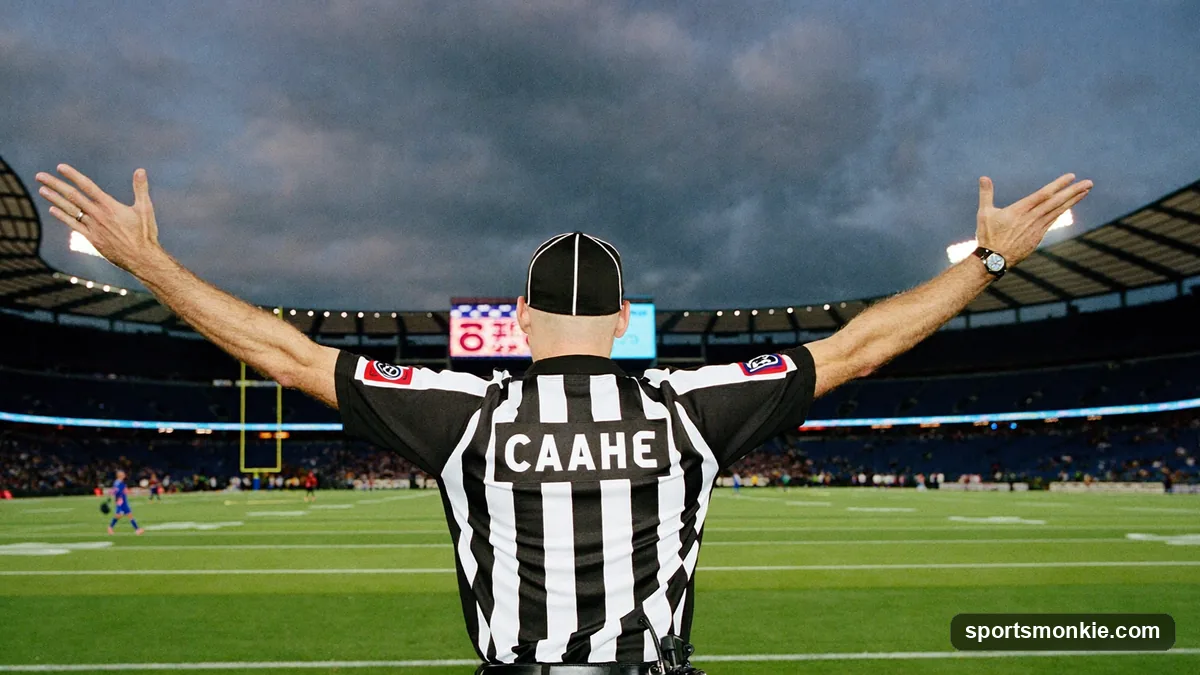
Football referee signals are the standardized hand and arm gestures NFL officials throw on every play to announce touchdowns, first downs, penalties, and administrative rulings — both arms straight overhead means a score, wrists circling at the chest means false start, and a wrist grab in front of the body means holding. These signals exist because a stadium roar can drown out a whistle, so officials rely on a shared visual language that players, coaches, broadcasters, and 70,000 fans in the stands can all read at once.
Every signal starts with the covering official — the one standing closest to the play — throwing the flag and signal immediately. The referee, who is the crew’s spokesperson, then repeats the signal facing the press box and announces the call over a wireless microphone. Learning to read these gestures turns a confusing flag on the field into an instant, understandable ruling.
The core scoring signals
Scoring signals are the ones every fan recognizes, because they trigger the loudest crowd reaction. The referee throws these directly toward the end zone or the broadcast camera so there’s no ambiguity about the outcome of the play.
A touchdown and a successful field goal or extra point actually share the same signal: both arms extended straight up over the head. The context — whether the ball crossed the goal line or sailed through the uprights — tells you which one just happened. Safety uses a similar overhead motion but is visually distinct, since it awards the defense two points instead of the offense six.
Penalty signals every fan should know
Penalty signals are where hand signals matter most, because the flag on the ground doesn’t tell you what happened — only the gesture does. Officials aim to make these signals visually connect to the infraction itself, which is why holding looks like a grab and a personal foul looks like a strike.
False start and delay of game look similar at a glance — both involve circular or rotating arm motion near the chest — but false start is a pre-snap offensive movement penalty, while delay of game means the offense failed to snap the ball before the play clock expired. Pass interference and offensive holding are two of the most consequential penalty signals in the game, since both can wipe out a long completion or a touchdown.
Full signal chart: gesture and meaning
Use this table as a quick reference the next time a flag hits the turf and you want to know what just happened before the announcer explains it.
| Signal | Gesture | Meaning |
|---|---|---|
| Touchdown / Field Goal / Extra Point Good | Both arms extended straight up overhead, palms facing in | Six points scored, or the kick passed between the uprights |
| Safety | Both arms extended straight up overhead, palms together | Two points awarded to the defense; ball spotted at the offense’s own end |
| First Down | One arm extended horizontally, pointing toward the offense’s new target goal line | The offense has gained enough yardage for a new set of downs |
| Incomplete Pass | Both arms wave outward and inward in front of the body | A forward pass hit the ground or was not legally caught |
| Holding | One hand grasps the opposite wrist in front of the chest | Illegal grabbing or restricting of an opponent; 10 yards on offense, 5 on defense |
| False Start | Both wrists rotate over one another at chest height | Offensive player moved illegally before the snap; 5-yard penalty, down replayed |
| Delay of Game | Both forearms rotate over one another out in front of the body | The offense failed to snap the ball before the play clock expired |
| Offside / Encroachment | Both hands placed on the hips | A defensive player lined up in or crossed the neutral zone before the snap |
| Pass Interference | Both arms extended forward in a pushing motion | Illegal contact with a receiver or defender before the pass arrives |
| Personal Foul | One wrist strikes down on the other, held above the head | Excessive or dangerous contact beyond the rules of legal play; 15 yards |
| Unsportsmanlike Conduct | Arms extended out to the sides, parallel to the ground | Taunting, excessive celebration, or other conduct violations |
| Timeout | One hand placed flat on top of the other, forming a “T” | Play clock and game clock stop at a team’s or official’s request |
| Facemask | One hand grips an imaginary facemask at face level | Illegal grabbing of the ball carrier’s or tackler’s facemask |
| Roughing the Passer | Extended arm makes a slashing motion toward the ground | Illegal, unnecessary contact with the quarterback after the throw |
Positional and administrative signals
Not every signal is about a penalty. Officials also use hand signals to manage the flow of the game — restarting the play clock after a stoppage, marking a loss of down, or signaling that a challenge flag is under review. These gestures rarely draw a crowd reaction, but they keep the game moving at the correct pace and confirm to both benches exactly what the officiating crew just decided.
The seven-person NFL crew divides responsibility by position, so the signal you see first usually comes from the official nearest the play — the head linesman at the sideline for a first down, the back judge or field judge for a deep pass interference call, the umpire for an interior-line holding penalty. The referee’s job is to gather that information, confirm it, and re-signal it toward the press box.
Why hand signals still matter in the replay era
Instant replay and coach’s challenges have added a layer of video review to nearly every close call, but the hand signal remains the first and most important communication tool on the field. It tells the offense whether to keep the play alive, tells the defense whether to celebrate, and tells broadcasters what graphic to put on screen — all before the referee’s microphone announcement even finishes. Even after a booth or replay-assist review overturns a call, the signal sequence repeats: the referee faces the sideline, signals the reversed or confirmed ruling, and the game resets around it.
Understanding these gestures is closely related to knowing how officiating differs across sports. If you’ve ever wondered how football’s signal system compares to other leagues, see our breakdown of referee hand signals by sport, which lines up football, basketball, and soccer conventions side by side. For a broader look at how the American football NFL rulebook structures penalties and officiating crews, that guide covers the full mechanics behind every flag. And if you want to compare systems directly, our guides to basketball referee signals and soccer referee signals show how the same core principle — visual communication over noise — plays out with a completely different signal vocabulary.
Quick recap
Football referee signals turn an invisible ruling into something every fan in the stadium can read in under two seconds. Scoring signals (touchdown, field goal, safety) are thrown high and wide for maximum visibility, penalty signals mimic the infraction itself, and administrative signals like timeout and first down keep the game clock and the chains moving correctly. Once you recognize the dozen or so signals in the chart above, you’ll rarely need to wait for the announcer to know exactly what just happened on the field.
Frequently asked questions
What are football referee signals?+
Football referee signals are standardized hand and arm gestures NFL officials use to communicate rulings on every play — scores, penalties, and administrative calls — so players, coaches, broadcasters, and fans understand the decision instantly, even without hearing the whistle or flag explanation.
What is the signal for a touchdown in football?+
A touchdown is signaled by extending both arms straight up over the head, palms facing each other. The referee uses the same signal to confirm a successful field goal or extra point.
How do referees signal a first down?+
The official signals a first down by extending one arm horizontally, pointing toward the offense's new target goal line. It is usually thrown by the head linesman or line judge at the line-to-gain marker, then echoed by the referee.
What is the hand signal for holding in football?+
Holding is signaled by grasping one wrist with the opposite hand in front of the chest, representing the illegal grab that caused the penalty. It is a 10-yard penalty on the offense or a 5-yard penalty on the defense.
How do you know if it's a false start?+
False start is signaled by rotating both wrists over one another at chest height, without a wrist grab. It means an offensive player moved illegally before the snap, resulting in a 5-yard penalty and a re-set of the down.
What signal means pass interference in football?+
Pass interference is signaled with both arms extended forward in a pushing motion, mimicking the contact that occurred before the ball arrived. It can be called on the offense or the defense and carries different yardage consequences for each.
What is the referee signal for a personal foul?+
A personal foul is signaled by one wrist striking down on the other above the head, indicating rough or dangerous contact beyond the rules of legal play. It is a 15-yard penalty and can lead to ejection on repeat or flagrant fouls.
Why do football referees use hand signals instead of just announcing penalties?+
Officials use hand signals because a stadium's noise and distance make voice alone unreliable. The signal is thrown immediately by the covering official, repeated by the referee facing the press box, and paired with a wireless-mic announcement — giving fans, coaches, and broadcasters a visual and audio confirmation at the same time.
Sources
Play & tools
Free browser games and tools — no account, no download.
- Play 17-0 — Draft nine and chase a flawless NFL regular season — the perfect 17-0 run, no playoffs.
- Play 20-0 — Draft nine and chase a perfect NFL season — regular season and playoffs, undefeated.
- Play 16-0 — Draft nine and chase a perfect 16-0 — the classic 16-game NFL regular season, no playoffs.
- Play Flawless Six — Draft five players and a head coach, then chase a perfect NFL season with the right chemistry.
- Play Guess the NFL Player — A new mystery NFL player every day. Eight guesses, with a clue on each — plus free unlimited mode.
- Play NFL Wordle — A Wordle for football — guess the daily NFL player in eight tries, with green-amber-grey feedback on every clue.
- Play NFL Connections — Sort sixteen football tiles into four hidden groups of four. A new daily puzzle, four mistakes allowed, plus unlimited mode.
- Explore all our games →
- Open the schedule simulator — Pick every 2026 NFL game and watch the standings and playoff seeds update live.
- Open the squares generator — Generate a randomized, printable Super Bowl squares grid for your party — free, no sign-up.
- Open the trade calculator — Weigh any fantasy football trade instantly — clear winner and value gap.
- Run the NFL predictor — Simulate the NFL bracket and see who your picks send to the Super Bowl.
- Open the passer rating calculator — Calculate the official NFL passer rating (0–158.3) from any passing line, with the formula shown.
- Explore all our free sports tools →
Related nfl guides
View all →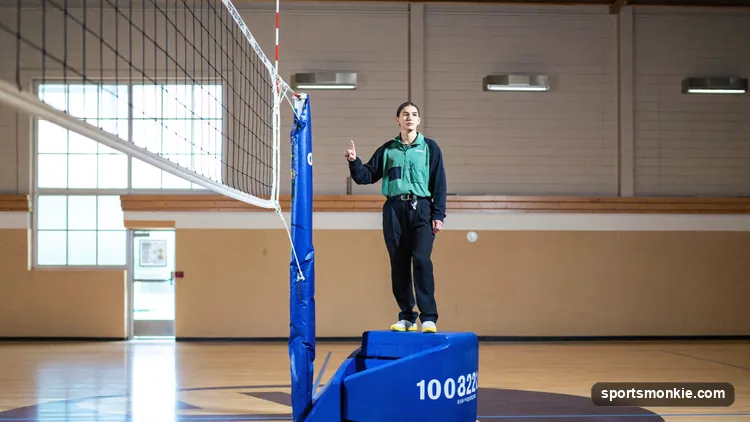
Volleyball Referee Signals: Every Official Hand Signal Explained
Volleyball referee signals explained: point, ball in/out, four hits, double contact, net touch, foot fault, ball touched, delay, substitution, and end of set.
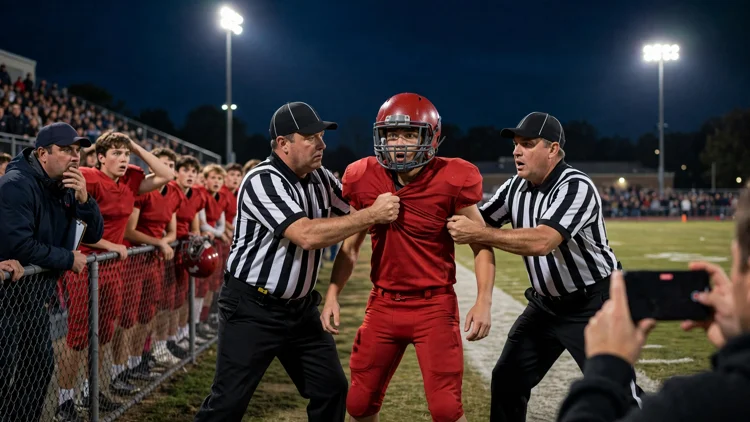
Missouri Referee Suspended Indefinitely After Grabbing a Glendale Player in Viral Video
A Missouri high school referee grabbed Glendale receiver Joelle Rover by the jersey after a touchdown, and the state association suspended him indefinitely.
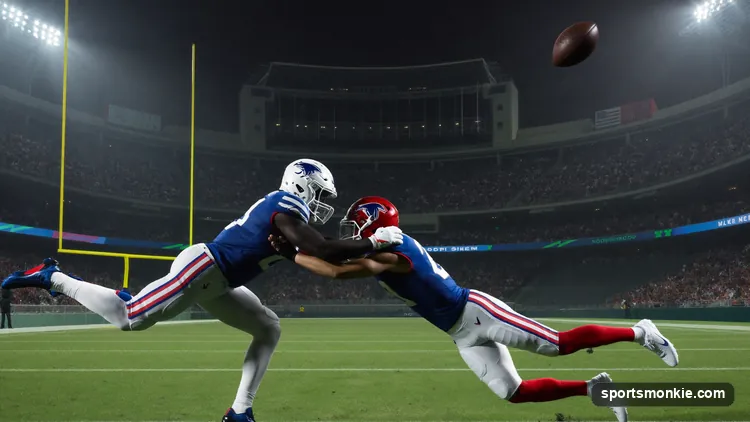
What Is Pass Interference in Football? DPI & OPI
Pass interference is illegal contact that hinders a receiver's chance to catch a pass. In the NFL, defensive PI is a spot foul and automatic first down.
What Is Holding in Football? Offense & Defense
Holding in football is illegally grabbing or restricting an opponent. Offensive holding costs 10 yards, defensive holding 5 yards and a first down.
What Is Intentional Grounding? NFL Rule
Intentional grounding is when a QB in the pocket throws away a pass with no receiver near to avoid a sack. The NFL rule, penalty, and why a spike is legal.
What Is a First Down in Football? The 10-Yard Rule Explained
A first down gives the offense four attempts to move the ball 10 yards. Gain the 10 and you earn a fresh set of downs. Here's how the core rule works.