
What Is Pass Interference in Football? DPI & OPI
On this page5
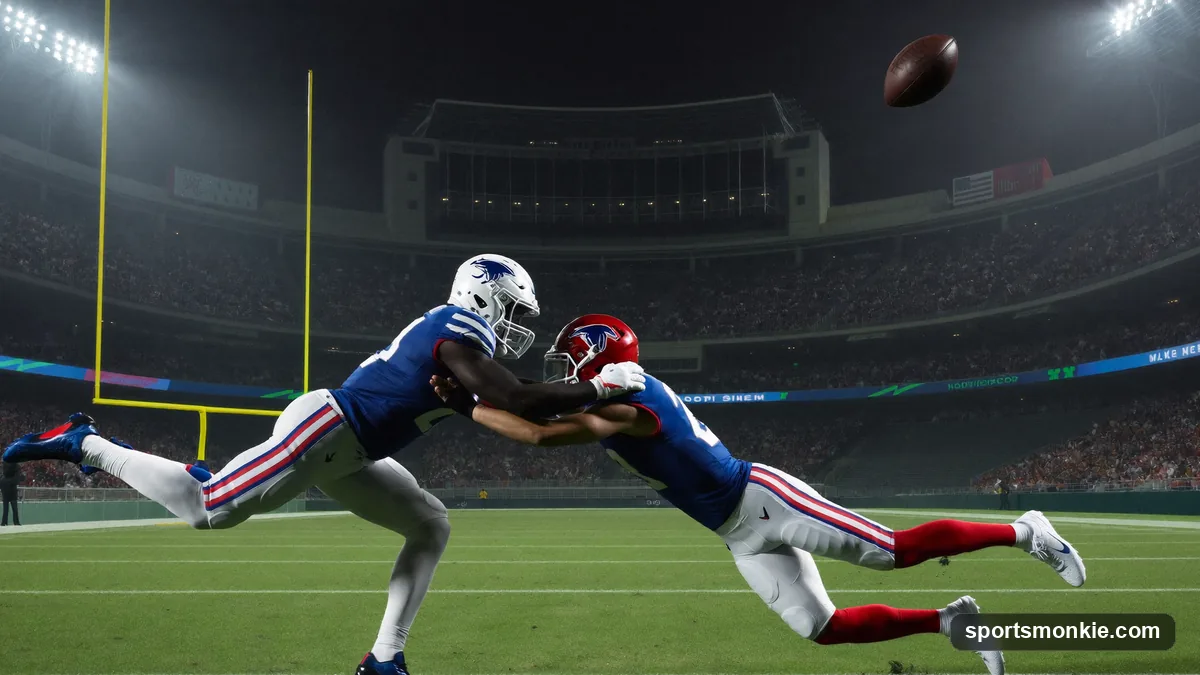
Pass interference is significant illegal contact that hinders an eligible receiver’s opportunity to catch a catchable forward pass while the ball is in the air, more than one yard beyond the line of scrimmage. In the NFL, defensive pass interference (DPI) is a spot foul plus an automatic first down; offensive pass interference (OPI) is a flat 10-yard penalty.
The two types: DPI and OPI
There are two sides to the same rule, and the NFL treats them very differently.
| Defensive PI (DPI) | Offensive PI (OPI) | |
|---|---|---|
| Who commits it | The defender | The receiver |
| Typical act | Grabbing an arm, playing through the receiver’s back | Pushing off to create separation |
| Penalty | Spot foul + automatic first down | 10 yards from previous spot |
| Yardage cap | None — can be 40+ yards | Capped at 10 yards |
That imbalance is why a single DPI flag on a deep ball can be one of the most valuable “plays” an offense runs.
When interference can — and can’t — be called
Three conditions must all be true: the pass is a forward pass, the ball is in the air, and the contact happens more than one yard downfield. Inside that first yard, contact falls under illegal-contact and holding rules instead. The pass also has to be catchable; there is no interference on a ball no receiver could reach.
Contact before the throw is a different rule
If a defender grabs or bumps a receiver before the quarterback releases the ball, that is not pass interference — it is illegal contact or holding. Interference only applies to contact while the ball is in flight. This distinction matters on scramble plays, where a quarterback buying time with play action can turn early contact into a different flag entirely.
Why face-guarding is legal in the NFL
Unlike college and high school, the NFL allows a defender to wave his arms in front of a receiver’s face without looking back for the ball, as long as he makes no contact. “Face-guarding” alone is not interference in the pros. The foul requires contact that restricts the catch, which is why NFL defensive backs are coached to play the receiver’s hands rather than the ball when they lose track of it.
How a PI call can decide a game
Because DPI is uncapped, one flag can flip field position from a team’s own 30 to the opponent’s 30. It is not reviewable as of 2026 — the 2019 replay experiment lasted a single season — so the on-field judgment stands. A late DPI can set up a game-winning drive or, in overtime, hand a team the field position it needs to end the game. For more on how the pro game is officiated, see our NFL rules and guides.
The cost of a disputed no-call showed up in October 2026, when a third-down non-call on Cardinals tight end Trey McBride sparked the sideline argument that ended with the NFL reviewing an official who appeared to curse at McBride.
Frequently asked questions
What is the penalty for defensive pass interference in the NFL?+
Defensive pass interference in the NFL is a spot foul: the offense gets the ball at the exact spot where the foul occurred, plus an automatic first down. There is no yardage cap, so a deep pass drawing a DPI flag can gain 40, 50 or more yards in a single play. If the foul happens in the end zone, the ball is placed at the 1-yard line. This makes DPI one of the most game-changing penalties in football.
How is offensive pass interference different from defensive?+
Offensive pass interference (OPI) is called on the receiving team's player — usually for pushing off a defender to create separation — and is a flat 10-yard penalty from the previous spot with no automatic first down and no loss of down beyond the yardage. Defensive pass interference (DPI) is a spot foul with an automatic first down. The NFL punishes DPI far more harshly than OPI, which is why the same shove is far more costly for a defender.
When can pass interference be called?+
Pass interference can only be called on a forward pass, once the ball is in the air, and only more than one yard beyond the line of scrimmage. Contact within the first yard is governed by different illegal-contact and holding rules. The pass must also be catchable in the officials' judgment; there is no interference on an uncatchable ball. Contact before the ball is thrown is not PI — it may be illegal contact or holding instead.
Is face-guarding pass interference in the NFL?+
No. In the NFL a defender may turn and wave his arms in front of a receiver's face without making contact — 'face-guarding' — and it is legal as long as there is no contact that hinders the receiver. This differs from college and high school rules, where face-guarding can be flagged. In the NFL, interference requires actual contact that restricts the receiver's opportunity to make the catch.
Is pass interference reviewable?+
Not currently. The NFL briefly made pass interference reviewable by replay for the 2019 season after a notorious missed call in the NFC Championship Game, but the experiment was scrapped after one year because reversals were inconsistent. As of 2026, a pass-interference call — or a non-call — cannot be challenged and stands as the officials rule it on the field.
What's the difference between pass interference and holding?+
Holding involves grabbing or restricting an opponent and can happen anywhere on the field at almost any time, including on running plays; defensive [holding](/what-is-holding-in-football/) is a 5-yard penalty and automatic first down. Pass interference specifically involves contact that hinders a receiver's chance to catch a pass in the air, more than a yard downfield, and defensive PI is a spot foul. A grab before the ball is thrown is holding; contact on the ball in the air is interference.
Can there be pass interference on a tipped ball?+
No. Once a pass is tipped or touched by any player at or beyond the line, pass-interference restrictions are off — defenders and receivers can make contact freely as they both play a now-'loose' ball. This is why a deflection at the line can suddenly turn a would-be penalty into legal, chaotic contact downfield.
Sources
Play & tools
Free browser games and tools — no account, no download.
- Play 17-0 — Draft nine and chase a flawless NFL regular season — the perfect 17-0 run, no playoffs.
- Play 20-0 — Draft nine and chase a perfect NFL season — regular season and playoffs, undefeated.
- Play 16-0 — Draft nine and chase a perfect 16-0 — the classic 16-game NFL regular season, no playoffs.
- Play Flawless Six — Draft five players and a head coach, then chase a perfect NFL season with the right chemistry.
- Play Guess the NFL Player — A new mystery NFL player every day. Eight guesses, with a clue on each — plus free unlimited mode.
- Play NFL Wordle — A Wordle for football — guess the daily NFL player in eight tries, with green-amber-grey feedback on every clue.
- Play NFL Connections — Sort sixteen football tiles into four hidden groups of four. A new daily puzzle, four mistakes allowed, plus unlimited mode.
- Explore all our games →
- Open the schedule simulator — Pick every 2026 NFL game and watch the standings and playoff seeds update live.
- Open the squares generator — Generate a randomized, printable Super Bowl squares grid for your party — free, no sign-up.
- Open the trade calculator — Weigh any fantasy football trade instantly — clear winner and value gap.
- Run the NFL predictor — Simulate the NFL bracket and see who your picks send to the Super Bowl.
- Open the passer rating calculator — Calculate the official NFL passer rating (0–158.3) from any passing line, with the formula shown.
- Explore all our free sports tools →
Related nfl guides
View all →
What Is Holding in Football? Offense & Defense
Holding in football is illegally grabbing or restricting an opponent. Offensive holding costs 10 yards, defensive holding 5 yards and a first down.
What Is a Challenge Flag in Football? NFL Replay Rules
A challenge flag is the red flag an NFL coach throws to request an instant-replay review. Teams get two challenges, a third if both succeed, and lose a timeout if wrong.
What Is a Safety in Football? The 2-Point Score
A safety in football is worth 2 points, awarded to the defense when the ball carrier is downed in his own end zone. The conceding team then free-kicks from its 20.
What Is an Eligible Receiver in Football?
An eligible receiver is a player allowed to catch a forward pass — the QB, backs, tight ends and the two players on the ends of the line. Interior linemen are ineligible.
What Is the Two-Minute Warning in Football?
The two-minute warning is an automatic clock stoppage when two minutes remain in each half of an NFL game. It works like a free timeout for both teams.
What Is a Touchback in Football? Rules
A touchback is when the ball is dead in the end zone off the opponent. No points score; the receiving team gets the ball at a set yard line.