
What Is Holding in Football? Offense & Defense
On this page4
Holding in football is illegally grabbing, hooking or restricting an opponent so they cannot move freely, and it comes in two forms. Offensive holding, when a blocker grabs a defender illegally, is a 10-yard penalty in the NFL. Defensive holding, when a defender grabs or restricts a receiver or blocker, is a 5-yard penalty plus an automatic first down.
The reason holding is the most-discussed penalty in the sport is that it happens on nearly every play to some degree, and officials must judge which grabs cross the line. Understanding that line, legal block versus illegal hold, is the whole game. Here is how the NFL rulebook draws it, on both sides of the ball.
Legal block vs illegal hold
Blocking is legal and essential; holding is the illegal version of it. The rulebook allows a blocker to use the body and open hands, but only inside the opponent’s frame, roughly the area between the shoulders and the torso, and the blocker cannot clamp on and restrict.
It becomes holding when the contact turns into grabbing, hooking, twisting or restricting. The classic offenses are:
- Grabbing outside the frame (an arm, the back of a jersey, a shoulder from behind).
- Hooking or wrapping an arm around a defender to stop them getting past.
- Grabbing and twisting a jersey to steer or slow an opponent.
- Pulling a defender to the ground who was about to beat the block.
If a defender is obstructed and the blocker releases, that is a block. If the defender is grabbed and restricted, that is a hold.
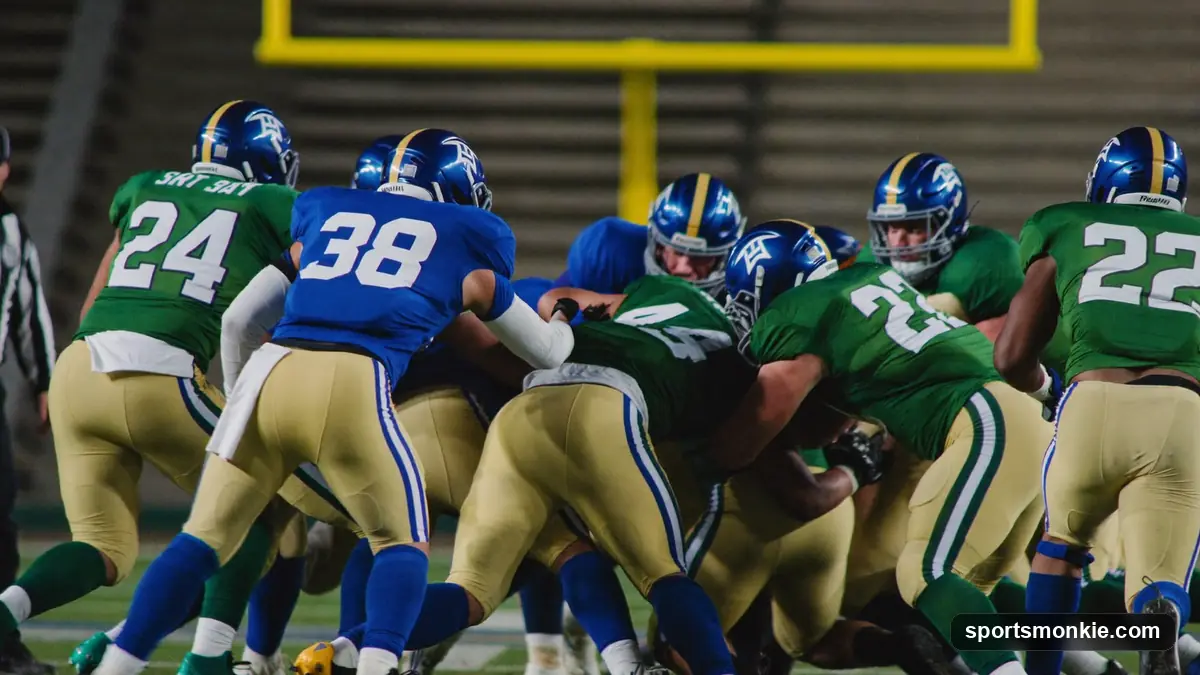
Officials are also taught to watch for tells that a grab has crossed the line even when the hands are hidden in a pile: a defender being visibly turned or spun, a jersey stretched out of shape, or a rusher yanked off his path to the quarterback. The “material restriction” idea matters here, a brief, incidental grab that does not affect the play is often left uncalled, while a grab that clearly stops or steers an opponent is flagged. That judgment of impact is why two similar-looking grabs can draw different calls.
Offensive vs defensive holding
The two types of holding are penalised very differently, because they distort the game in different ways. Neither should be confused with pass interference, which is contact on a ball already in the air rather than a grab or restriction.
| Element | Offensive holding | Defensive holding |
|---|---|---|
| Who commits it | A blocker (usually a lineman) | A defender (often a cornerback) |
| Typical act | Grabbing/hooking a pass rusher or defender | Grabbing a receiver or blocker |
| NFL penalty | 10 yards | 5 yards |
| Automatic first down? | No | Yes |
| Effect | Sets the offense back and can wipe out a big play | Extends the offensive drive |
Offensive holding is punished harder in yardage because it directly helps the offense gain ground unfairly, often springing a run or protecting the passer. Defensive holding carries the automatic first down because it usually denies the offense a fair chance to complete a play, so the rule restores that opportunity.
Where holding sits among NFL penalties
Holding is one of a family of penalties that police what players can and cannot do to each other and to the play. It sits near the line of scrimmage and in pass protection, whereas a foul like intentional grounding targets what a quarterback does with the ball under pressure. On the scoring side, a safety shows how field position and the end zone create their own rules entirely.
What makes holding uniquely contentious is its frequency. Because some grabbing occurs on almost every snap, officials effectively decide which holds are blatant enough to flag, which is why fans and coaches argue about “ticky-tack” calls and missed ones alike. A holding flag can erase a touchdown or extend a drive, so its impact often outweighs its modest yardage.
Why it matters so much
A single holding call can swing a game. Offensive holding negates the play it happened on, so a 40-yard run called back for a hold becomes first-and-20, a huge momentum shift. Defensive holding, conversely, can rescue an offense on third down by handing it a fresh set of downs it did not earn on the field.
Because of that leverage, holding is coached carefully: linemen are taught to keep their hands inside the frame and “punch and release” rather than grab, and defensive backs are drilled to play the ball rather than the receiver’s body. The teams that draw the fewest holding flags are usually the best-coached in fundamentals, a discipline that shows up across the finer points of the game, from blocking technique to special-teams plays like the onside kick.
There is a strategic side to when holding gets called, too. Offensive linemen sometimes accept the risk of a hold deep in their own territory or on a critical pass-protection snap, reasoning that a penalty is better than a sack or a game-changing hit on the quarterback. Coaches weigh this trade-off constantly: a hold that prevents a strip-sack near your own end zone can be the lesser evil, while a needless hold that erases a long gain is a self-inflicted wound. Understanding the penalty is therefore not just about spotting the foul, but about grasping why a lineman might gamble on committing one.
The short version: holding is illegally grabbing or restricting an opponent; offensive holding costs 10 yards, defensive holding costs 5 yards plus an automatic first down; and the difference between a legal block and a hold is whether the hands stay inside the frame and release, or grab and restrict.
Frequently asked questions
What's the difference between holding and blocking?+
Legal blocking uses the body and open hands inside the opponent's frame (roughly shoulders to torso) to obstruct them, and the blocker must release rather than clamp on. Holding is when that contact becomes grabbing, hooking, twisting or restricting, especially grabbing outside the frame, latching onto a jersey, or pulling a defender who is trying to get past. The act is similar; the difference is grabbing and restricting versus obstructing and releasing.
Is grabbing the jersey holding?+
Usually yes, if it restricts the opponent. Grabbing and pulling a jersey to slow or steer a player is the textbook hold that officials look for, and jersey grabs outside the frame are penalised most reliably. A brief, incidental touch of the jersey that does not restrict movement may be let go, but a sustained grab that controls an opponent is holding.
What does a hold look like in football?+
The clearest tells are a blocker's arm wrapping or hooking around a defender's back or shoulder, a hand grabbing and twisting a jersey, or a defender yanking a receiver's arm as they try to run a route. Officials also watch for a blocker being pulled off balance or 'tackled from behind' by a lineman. If a player is visibly grabbed and restricted rather than shoved, it is likely a hold.
Has a quarterback ever been called for holding?+
Yes, though it is rare. A quarterback can be flagged for offensive holding if, for example, they grab a defender during a scramble or as a blocker on a trick play or turnover return. It does not happen often because quarterbacks rarely block, but the rule applies to any offensive player who illegally grabs an opponent, quarterbacks included.
Sources
Play & tools
Free browser games and tools — no account, no download.
- Play 17-0 — Draft nine and chase a flawless NFL regular season — the perfect 17-0 run, no playoffs.
- Play 20-0 — Draft nine and chase a perfect NFL season — regular season and playoffs, undefeated.
- Play 16-0 — Draft nine and chase a perfect 16-0 — the classic 16-game NFL regular season, no playoffs.
- Play Flawless Six — Draft five players and a head coach, then chase a perfect NFL season with the right chemistry.
- Play Guess the NFL Player — A new mystery NFL player every day. Eight guesses, with a clue on each — plus free unlimited mode.
- Play NFL Wordle — A Wordle for football — guess the daily NFL player in eight tries, with green-amber-grey feedback on every clue.
- Play NFL Connections — Sort sixteen football tiles into four hidden groups of four. A new daily puzzle, four mistakes allowed, plus unlimited mode.
- Explore all our games →
- Open the schedule simulator — Pick every 2026 NFL game and watch the standings and playoff seeds update live.
- Open the squares generator — Generate a randomized, printable Super Bowl squares grid for your party — free, no sign-up.
- Open the trade calculator — Weigh any fantasy football trade instantly — clear winner and value gap.
- Run the NFL predictor — Simulate the NFL bracket and see who your picks send to the Super Bowl.
- Open the passer rating calculator — Calculate the official NFL passer rating (0–158.3) from any passing line, with the formula shown.
- Explore all our free sports tools →
Related nfl guides
View all →
What Is Pass Interference in Football? DPI & OPI
Pass interference is illegal contact that hinders a receiver's chance to catch a pass. In the NFL, defensive PI is a spot foul and automatic first down.
What Is a Challenge Flag in Football? NFL Replay Rules
A challenge flag is the red flag an NFL coach throws to request an instant-replay review. Teams get two challenges, a third if both succeed, and lose a timeout if wrong.
What Is a Safety in Football? The 2-Point Score
A safety in football is worth 2 points, awarded to the defense when the ball carrier is downed in his own end zone. The conceding team then free-kicks from its 20.
What Is an Eligible Receiver in Football?
An eligible receiver is a player allowed to catch a forward pass — the QB, backs, tight ends and the two players on the ends of the line. Interior linemen are ineligible.
What Is the Two-Minute Warning in Football?
The two-minute warning is an automatic clock stoppage when two minutes remain in each half of an NFL game. It works like a free timeout for both teams.
What Is a Touchback in Football? Rules
A touchback is when the ball is dead in the end zone off the opponent. No points score; the receiving team gets the ball at a set yard line.