
Onside Kick Rules: 2025 NFL Changes Explained
On this page5
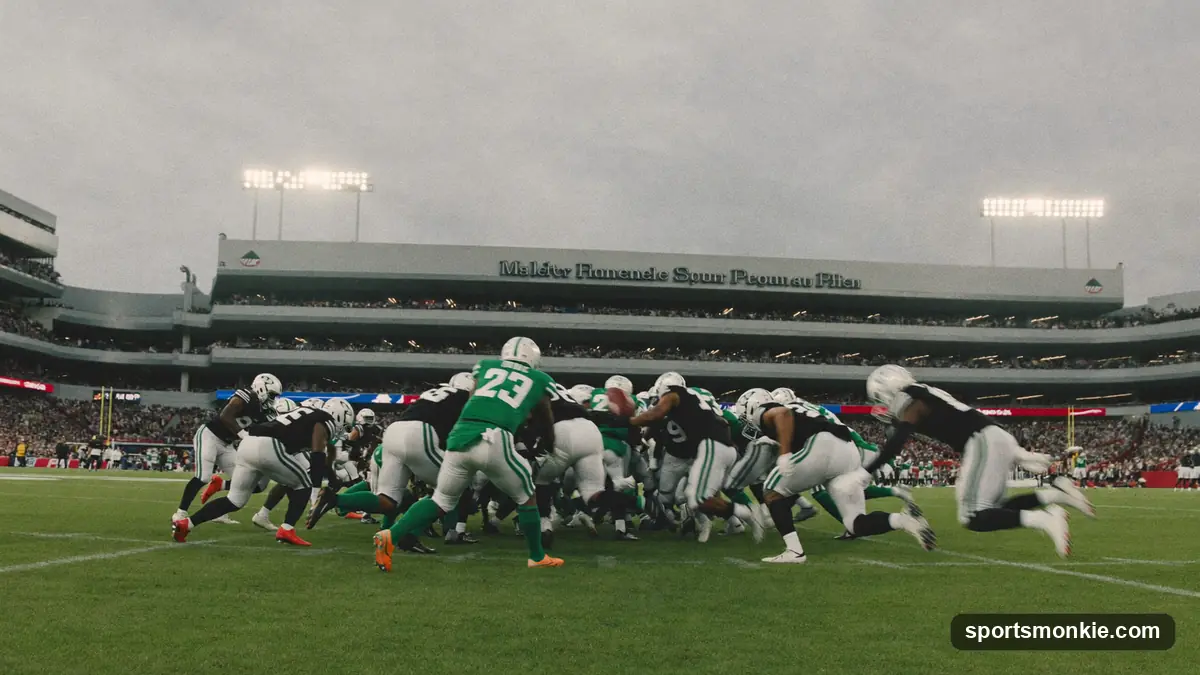
An onside kick in the NFL is now a declared play: as of the 2026 season, only a trailing team may attempt one, and it has to tell the officials before the kick. The ball is kicked from the kicking team’s 35-yard line and must travel at least 10 yards, or be touched by the receiving team, before the kicking team can legally recover it. That is the whole rule in one breath.
The details changed a lot in the last two years, so a lot of what fans “know” about onside kicks is now out of date. Below is how the current rule works under the dynamic kickoff, what the 2025 change actually did, and the myths worth clearing up.
Freshness note: this reflects the rules in force for the 2025 and 2026 NFL seasons. The league has adjusted its kickoff format almost every year recently, so confirm against the current NFL rulebook before a new season.
How the current onside kick works
Under the dynamic kickoff, a normal kickoff and an onside kick use completely different alignments, so the kicking team has to commit to the onside attempt in advance by declaring it.
- You must be trailing. Only a team that is behind may declare an onside kick.
- You must declare it. The kicking team notifies the officials, and the defense is allowed to set up accordingly.
- The ball is kicked from the 35-yard line, the same spot as a standard kickoff.
- A special alignment is used: six players on one side of the kicker and four on the other, rather than the dynamic-kickoff setup used on normal kicks.
- The 10-yard rule applies: the kicking team cannot touch the ball until it has gone 10 yards or been touched by the receiving team.
Because the attempt is declared, the element of surprise is gone. The kicking team is trying to win a short, contested scramble for a live ball, not to catch anyone off guard.
What the 2025 change did
The headline change for the 2025 season was timing. Under the 2024 rules, a trailing team could only attempt an onside kick in the fourth quarter. That restriction was exposed when a team fell far behind earlier in a game and had no legal way to try to get the ball back.
Now a trailing team can declare an onside kick at any point in the game. The table below sums up the shift.
| Element | 2024 rule | 2025-2026 rule |
|---|---|---|
| Who can attempt | Trailing team only | Trailing team only |
| When | Fourth quarter only | Any point in the game |
| Declaration required | Yes | Yes |
| Kick spot | 35-yard line | 35-yard line |
| 10-yard recovery rule | Yes | Yes |
The core mechanics, the declaration, the kick spot and the 10-yard rule, stayed the same. Only the window opened up.
The myths worth killing
Two ideas about onside kicks are stubbornly wrong. The first is that the ball must bounce along the ground. It does not; a kick can be recovered in the air once it has gone 10 yards or been touched by the receiving team. Kickers drive the ball into the turf on purpose because a high-bouncing ball is awkward for the receiving team to handle, not because a rule demands it.
The second is that the receiving team has to let the ball travel 10 yards. That limit only binds the kicking team. The receiving side can pounce on the ball immediately, and often does, calling for a fair catch or simply securing possession. This is one of those rules where the details flip the whole strategy, much like the field-position stakes we cover in what a touchback is.
A third misconception is that any kicking-team player can just grab the ball once it goes 10 yards. That part is true, but the risk is what fans forget: if the kicking team touches the ball before it travels 10 yards and the receiving team has not touched it, that is an illegal touch and the receiving team gets the ball at the spot. So the kicking team is racing to the ball while also being careful not to touch it a fraction too early, which is a big reason recoveries are so hard to pull off cleanly.
How teams try to win the recovery
With surprise gone, the kicking team’s edge comes down to execution. Most attempts use a hard, downward strike that makes the ball bounce high near the 10-yard mark, so a kicking-team player can time a leap and grab it the instant it becomes legal to recover. The receiving team counters by putting sure-handed players, often receivers and defensive backs, on the front line to field the kick early and end the play before any bounce.
Why the onside kick still matters
Even with recovery rates down around 6 percent in recent seasons, the onside kick is often a trailing team’s only path back into a game late. The 2025 changes were designed to make it a slightly fairer gamble by widening when it can be used.
It sits alongside the other late-game levers a losing team pulls, from the two-point conversion to clock management, and understanding the rulebook edges is what separates a smart comeback from a wasted possession. For another quarterback-era rule that turns on precise definitions, see our explainer on what intentional grounding is, and for the extra-period math, NFL overtime rules.
The short version: only a trailing team can declare an onside kick, it comes from the 35 in a six-and-four alignment, the ball must go 10 yards or be touched before the kicking team recovers, and since 2025 it can be tried at any point in the game.
Frequently asked questions
Does an onside kick have to touch the ground?+
No, that is a common myth. There is no rule that an onside kick must bounce. The real requirement is that the ball travels at least 10 yards from the spot of the kick, or is first touched by the receiving team. Once either happens, the kicking team can recover it, on the ground or in the air. Most onside kicks are driven into the turf simply because a bouncing ball is harder for the receiving team to field cleanly.
Does the receiving team have to wait for the ball to go 10 yards?+
No. The 10-yard rule only restricts the kicking team. The receiving team can catch or recover the ball at any point, even a yard off the tee. If a receiving player touches it first, the kicking team is then free to recover immediately, because the touch removes the 10-yard restriction.
Can a team attempt an onside kick when it is winning?+
No. Under the current declared-onside rule, only the trailing team is allowed to attempt one. A team that is level or ahead must kick normally. This is a deliberate limit: the rule is designed to give teams that are behind a fair chance to get the ball back, not to let leading teams gamble for extra possessions.
How often do onside kicks actually work?+
Recovery rates had fallen to roughly 6 percent in recent seasons, largely because earlier alignment rules stacked the odds against the kicking team. The 2025 changes, including allowing the attempt at any time while trailing, were made partly to nudge that success rate back up into double digits by giving kicking teams more realistic opportunities.
Sources
Play & tools
Free browser games and tools — no account, no download.
- Play 17-0 — Draft nine and chase a flawless NFL regular season — the perfect 17-0 run, no playoffs.
- Play 20-0 — Draft nine and chase a perfect NFL season — regular season and playoffs, undefeated.
- Play 16-0 — Draft nine and chase a perfect 16-0 — the classic 16-game NFL regular season, no playoffs.
- Play Flawless Six — Draft five players and a head coach, then chase a perfect NFL season with the right chemistry.
- Play Guess the NFL Player — A new mystery NFL player every day. Eight guesses, with a clue on each — plus free unlimited mode.
- Play NFL Wordle — A Wordle for football — guess the daily NFL player in eight tries, with green-amber-grey feedback on every clue.
- Play NFL Connections — Sort sixteen football tiles into four hidden groups of four. A new daily puzzle, four mistakes allowed, plus unlimited mode.
- Explore all our games →
- Open the schedule simulator — Pick every 2026 NFL game and watch the standings and playoff seeds update live.
- Open the squares generator — Generate a randomized, printable Super Bowl squares grid for your party — free, no sign-up.
- Open the trade calculator — Weigh any fantasy football trade instantly — clear winner and value gap.
- Run the NFL predictor — Simulate the NFL bracket and see who your picks send to the Super Bowl.
- Open the passer rating calculator — Calculate the official NFL passer rating (0–158.3) from any passing line, with the formula shown.
- Explore all our free sports tools →
Related nfl guides
View all →
What Is Intentional Grounding? NFL Rule
Intentional grounding is when a QB in the pocket throws away a pass with no receiver near to avoid a sack. The NFL rule, penalty, and why a spike is legal.
Overtime Rules in the NFL: How OT Works (2026)
NFL overtime is a 10-minute period where both teams now get a possession. Regular-season OT can end in a tie; playoff OT plays until someone wins.

What Is a Challenge Flag in Football? NFL Replay Rules
A challenge flag is the red flag an NFL coach throws to request an instant-replay review. Teams get two challenges, a third if both succeed, and lose a timeout if wrong.
Auburn Stuns No. 1 Georgia 27-24 on Alex McPherson's Walk-Off Kick in Athens
Auburn rallied from 14-0 down, survived Georgia's late tie, and won 27-24 in Athens on Alex McPherson's 34-yard kick as time expired after a Stockton fumble.
McVay Says He Is 'Sick' After Settling for the Kick That Was Blocked in Overtime
Sean McVay blamed himself for a conservative third-down run that set up Harrison Mevis's blocked 48-yard kick in the Rams' 37-34 overtime loss to Buffalo.
Jalon Daniels Calls His Mom Onto the Postgame Desk After His First NFL Win
Undrafted Bucs rookie Jalon Daniels won his first NFL start in Dallas, then called his mother Star onto the Prime Video postgame desk live on air.