
What Is an Eligible Receiver in Football?
On this page5
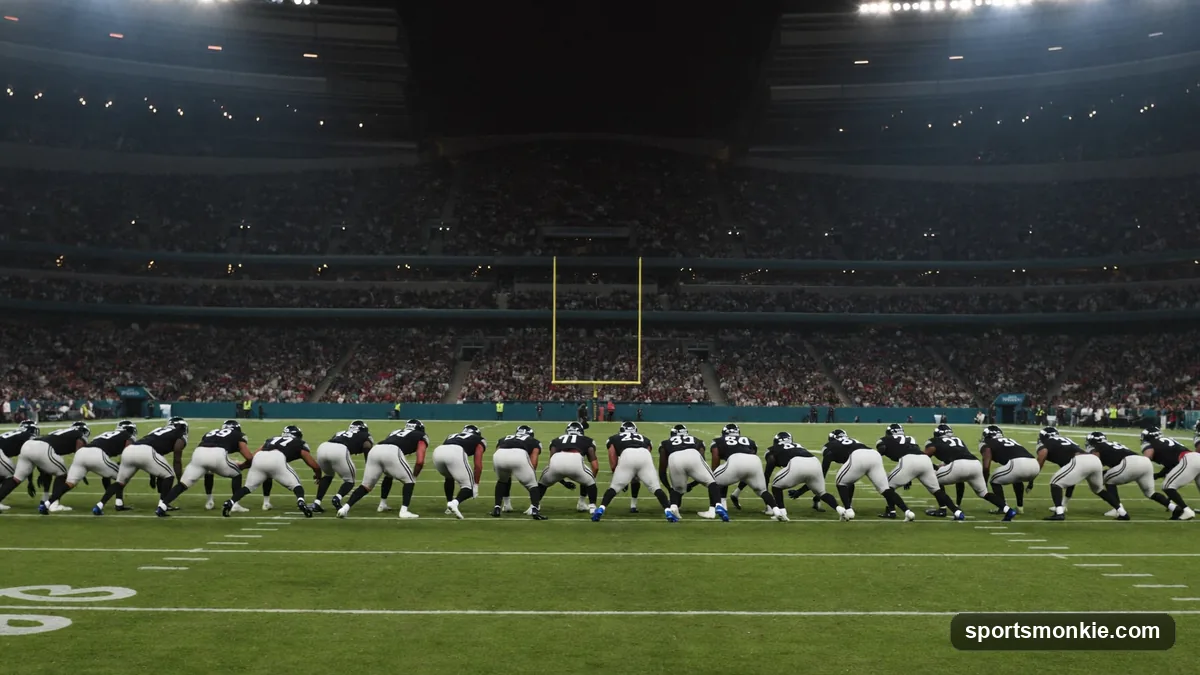
An eligible receiver is an offensive player permitted to catch a forward pass: the quarterback, running backs, tight ends, and the two players positioned on the ends of the line of scrimmage. The five interior offensive linemen are ineligible. Formation and numbering rules decide eligibility on every single snap.
Who is eligible on every play
On a standard passing play, five offensive players are eligible: the players in the backfield (running backs), the tight ends and wide receivers, and specifically the two players who line up on the outer ends of the line. Everyone else on the line — the center, guards, and any tackle not on the end — is ineligible and there to block.
Why interior linemen can’t catch passes
The rule exists to keep the offense honest. If any blocker could drift downfield and catch a pass, defenses would have no way to know who to cover. So the interior linemen, who usually wear numbers 50-79, are flagged as ineligible: they cannot catch a forward pass and cannot move more than one yard past the line before the ball is thrown. Breaking the second rule is “ineligible receiver downfield,” a 5-yard penalty that often wipes out a big play-action gain.
The numbers that signal eligibility
| Player | Typical numbers | Eligible? |
|---|---|---|
| Interior linemen (C, G) | 50-79 | No |
| Tackles | 50-79 | No (unless reported) |
| Tight ends | 80-89, 40-49 | Yes (if on the end) |
| Wide receivers | 10-19, 80-89 | Yes |
| Running backs | 20-49 | Yes |
Reporting eligible and the “covered” trap
A lineman can become eligible for one play by reporting to the referee, who announces it to the defense — the classic “tackle-eligible” trick. Just as important is the covered-receiver trap: only the outermost player on each end of the line is eligible, so a receiver split wide can accidentally “cover up” the tight end inside him and make him ineligible. Coaches drill alignment to avoid handing officials an easy flag.
Why eligibility matters to the whole passing game
Eligibility is the invisible framework behind every route combination, pick play, and trick play. It interacts with pass interference — only eligible receivers can draw or commit it — and with the down-and-distance math that a first down resets. Master it and pre-snap formations suddenly make sense. Explore more fundamentals in our NFL guides.
Frequently asked questions
Who are the eligible receivers in football?+
The eligible receivers are the running backs and any player in the backfield, the tight ends, the wide receivers, and specifically the two players lined up on the ends of the line of scrimmage. The quarterback is also eligible once the ball has been handed off or if a pass is tipped. In total, five offensive players are eligible on any given passing play, while the interior linemen are not.
Why are offensive linemen ineligible receivers?+
The five interior offensive linemen — the center, both guards, and the players not on the end of the line — are ineligible so that the offense cannot disguise blockers as receivers and gain an unfair advantage downfield. They typically wear numbers 50-79, which flags them as ineligible to officials. Their job is to block, and they may not catch a forward pass or move more than one yard downfield before a pass is thrown.
Can an offensive lineman become an eligible receiver?+
Yes, by reporting as eligible to the referee before the snap. On 'tackle-eligible' or reported-eligible plays, a lineman wearing an ineligible number tells the official he is eligible for that play, the referee announces it to the defense, and he can then legally catch a pass. He must still line up in a legal position. Once the play is over, he reverts to ineligible unless he reports again.
What is a covered receiver?+
A player who would normally be eligible on the end of the line becomes ineligible — 'covered up' — if another eligible receiver lines up outside him on the same side at the line of scrimmage. Only the outermost player on the line is eligible on each end. This is a common pre-snap trap: a receiver split wide can accidentally cover the tight end next to him, making the tight end ineligible.
What is illegal touching by an ineligible receiver?+
If an ineligible player, such as an interior lineman, catches or touches a forward pass, it is a penalty for illegal touching. Separately, if an ineligible player moves more than one yard past the line of scrimmage before the quarterback throws, it is 'ineligible receiver downfield,' a 5-yard penalty. Both rules stop the offense from using blockers as extra pass targets or masking run-pass intentions.
How many players must be on the line of scrimmage?+
The offense must have exactly seven players on the line of scrimmage at the snap. Only the two on the ends of that line are eligible receivers; the five inside them are not. The remaining four players line up in the backfield and are eligible. Getting this count wrong — too few on the line, or an eligible player covering another — is an illegal formation penalty.
Is the quarterback an eligible receiver?+
The quarterback is eligible, but usually only becomes a pass target after handing the ball off, on a trick play, or if a pass is tipped and comes back to him. On a standard drop-back the quarterback is the passer, not a receiver. Plays like a [play-action](/play-action-explained/) fake followed by a throwback to the quarterback rely on his eligibility.
Sources
Play & tools
Free browser games and tools — no account, no download.
- Play 17-0 — Draft nine and chase a flawless NFL regular season — the perfect 17-0 run, no playoffs.
- Play 20-0 — Draft nine and chase a perfect NFL season — regular season and playoffs, undefeated.
- Play 16-0 — Draft nine and chase a perfect 16-0 — the classic 16-game NFL regular season, no playoffs.
- Play Flawless Six — Draft five players and a head coach, then chase a perfect NFL season with the right chemistry.
- Play Guess the NFL Player — A new mystery NFL player every day. Eight guesses, with a clue on each — plus free unlimited mode.
- Play NFL Wordle — A Wordle for football — guess the daily NFL player in eight tries, with green-amber-grey feedback on every clue.
- Play NFL Connections — Sort sixteen football tiles into four hidden groups of four. A new daily puzzle, four mistakes allowed, plus unlimited mode.
- Explore all our games →
- Open the schedule simulator — Pick every 2026 NFL game and watch the standings and playoff seeds update live.
- Open the squares generator — Generate a randomized, printable Super Bowl squares grid for your party — free, no sign-up.
- Open the trade calculator — Weigh any fantasy football trade instantly — clear winner and value gap.
- Run the NFL predictor — Simulate the NFL bracket and see who your picks send to the Super Bowl.
- Open the passer rating calculator — Calculate the official NFL passer rating (0–158.3) from any passing line, with the formula shown.
- Explore all our free sports tools →
Related nfl guides
View all →
What Is a Challenge Flag in Football? NFL Replay Rules
A challenge flag is the red flag an NFL coach throws to request an instant-replay review. Teams get two challenges, a third if both succeed, and lose a timeout if wrong.
What Is a Safety in Football? The 2-Point Score
A safety in football is worth 2 points, awarded to the defense when the ball carrier is downed in his own end zone. The conceding team then free-kicks from its 20.
What Is Pass Interference in Football? DPI & OPI
Pass interference is illegal contact that hinders a receiver's chance to catch a pass. In the NFL, defensive PI is a spot foul and automatic first down.
What Is the Two-Minute Warning in Football?
The two-minute warning is an automatic clock stoppage when two minutes remain in each half of an NFL game. It works like a free timeout for both teams.
What Is a Touchback in Football? Rules
A touchback is when the ball is dead in the end zone off the opponent. No points score; the receiving team gets the ball at a set yard line.
What Is Holding in Football? Offense & Defense
Holding in football is illegally grabbing or restricting an opponent. Offensive holding costs 10 yards, defensive holding 5 yards and a first down.