
What Is the Two-Minute Warning in Football?
On this page5
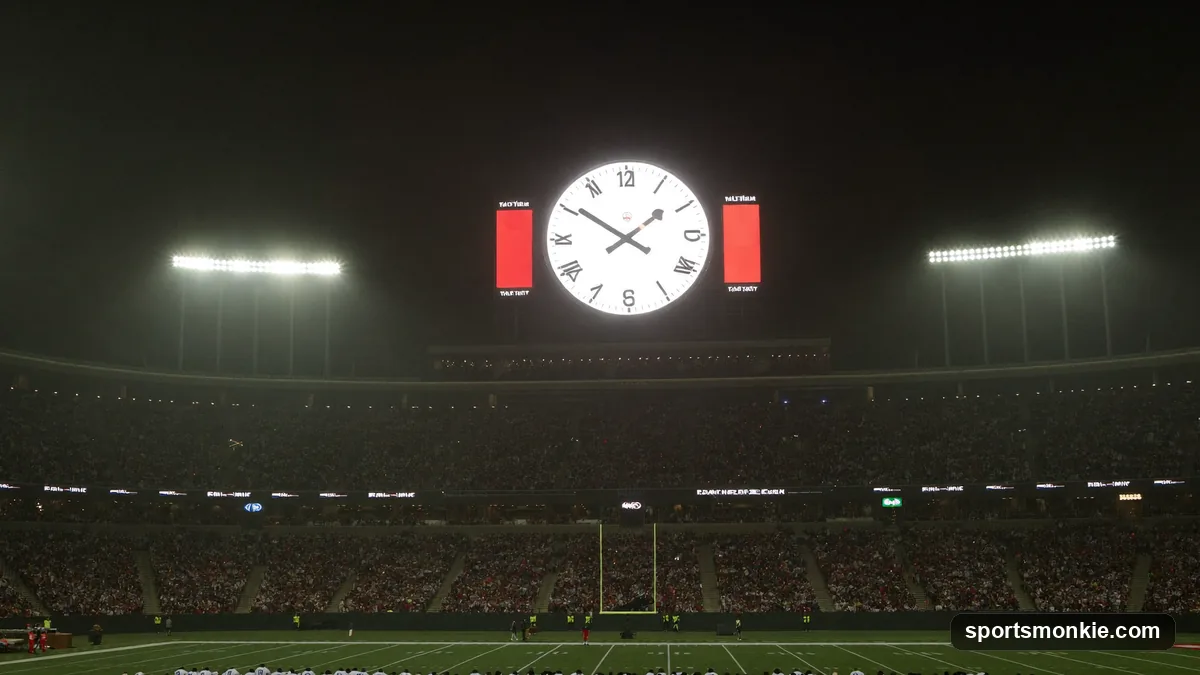
The two-minute warning is an automatic stoppage of the game clock when exactly two minutes remain in each half of an NFL game. It works like a free timeout for both teams and a scheduled broadcast break. It exists in the NFL but not in college football, and it sits at the heart of end-of-half clock management.
How the two-minute warning works
When the game clock ticks down to 2:00 in the second and fourth quarters, officials stop play automatically — no one has to call timeout. After a short break, play resumes from wherever it left off. That is the whole mechanic, but its effect on the end of a half is enormous, because it hands both teams a guaranteed stoppage at the exact moment clock management matters most.
Two per game, one per half
There is a common misconception that the warning happens every quarter. It does not.
| Quarter | Two-minute warning? |
|---|---|
| 1st | No |
| 2nd | Yes — at 2:00 |
| 3rd | No |
| 4th | Yes — at 2:00 |
| Overtime | No scheduled warning |
Why it exists at all
The warning is a relic. In the early NFL, the official time was kept on the field, not on the scoreboard, so the two-minute warning literally informed teams and fans how much time truly remained. Once the stadium clock became the official one, the informational purpose vanished — but the stoppage stayed because it manufactures late-game tension and gives broadcasters a dependable ad break.
The strategy it creates
Because the stoppage is free, a trailing team effectively gains an extra timeout and can spend its real ones more freely on a comeback drive. A leading team, meanwhile, tries to keep the ball and run the clock so that even the warning cannot save the opponent. This is the window where hurry-up offense, sideline routes, and spiking the ball all appear — and where a single pass interference flag can flip a game. Some of the highest-scoring games in NFL history were shaped by exactly these frantic final two minutes.
How it connects to overtime and comebacks
The final two minutes are the most clock-rich part of regulation, and they set up everything that follows. A team that scores here to force overtime relies on the warning and the inside-two-minutes first-down stoppage to preserve time. Understanding it is the first step to reading the end of any close NFL game — explore more in our NFL guides.
Frequently asked questions
What does the two-minute warning do?+
It automatically stops the game clock when two minutes remain in the second and fourth quarters, without either team having to call timeout. Play resumes after the break, and the stoppage effectively gives both teams an extra timeout at the most critical moment of each half. It also serves as a guaranteed commercial break for broadcasters.
How many two-minute warnings are there in a game?+
Two per regulation game — one at the two-minute mark of the second quarter and one at the two-minute mark of the fourth quarter. There is not one in every quarter; only at the end of each half. Overtime periods do not have a scheduled two-minute warning under the standard rules.
Does college football have a two-minute warning?+
No. The two-minute warning is unique to the NFL (and other pro leagues that adopt NFL-style rules). College football has no automatic two-minute stoppage, which is one of several clock-rule differences between the pro and college games. College instead stops the clock after a first down to move the chains, a rule the NFL does not use outside the final two minutes.
Why does the two-minute warning exist?+
It dates back to an era when the stadium scoreboard clock was not the official time — the official time was kept on the field, so the warning told teams and fans how much time truly remained. That need disappeared once the scoreboard became official, but the stoppage stayed because it adds late-game drama and a reliable broadcast break. Today it is purely a scheduled stoppage rather than an informational one.
How does the two-minute warning affect strategy?+
Because it guarantees a clock stoppage, a trailing team can treat it as a bonus timeout and manage its real timeouts more aggressively, while the leading team knows the clock will stop regardless. Teams often try to run the clock inside 2:05 so the warning burns more time, or conversely rush a play off just before it to preserve a down without stopping momentum.
Does the clock stop for the two-minute warning after a first down?+
Inside the final two minutes of a half the NFL clock already stops on a first down to allow the chains to be set, which combines with the warning to make the last two minutes clock-rich for a trailing offense. This is the window where hurry-up offense, spiking the ball, and using the sideline all come together — see our overtime and clock explainers for how it ties into a game's finish.
Can a team score right before the two-minute warning?+
Yes — the warning is just a stoppage, not a dead period. A team can run a play, score, or gain a [first down](/first-down-explained/) in the seconds before the clock hits 2:00, and then the warning stops play. Coaches sometimes time a play deliberately so the warning falls at the most useful moment for their situation.
Sources
Play & tools
Free browser games and tools — no account, no download.
- Play 17-0 — Draft nine and chase a flawless NFL regular season — the perfect 17-0 run, no playoffs.
- Play 20-0 — Draft nine and chase a perfect NFL season — regular season and playoffs, undefeated.
- Play 16-0 — Draft nine and chase a perfect 16-0 — the classic 16-game NFL regular season, no playoffs.
- Play Flawless Six — Draft five players and a head coach, then chase a perfect NFL season with the right chemistry.
- Play Guess the NFL Player — A new mystery NFL player every day. Eight guesses, with a clue on each — plus free unlimited mode.
- Play NFL Wordle — A Wordle for football — guess the daily NFL player in eight tries, with green-amber-grey feedback on every clue.
- Play NFL Connections — Sort sixteen football tiles into four hidden groups of four. A new daily puzzle, four mistakes allowed, plus unlimited mode.
- Explore all our games →
- Open the schedule simulator — Pick every 2026 NFL game and watch the standings and playoff seeds update live.
- Open the squares generator — Generate a randomized, printable Super Bowl squares grid for your party — free, no sign-up.
- Open the trade calculator — Weigh any fantasy football trade instantly — clear winner and value gap.
- Run the NFL predictor — Simulate the NFL bracket and see who your picks send to the Super Bowl.
- Open the passer rating calculator — Calculate the official NFL passer rating (0–158.3) from any passing line, with the formula shown.
- Explore all our free sports tools →
Related nfl guides
View all →
What Is a Challenge Flag in Football? NFL Replay Rules
A challenge flag is the red flag an NFL coach throws to request an instant-replay review. Teams get two challenges, a third if both succeed, and lose a timeout if wrong.
What Is a Safety in Football? The 2-Point Score
A safety in football is worth 2 points, awarded to the defense when the ball carrier is downed in his own end zone. The conceding team then free-kicks from its 20.
What Is an Eligible Receiver in Football?
An eligible receiver is a player allowed to catch a forward pass — the QB, backs, tight ends and the two players on the ends of the line. Interior linemen are ineligible.
What Is Pass Interference in Football? DPI & OPI
Pass interference is illegal contact that hinders a receiver's chance to catch a pass. In the NFL, defensive PI is a spot foul and automatic first down.
What Is a Touchback in Football? Rules
A touchback is when the ball is dead in the end zone off the opponent. No points score; the receiving team gets the ball at a set yard line.
What Is Holding in Football? Offense & Defense
Holding in football is illegally grabbing or restricting an opponent. Offensive holding costs 10 yards, defensive holding 5 yards and a first down.