
What Is a Safety in American Football? Rules and Scoring
On this page7
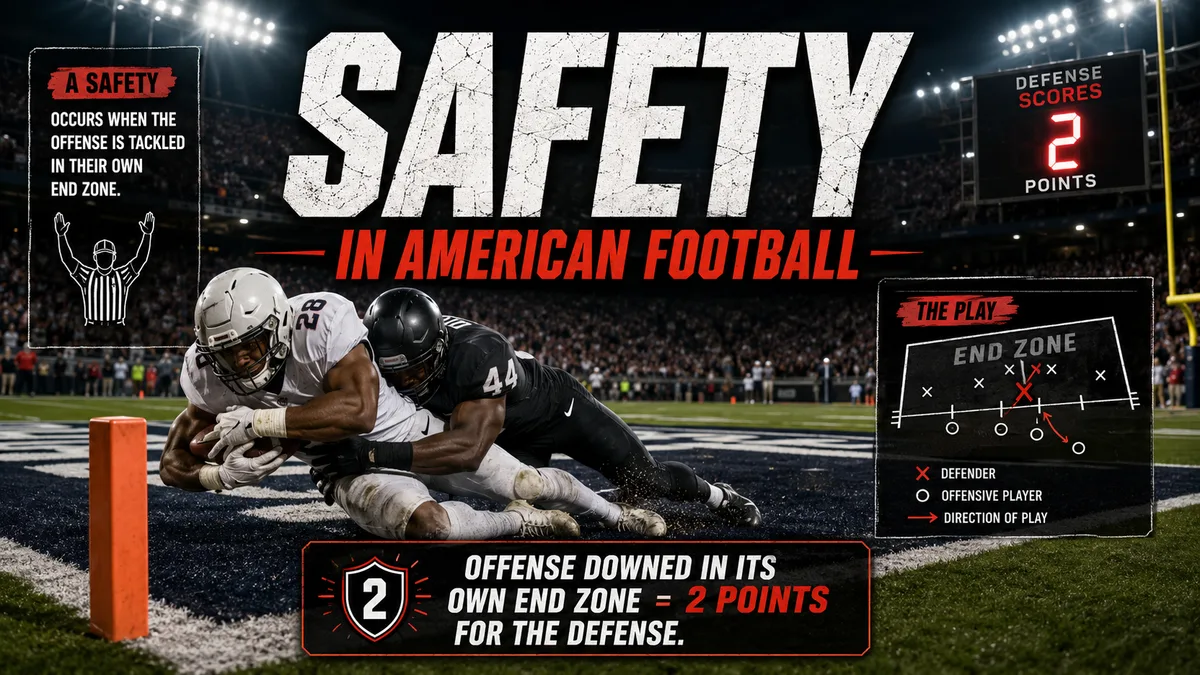
A safety is worth two points to the defending team, awarded when the ball becomes dead in the offense’s own end zone and the offense put it there — usually a tackle, but also a penalty, a fumble out the back, or a bad snap. The conceding team then free-kicks from its own 20, so the scoring team gets points and possession. That double reward is unique in football’s scoring system.
Scoring almost always belongs to the offense. The safety is the exception.
What a safety is
A safety is worth two points and is awarded to the defending team. The most common way it happens is when an offensive player is tackled with the ball in his own end zone. Because the offense started the play close to its own goal line, the defense pushes the ball carrier back over it and brings him down there.
It is the only score in football that the defense produces by making a stop rather than by carrying the ball into the opponent’s end zone.
Ways a safety can be scored
A safety is not limited to a tackle. It is called whenever the ball becomes dead in the end zone and the team responsible for it being there is the offense:
- The ball carrier is tackled in his own end zone.
- An offensive penalty is committed in the offense’s own end zone (for example, holding).
- The offense fumbles the ball out of bounds through its own end zone.
- A snap or backward pass flies out of the back of the end zone.
- A blocked punt goes out of the back of the punting team’s end zone.
What happens after a safety
This is what makes the safety unique. After scoring, the team that conceded the safety must give the ball back with a free kick from its own 20-yard line. So the scoring team collects two points and then receives a kick, giving it a strong chance to score again shortly after. That combination of points plus possession is why a safety can quietly swing a close game.
How the safety compares
| Score | Points | How it happens |
|---|---|---|
| Touchdown | 6 | Ball carried or caught in the opponent’s end zone |
| Field goal | 3 | Ball kicked through the uprights |
| Safety | 2 | Offense tackled or penalized in its own end zone |
| Extra point | 1 | Kick after a touchdown |
The intentional safety
Sometimes giving up two points is the smart play, which sounds absurd until you look at the alternative. A team punting from its own end zone has the punter standing at the back line with no room for error. A block, or even a decent return, hands the opponent a touchdown from close range.
Take the safety instead and the maths changes. You concede two points, but you free-kick from your own 20 instead of punting from your own goal line, which typically nets 30 to 40 yards of field position and removes the block risk entirely. Teams protecting a lead of more than two points late in the fourth quarter do this deliberately, and it is also a clock-burning device: the runner can retreat and take his time before going down.
Why it is so rare
Safeties are uncommon: a typical NFL season yields only a couple of dozen across roughly 270 games. Offenses know exactly how exposed they are near their own goal line and call accordingly, favouring runs into the line and quick throws over anything that keeps the quarterback deep. When a safety does happen, it is usually heavy pressure from the defense or a mistake, most often a snap sailing past the quarterback in shotgun.
The one-point safety
For rules obsessives, the strangest score in football is the one-point safety, awarded to the defending team when a safety occurs during a conversion attempt after a touchdown. It requires the ball to end up back in the attacking team’s end zone during the try, typically after a blocked kick is recovered and carried backwards.
It has never happened in an NFL game. College football has produced a handful, and if you ever see one live, you are watching something rarer than a perfect season.
Frequently asked questions
How many points is a safety worth in football?+
A safety is worth two points, awarded to the defending team. It is the only score in football the defense earns by making a stop rather than by carrying the ball into the opponent's end zone, and the scoring team receives a free kick afterwards.
What happens after a safety?+
The team that conceded the safety must free-kick the ball to the other team from its own 20-yard line. So the scoring team collects two points and then gets possession, a combination no other score produces. The kick may be a punt, placekick, or dropkick.
What is the difference between a safety score and a safety position?+
They share a name but are unrelated. A safety score is the two-point play described here. A safety is also a defensive back position, free safety or strong safety, who lines up deep to defend passes and support against the run.
Why would a team take an intentional safety?+
To trade two points for field position. A team punting from deep in its own end zone risks a block or a short return that sets up a touchdown. Conceding a safety costs two points but lets them free-kick from the 20, and late in a game that is often the cheaper option.
What is a one-point safety?+
A safety scored during a conversion attempt after a touchdown, worth one point to the defending team. It requires the ball to return to the attacking team's end zone during the try. No NFL one-point safety has ever been recorded; a handful exist in college football.
How common are safeties in the NFL?+
Rare. A typical NFL season produces only a couple of dozen safeties across roughly 270 games, so most single games have none. Offenses avoid risky plays when backed up near their own goal line specifically to prevent them.
Sources
Play & tools
Free browser games and tools — no account, no download.
- Play 17-0 — Draft nine and chase a flawless NFL regular season — the perfect 17-0 run, no playoffs.
- Play 20-0 — Draft nine and chase a perfect NFL season — regular season and playoffs, undefeated.
- Play 16-0 — Draft nine and chase a perfect 16-0 — the classic 16-game NFL regular season, no playoffs.
- Play Flawless Six — Draft five players and a head coach, then chase a perfect NFL season with the right chemistry.
- Play Guess the NFL Player — A new mystery NFL player every day. Eight guesses, with a clue on each — plus free unlimited mode.
- Play NFL Wordle — A Wordle for football — guess the daily NFL player in eight tries, with green-amber-grey feedback on every clue.
- Play NFL Connections — Sort sixteen football tiles into four hidden groups of four. A new daily puzzle, four mistakes allowed, plus unlimited mode.
- Explore all our games →
- Open the schedule simulator — Pick every 2026 NFL game and watch the standings and playoff seeds update live.
- Open the squares generator — Generate a randomized, printable Super Bowl squares grid for your party — free, no sign-up.
- Open the trade calculator — Weigh any fantasy football trade instantly — clear winner and value gap.
- Run the NFL predictor — Simulate the NFL bracket and see who your picks send to the Super Bowl.
- Open the passer rating calculator — Calculate the official NFL passer rating (0–158.3) from any passing line, with the formula shown.
- Explore all our free sports tools →
Related nfl guides
View all →
What Is a Safety in Football? The 2-Point Score
A safety in football is worth 2 points, awarded to the defense when the ball carrier is downed in his own end zone. The conceding team then free-kicks from its 20.

What Is a Field Goal in American Football? Points and Range
A field goal is a place-kick through the uprights worth three points when an offense cannot or chooses not to score a touchdown.

What Is a Challenge Flag in Football? NFL Replay Rules
A challenge flag is the red flag an NFL coach throws to request an instant-replay review. Teams get two challenges, a third if both succeed, and lose a timeout if wrong.
What Is an Eligible Receiver in Football?
An eligible receiver is a player allowed to catch a forward pass — the QB, backs, tight ends and the two players on the ends of the line. Interior linemen are ineligible.
What Is Pass Interference in Football? DPI & OPI
Pass interference is illegal contact that hinders a receiver's chance to catch a pass. In the NFL, defensive PI is a spot foul and automatic first down.
What Is the Two-Minute Warning in Football?
The two-minute warning is an automatic clock stoppage when two minutes remain in each half of an NFL game. It works like a free timeout for both teams.