
Roughing the Passer Rule Explained
On this page5
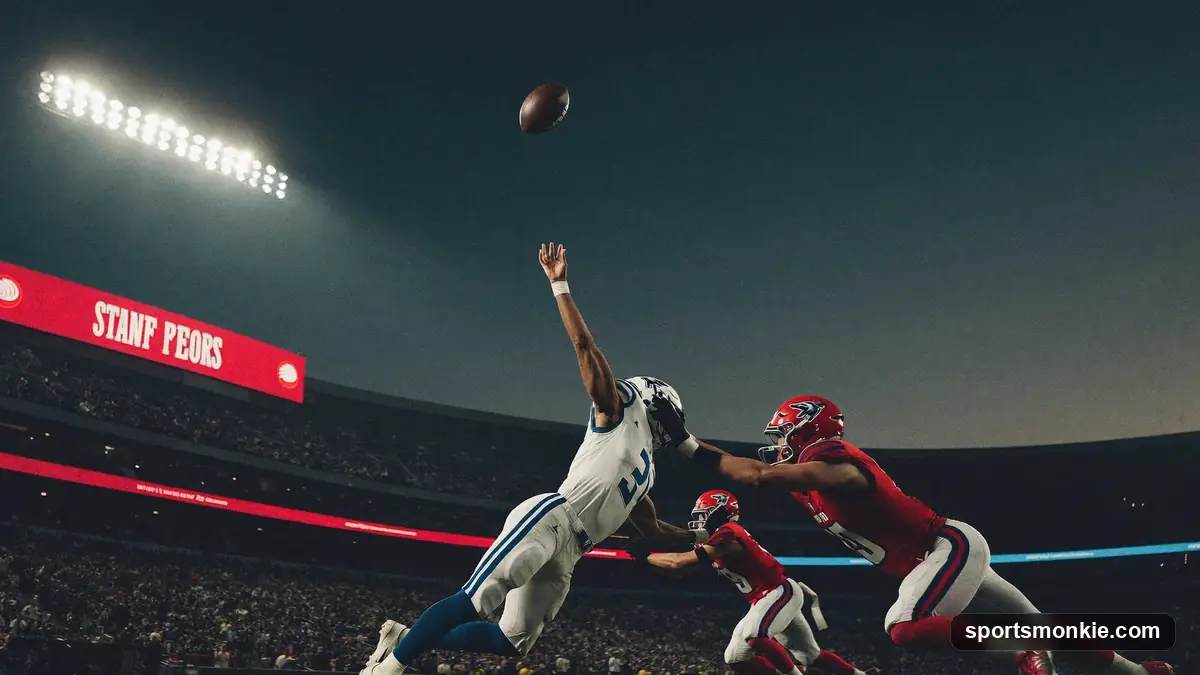
Roughing the passer is an NFL penalty called when a defender makes illegal or unnecessary contact with the quarterback while he is throwing the ball or immediately after he releases it. It carries a 15-yard penalty and an automatic first down, and it exists to protect quarterbacks who are exposed and defenceless in the act of passing.
That is the rule in a sentence, but it is also one of the most argued-about calls in football, because officials have to judge a defender’s intent and body weight in a fraction of a second. Here is exactly what the rule covers, why the penalty is so severe, and why fans and pass rushers alike find it maddening.
What the rule protects against
A quarterback in a throwing motion cannot brace for a hit, protect himself, or see a rusher coming from his blind side, so the NFL’s rulebook gives him special protection. Roughing the passer covers several distinct kinds of illegal contact, and a flag can come from any one of them:
- Body-weight hits — a defender who tackles the passer and lands on him with all or most of his weight.
- Head and neck contact — forcibly hitting the quarterback in the head or neck area (this overlaps with the separate “helmet” protections).
- Low hits — hitting the passer at or below the knees when the defender had a chance to avoid it.
- Late hits — hitting the quarterback clearly after he has thrown the ball.
- Unnecessary force — driving, throwing down, or otherwise unnecessarily punishing the passer.
The common thread is that the quarterback is defenceless while passing, and the rule asks defenders to pull up or adjust rather than deliver a full-force hit.
The penalty: 15 yards and an automatic first down
What makes roughing the passer so consequential is the punishment. It is a 15-yard penalty, marked from the previous spot, plus an automatic first down for the offense. That automatic first down is the sting: a defense can make a great play to force third-and-long and stop the pass, only for a flag to erase the stop, hand over 15 yards, and give the offense a brand-new set of downs, as explained in our guide to the first down. In flagrant cases the league can also fine or, very rarely, eject a player.
| Element | Detail |
|---|---|
| Penalty yardage | 15 yards from the previous spot |
| Down result | Automatic first down for the offense |
| Who it protects | The quarterback in a passing posture |
| Common triggers | Body-weight landing, head/neck hit, low hit, late hit |
| Additional discipline | Possible fine; ejection in flagrant cases |
Can it be called on a sack?
Yes, and this is where pass rushers get frustrated. Sacking the quarterback is legal and celebrated, but how a defender completes the sack matters. If he brings the quarterback down but lands on him with his full body weight, or contacts the head or the knees, the sack is negated and roughing the passer is called instead. So a play that looks like a momentum-swinging sack can flip into a 15-yard penalty and a first down. Defenders argue it is nearly impossible to tackle a quarterback cleanly without landing on him; the league counters that the protection is worth the difficulty. This is a different kind of judgment call from a mechanical penalty like holding or the clear-cut rule behind intentional grounding, and that subjectivity is exactly why it is debated.
Why the rule is so controversial
Roughing the passer sits at the centre of a genuine tension in football. On one side, quarterbacks are the sport’s most valuable and vulnerable players, and the NFL has steadily strengthened protections after seeing careers ended by hits to the head or knees. On the other side, defenders feel the rules have gone too far, penalising clean-looking football plays and rewarding quarterbacks with cheap first downs.
Because the call depends on an official’s real-time read of intent and body weight, two similar hits can be officiated differently, and high-profile flags in playoff and prime-time games have drawn intense criticism. The debate flares up whenever a marginal call decides a big moment, and it is unlikely to fully settle, since it reflects a real trade-off between player safety and letting the defense play.
How it fits the wider defensive game
For a defense, roughing the passer is a discipline issue as much as a rules issue. Coaches drill rushers to sack cleanly, to get their weight off the quarterback as they finish, and to avoid the head and knees, because a single flag can undo a well-schemed pass rush from a package like the dime defense. It also connects to the broader philosophy of protecting players from dangerous hits, the same instinct behind the rules around a defenceless player and the scoring safety covered in our explainer on the safety in American football.
The short version: roughing the passer is an NFL penalty for illegal contact on the quarterback as he throws, covering body-weight landings, head and neck hits, low hits and late hits. It costs the defense 15 yards and an automatic first down, can wipe out an otherwise clean sack, and is one of the most controversial calls in the game because it asks officials to judge intent and force in an instant, weighing quarterback safety against the defender’s right to make a play.
Frequently asked questions
How does roughing the passer work?+
When a quarterback is in a passing posture, defenders are limited in how they can hit him. Roughing the passer is called when a defender makes forcible, unnecessary or illegal contact, common triggers include landing on the quarterback with full or most of the defender's body weight, hitting him in the head or neck area, hitting him at or below the knees, or hitting him clearly after the ball is gone. When an official throws the flag, the penalty is 15 yards from the previous spot and an automatic first down, regardless of the down and distance. The rule is designed to protect a player who cannot defend himself while throwing.
Can you call roughing the passer on a sack?+
Yes, a sack and roughing the passer are not mutually exclusive. A defender can tackle the quarterback for a legal sack, but if the way he does it breaks the rules, for example driving the quarterback into the ground with his full body weight, or hitting the head or knees, the sack is wiped out and roughing the passer is called instead. So a play that looks like a big sack can turn into a 15-yard penalty and a first down for the offense if the contact is judged illegal. This is a major reason the rule frustrates pass rushers, who feel a clean-looking sack can be penalised.
Why is the roughing the passer rule so controversial?+
Because it requires officials to make split-second judgements about intent and body weight, and reasonable people often disagree with the call. Pass rushers argue it is nearly impossible to bring down a quarterback without landing on him, while the league argues the protections are needed to prevent serious injuries to its most important players. High-profile flags in big games have drawn heavy criticism, and the subjectivity means fans and commentators frequently debate whether a given hit was truly illegal. The tension between protecting quarterbacks and letting defenders play is the heart of the controversy.
What is the penalty for roughing the passer?+
Roughing the passer is a 15-yard penalty and an automatic first down for the offense. That combination is what makes it so damaging to a defense: even on a third-and-long that the defense appeared to stop, the flag gives the offense a fresh set of downs and 15 free yards. In flagrant cases a player can also be fined by the league or, rarely, ejected. The automatic first down is the key detail that separates roughing the passer from many lesser penalties. (Note: the brief's fourth PAA about how often announcers say the phrase is not a rules question, so we substituted this penalty question.)
Sources
Play & tools
Free browser games and tools — no account, no download.
- Play 17-0 — Draft nine and chase a flawless NFL regular season — the perfect 17-0 run, no playoffs.
- Play 20-0 — Draft nine and chase a perfect NFL season — regular season and playoffs, undefeated.
- Play 16-0 — Draft nine and chase a perfect 16-0 — the classic 16-game NFL regular season, no playoffs.
- Play Flawless Six — Draft five players and a head coach, then chase a perfect NFL season with the right chemistry.
- Play Guess the NFL Player — A new mystery NFL player every day. Eight guesses, with a clue on each — plus free unlimited mode.
- Play NFL Wordle — A Wordle for football — guess the daily NFL player in eight tries, with green-amber-grey feedback on every clue.
- Play NFL Connections — Sort sixteen football tiles into four hidden groups of four. A new daily puzzle, four mistakes allowed, plus unlimited mode.
- Explore all our games →
- Open the schedule simulator — Pick every 2026 NFL game and watch the standings and playoff seeds update live.
- Open the squares generator — Generate a randomized, printable Super Bowl squares grid for your party — free, no sign-up.
- Open the trade calculator — Weigh any fantasy football trade instantly — clear winner and value gap.
- Run the NFL predictor — Simulate the NFL bracket and see who your picks send to the Super Bowl.
- Open the passer rating calculator — Calculate the official NFL passer rating (0–158.3) from any passing line, with the formula shown.
- Explore all our free sports tools →
Related nfl guides
View all →
What Is a QB Sneak in Football?
A QB sneak is a short-yardage play where the quarterback takes the snap and dives straight ahead behind the line for a yard or two, ideal on 3rd- or 4th-and-1.
What Is a Sack in Football?
A sack is when the defense tackles the quarterback behind the line of scrimmage before they can throw, losing yards for the offense. It's a key pass-rush stat.
What Is Intentional Grounding? NFL Rule
Intentional grounding is when a QB in the pocket throws away a pass with no receiver near to avoid a sack. The NFL rule, penalty, and why a spike is legal.
Offensive Positions in Football Explained: Every Role on the Unit
Offensive positions in football explained: QB, RB/FB, WR, TE, and the five offensive line spots (LT, LG, C, RG, RT) with duties and alignment.
Quarterback Position in Football: Role, Skills, and Responsibilities Explained
The quarterback position leads the offense, calling plays, taking the snap, and throwing or handing off the ball. Learn the QB's full job in football.
What Is a Bootleg in Football?
A bootleg is a play where the quarterback fakes a handoff, then rolls out to the opposite side to pass or run. How it works vs play action.