
Offensive Positions in Football Explained: Every Role on the Unit
On this page8
- 01Offensive Positions in Football at a Glance
- 02Quarterback: The Offense’s Decision-Maker
- 03Running Backs: Halfback and Fullback
- 04Wide Receivers: The Perimeter Threats
- 05Tight End: Blocker and Receiver in One
- 06The Offensive Line: Five Spots That Protect Every Play
- 07Eligible vs. Ineligible Receivers Explained
- 08Why the Positions Work as a Unit
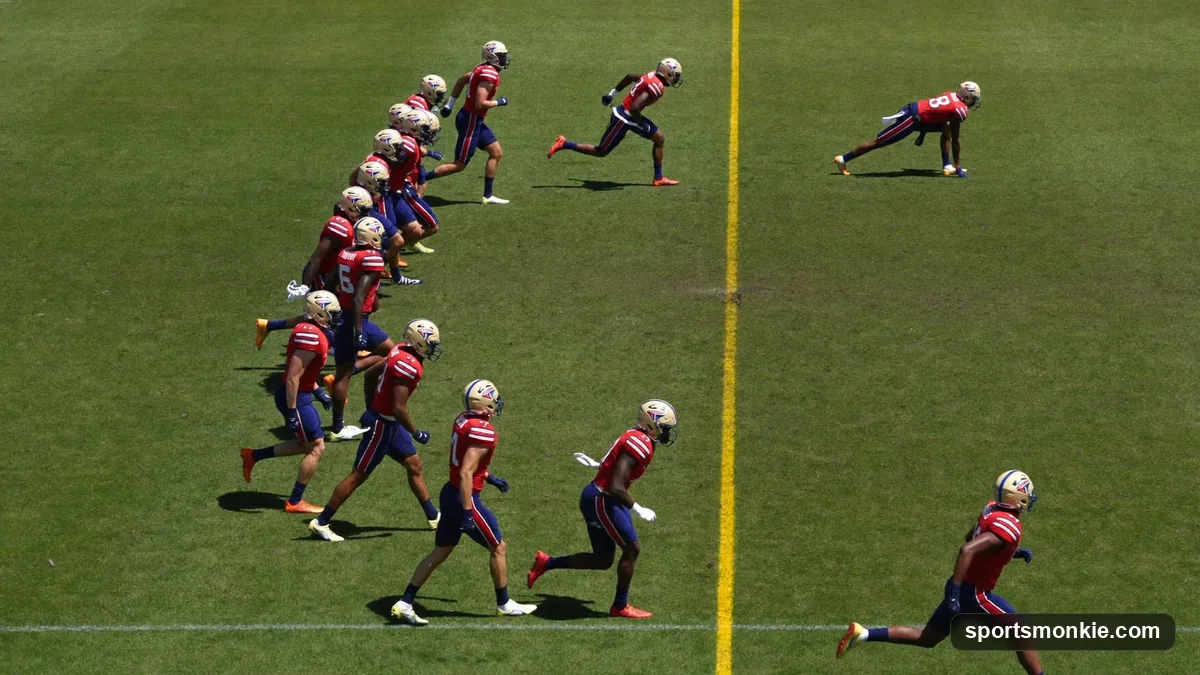
The offensive positions in football are the quarterback, running back (halfback and/or fullback), wide receiver, tight end, and the five offensive linemen — left tackle, left guard, center, right guard, and right tackle. Every offensive snap uses all 11 of these roles, and each one carries a distinct job: throwing or handing off the ball, catching passes, or blocking for the player who has it. Understanding what each spot does — and how they line up relative to each other — is the fastest way to actually follow an NFL offense instead of just watching the ball.
For the full picture of every position on both sides of the ball, see our football positions explained overview, or start with the American football / NFL hub for more explainers like this one.
Offensive Positions in Football at a Glance
| Position | Abbreviation | Primary Job | Where It Lines Up |
|---|---|---|---|
| Quarterback | QB | Throws passes, hands off, reads the defense | Directly behind center or in shotgun |
| Halfback / Running Back | RB, HB | Carries the ball, catches short passes, pass-blocks | Backfield, behind or beside the QB |
| Fullback | FB | Lead blocker, occasional runner/receiver | Backfield, ahead of the halfback |
| Wide Receiver | WR | Catches passes, blocks downfield | Split out near the sideline |
| Tight End | TE | Blocks like a lineman, catches like a receiver | Next to the tackle |
| Left Tackle | LT | Protects the QB’s blind side, run blocks | Left end of the line |
| Left Guard | LG | Interior run and pass blocking | Left of center |
| Center | C | Snaps the ball, calls line protections | Middle of the line |
| Right Guard | RG | Interior run and pass blocking | Right of center |
| Right Tackle | RT | Edge blocking, run and pass | Right end of the line |
Quarterback: The Offense’s Decision-Maker
The quarterback touches the ball on nearly every offensive snap, making it the most scrutinized position in football. Before the snap, the QB reads the defensive alignment and can change the play with an audible; after the snap, he either hands the ball off, throws it, or, on designed runs, keeps it himself. Elite quarterbacks like Patrick Mahomes combine arm talent with the pre-snap processing to exploit whatever look the defense shows. For a deeper breakdown of reads, throws, and the different QB archetypes, see our full quarterback position in football guide.
Running Backs: Halfback and Fullback
The backfield behind the quarterback typically holds one or two running backs. The halfback (often just called “running back”) is the featured ball carrier — a player like Christian McCaffrey or Derrick Henry combines vision, footwork, and burst to turn handoffs into yardage, while also catching passes out of the backfield and picking up blitzes. The fullback lines up ahead of the halfback and is primarily a lead blocker, clearing the path on running plays, though pass-catching fullbacks such as Kyle Juszczyk have kept the position relevant in modern offenses. Full position details, including stances and blocking assignments, live in our running back position in football explainer.
Wide Receivers: The Perimeter Threats
Wide receivers line up split out toward the sidelines, away from the tightly packed line of scrimmage, and their job is to get open and catch passes. Offenses typically deploy two to five receivers depending on personnel grouping, with roles split between outside receivers who win on the boundary (like Tyreek Hill’s deep speed) and slot receivers who work the middle of the field on shorter, quicker routes. Beyond catching, receivers are also asked to block on running plays and screens. See our wide receiver position explained guide for route types and alignment differences.
Tight End: Blocker and Receiver in One
The tight end lines up directly next to the offensive tackle and is the most dual-purpose position on offense — part lineman, part receiver. On a given play, a tight end like Travis Kelce might block a defensive end on a run play, then run a seam route for a touchdown two plays later. Because they can shift between blocking and route-running without substituting, tight ends give offensive coordinators disguise and flexibility that a pure receiver or lineman can’t provide. Our tight end position in football page covers the position’s evolution and the different TE alignments (in-line, slot, and “sniffer”).
The Offensive Line: Five Spots That Protect Every Play
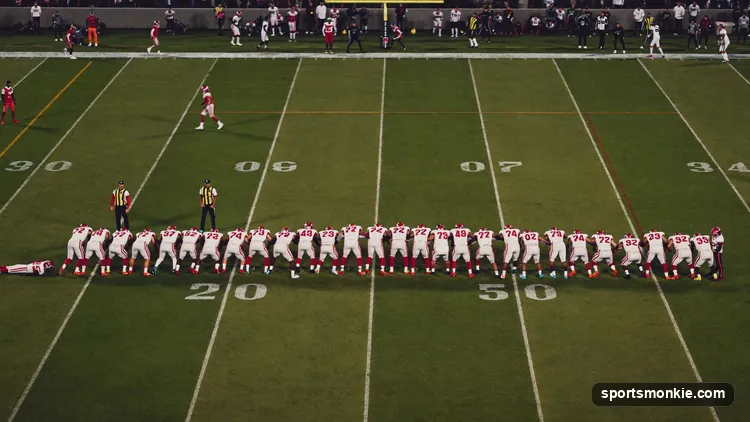
The offensive line is made up of five players who never touch the ball but decide whether every other position succeeds. From left to right: the left tackle (often the team’s best pass protector, guarding the quarterback’s blind side against edge rushers like Trent Williams handles), the left guard, the center (who snaps the ball and usually makes protection calls, a role long defined by Jason Kelce during his Eagles career), the right guard, and the right tackle. Guards and tackles drive-block on runs and set edges or anchor against interior rushers on passes; the whole unit works in coordinated combinations to open lanes and buy the quarterback time.
Eligible vs. Ineligible Receivers Explained
Not every offensive player is legally allowed to catch a forward pass. Eligible receivers include the quarterback, running backs, wide receivers, tight ends, and the two players positioned on the ends of the offensive line at the snap. The three interior offensive linemen — both guards and the center — are ineligible receivers by rule and cannot catch a pass unless the offense reports a formation change to the officials before the snap. Jersey numbers make this easy to spot on the field: in the NFL, players wearing 1-49 and 80-89 are eligible, while 50-79 are reserved for interior linemen and are ineligible unless specifically reported as eligible for that play.
Why the Positions Work as a Unit
No single position wins a play alone. The offensive line has to win its blocks for the quarterback to have time or the running back to find a crease; receivers and tight ends have to separate for the QB to have a target; and the quarterback has to make the right read for all that blocking and route-running to pay off. That interdependence is what makes offensive football a coordination sport as much as an athletic one — and why scouts and coaches evaluate every offensive position not just on talent, but on how well it fits the other 10 players around it.
Frequently asked questions
What are the offensive positions in football?+
There are 11 offensive positions on the field: quarterback, running back (halfback and/or fullback), wide receiver (usually two to three), tight end, and five offensive linemen — left tackle, left guard, center, right guard, and right tackle. Formations mix and match these roles, but every snap uses all 11.
What is the difference between a halfback and a fullback?+
The halfback (often just called running back) is the primary ball carrier and the faster, more elusive back. The fullback usually lines up ahead of the halfback and blocks first, though modern fullbacks like Kyle Juszczyk also catch passes out of the backfield.
What does the offensive line do in football?+
The offensive line's five players — left tackle, left guard, center, right guard, right tackle — block defenders on every play, opening running lanes and protecting the quarterback from the pass rush. The center also snaps the ball to start each play.
What is the difference between an eligible and ineligible receiver?+
Eligible receivers are the players allowed to legally catch a forward pass: the QB, RB, WR, TE, and the two players on the ends of the offensive line, based on their pre-snap position and jersey number. The three interior linemen (both guards and the center) are ineligible receivers and cannot catch a pass unless they report as eligible.
How do you tell an eligible receiver by jersey number?+
In the NFL, players wearing numbers 1-49 and 80-89 are eligible to catch passes, while numbers 50-79 belong to interior linemen and are ineligible unless the team reports that player as an eligible receiver before the snap.
What is the difference between a wide receiver and a tight end?+
A wide receiver lines up split out near the sideline and is primarily a pass catcher. A tight end lines up next to the offensive tackle and splits time between blocking like a lineman and running routes like a receiver.
Is quarterback the most important offensive position?+
Most coaches and analysts treat quarterback as the most valuable offensive position because it touches the ball on nearly every snap and drives both the passing and running game through pre-snap reads and audibles.
How many offensive linemen are on the field at once?+
Five offensive linemen play every snap in a standard formation: left tackle, left guard, center, right guard, and right tackle. Some formations add a sixth blocker, but the five interior line spots never change.
Sources
Play & tools
Free browser games and tools — no account, no download.
- Play 17-0 — Draft nine and chase a flawless NFL regular season — the perfect 17-0 run, no playoffs.
- Play 20-0 — Draft nine and chase a perfect NFL season — regular season and playoffs, undefeated.
- Play 16-0 — Draft nine and chase a perfect 16-0 — the classic 16-game NFL regular season, no playoffs.
- Play Flawless Six — Draft five players and a head coach, then chase a perfect NFL season with the right chemistry.
- Play Guess the NFL Player — A new mystery NFL player every day. Eight guesses, with a clue on each — plus free unlimited mode.
- Play NFL Wordle — A Wordle for football — guess the daily NFL player in eight tries, with green-amber-grey feedback on every clue.
- Play NFL Connections — Sort sixteen football tiles into four hidden groups of four. A new daily puzzle, four mistakes allowed, plus unlimited mode.
- Explore all our games →
- Open the schedule simulator — Pick every 2026 NFL game and watch the standings and playoff seeds update live.
- Open the squares generator — Generate a randomized, printable Super Bowl squares grid for your party — free, no sign-up.
- Open the trade calculator — Weigh any fantasy football trade instantly — clear winner and value gap.
- Run the NFL predictor — Simulate the NFL bracket and see who your picks send to the Super Bowl.
- Open the passer rating calculator — Calculate the official NFL passer rating (0–158.3) from any passing line, with the formula shown.
- Explore all our free sports tools →
Related nfl guides
View all →
Quarterback Position in Football: Role, Skills, and Responsibilities Explained
The quarterback position leads the offense, calling plays, taking the snap, and throwing or handing off the ball. Learn the QB's full job in football.
Football Positions Explained: Every Offense, Defense & Special Teams Role
Football positions explained: every offense, defense, and special teams role in American football, what each one does, and how they fit together.
What Is a Bootleg in Football?
A bootleg is a play where the quarterback fakes a handoff, then rolls out to the opposite side to pass or run. How it works vs play action.
Football Formations and Coverages Explained: The Complete NFL Guide
Football formations and coverages explained: how NFL offenses line up, how defenses answer with zone and man coverage, and why each matchup wins or loses.
What Is a QB Sneak in Football?
A QB sneak is a short-yardage play where the quarterback takes the snap and dives straight ahead behind the line for a yard or two, ideal on 3rd- or 4th-and-1.
What Is a Sack in Football?
A sack is when the defense tackles the quarterback behind the line of scrimmage before they can throw, losing yards for the offense. It's a key pass-rush stat.