
Football Positions Explained: Every Offense, Defense & Special Teams Role
On this page5
Football positions split into three units on every NFL roster: offense, defense, and special teams, each fielding 11 players with a distinct job. Offense tries to score by running or passing the ball down the field; defense tries to stop them and force a turnover or punt; special teams handles every kick, from kickoffs and punts to field goals. Understanding American football starts with knowing what each of those 33 roster spots is actually asked to do on a given play.
This guide breaks down every position group, explains the one-paragraph job description for each role, and links out to a full breakdown of every individual position so you can go deeper on any one of them.
Offense: The 11 Players Who Move the Ball
The offense’s job is simple to state and hard to execute: gain 10 yards in four downs, or score. Every snap starts with the quarterback position in football, the player who takes the snap and either hands off, throws, or runs. Behind and around him, the running back position in football carries the ball on designed runs and catches passes out of the backfield, while a fullback (when a team uses one) leads the way as a blocker.
Out wide, the wide receiver position explained covers the players who run routes and catch passes downfield — most offenses use two to four receivers per play, split between outside “X” and “Z” receivers and slot receivers who work the middle of the field. The tight end position in football lines up next to the tackle and splits time between blocking like a lineman and catching passes like a receiver, which makes it one of the most versatile jobs on the roster.
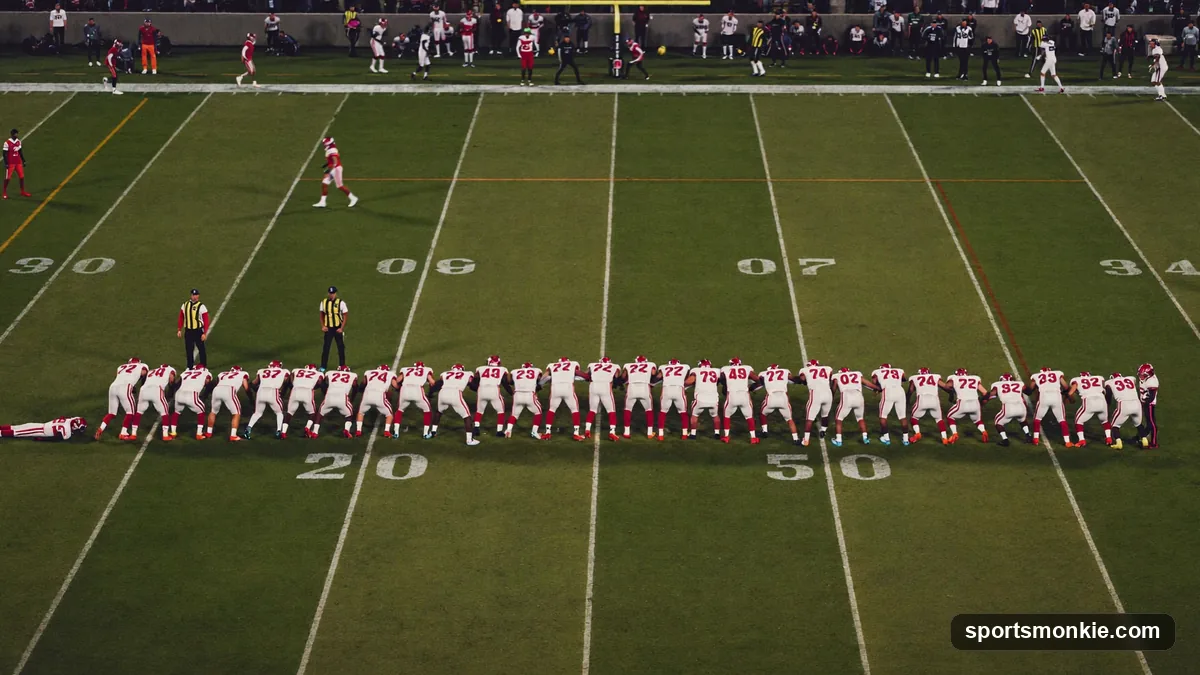
None of that works without the offensive line: the center, two guards, and two tackles who snap the ball, protect the quarterback, and open running lanes. They almost never touch the football, but they decide how much time and space every other offensive position gets. For a full breakdown of these five roles, see football offensive positions explained.
Defense: The 11 Players Who Stop It
Defense mirrors offense in structure but not in job description. The defensive line (defensive ends and tackles, plus a nose tackle in some schemes) lines up across from the offensive line to stop the run and rush the passer. Behind them, the linebacker position in football covers players who read the play, fill running lanes, blitz the quarterback, and drop into pass coverage — a middle or inside linebacker often calls the defensive signals, similar to how a quarterback runs the offense.
The defensive backfield, or secondary, is split between the cornerback position in football, who covers receivers man-to-man or in zone near the line of scrimmage, and the safety position in football, who plays deeper as the last line of defense against big pass plays while also helping stop the run. A full position-by-position walkthrough is at football defensive positions explained.
Special Teams: The Third Phase of Football
Special teams handles anything involving a kick, and it decides more games than casual fans realize. The kicker attempts field goals, extra points, and kickoffs. The punter kicks the ball away on fourth down to flip field position. A long snapper delivers a precise, fast snap on punts and kicks, a holder sets the ball for field goal attempts, and return specialists — often a team’s fastest players — try to gain yards on kickoff and punt returns. Blocking for those returners, and covering kicks to stop the other team’s returner, are jobs assigned to reserve players across the offensive and defensive rosters.
Football Positions by Group
| Unit | Position | Primary Job |
|---|---|---|
| Offense | Quarterback (QB) | Runs the offense, throws or hands off the ball |
| Offense | Running Back (RB) | Carries the ball, catches passes out of the backfield |
| Offense | Wide Receiver (WR) | Runs routes, catches passes downfield |
| Offense | Tight End (TE) | Blocks and catches passes near the line |
| Offense | Offensive Line (C/G/T) | Blocks to protect the QB and open running lanes |
| Defense | Defensive Line (DE/DT) | Stops the run, rushes the passer |
| Defense | Linebacker (LB) | Reads the play, stops runs, covers or blitzes |
| Defense | Cornerback (CB) | Covers receivers near the line of scrimmage |
| Defense | Safety (S) | Plays deep, last line against big plays |
| Special Teams | Kicker (K) | Field goals, extra points, kickoffs |
| Special Teams | Punter (P) | Punts on fourth down to flip field position |
| Special Teams | Returner | Returns kickoffs and punts for yardage |
How the Positions Work Together
No position operates in isolation. The offense’s personnel and formation dictate which defensive positions get matched up against them — more receivers on the field usually pulls a linebacker off and adds a defensive back, while a heavier run-focused formation invites extra defensive linemen. Coaches on both sides adjust their calls before and after the snap based on which positions are lined up across from them, which is why formations and coverages are their own layer of strategy on top of the individual roles. For how that chess match plays out, see NFL formations and coverages explained.
Special teams then resets the field position for both units after every score, punt, or missed field goal, which is why it counts as a genuine third phase of the game rather than an afterthought between offensive and defensive series.
You can put the position map to work in Flawless Six, where every pick has to fill a defined roster role, or use NFL Connections to test whether you can spot the link between players, teams, and football terms.
Frequently Asked Questions
What are the main football positions? They split into offense (quarterback, running back, wide receiver, tight end, offensive line), defense (defensive line, linebackers, cornerbacks, safeties), and special teams (kicker, punter, returners).
How many positions are there in football? There’s no single fixed count since schemes rename and blend roles, but a full roster carries 20-plus distinct named positions across all three units.
What is the hardest football position? Quarterback, because it demands pre-snap reads, in-play processing, and accurate throws under pressure, all within a few seconds.
How many players are on the field per team? Eleven, whether the unit on the field is offense, defense, or special teams.
What’s the difference between a cornerback and a safety? Cornerbacks cover receivers close to the line; safeties play deeper as the last line of defense and help against the run.
Frequently asked questions
What are the main football positions?+
The main football positions fall into three units. Offense: quarterback, running back, wide receiver, tight end, and the offensive line (center, guards, tackles). Defense: defensive line (ends and tackles), linebackers, and defensive backs (cornerbacks and safeties). Special teams: kicker, punter, long snapper, holder, and return specialists.
How many positions are there in football?+
There is no single fixed number because some positions overlap or get renamed by scheme, but a standard 11-man offense uses roughly 8-9 distinct position types, a base 4-3 or 3-4 defense uses about 7, and special teams adds kicker, punter, long snapper, holder, and returners. Counted individually, most rosters carry 20-plus named positions.
What is the easiest football position to learn?+
Wide receiver and running back are usually the easiest for new players to pick up because the core job (catch the ball, run with the ball) is intuitive, even though route trees and blocking assignments add complexity at higher levels.
What position is the hardest in football?+
Quarterback is widely considered the hardest football position. It requires reading the defense before the snap, processing coverage after the snap, and delivering an accurate throw in under three seconds, all while 300-pound defenders are trying to reach the passer.
How many players are on the field per team in football?+
Each team has 11 players on the field at a time, whether the unit is offense, defense, or special teams. Substitutions between plays let teams swap personnel groups to match the situation.
What is the offensive line and why does it matter?+
The offensive line is the group of five players -- center, two guards, and two tackles -- who block for the quarterback and running backs. They rarely touch the ball but determine whether every other offensive position has room to work.
What's the difference between a cornerback and a safety?+
Cornerbacks line up outside near the receivers and mostly play man or zone coverage close to the line of scrimmage. Safeties line up deeper, provide the last line of defense against big plays, and also help in run support.
Do special teams positions matter as much as offense or defense?+
Yes. Special teams plays (kickoffs, punts, field goals, and returns) decide field position and points in close games, and specialists like kickers and punters are full roster spots precisely because those plays swing outcomes.
Sources
Play & tools
Free browser games and tools — no account, no download.
- Play 17-0 — Draft nine and chase a flawless NFL regular season — the perfect 17-0 run, no playoffs.
- Play 20-0 — Draft nine and chase a perfect NFL season — regular season and playoffs, undefeated.
- Play 16-0 — Draft nine and chase a perfect 16-0 — the classic 16-game NFL regular season, no playoffs.
- Play Flawless Six — Draft five players and a head coach, then chase a perfect NFL season with the right chemistry.
- Play Guess the NFL Player — A new mystery NFL player every day. Eight guesses, with a clue on each — plus free unlimited mode.
- Play NFL Wordle — A Wordle for football — guess the daily NFL player in eight tries, with green-amber-grey feedback on every clue.
- Play NFL Connections — Sort sixteen football tiles into four hidden groups of four. A new daily puzzle, four mistakes allowed, plus unlimited mode.
- Explore all our games →
- Open the schedule simulator — Pick every 2026 NFL game and watch the standings and playoff seeds update live.
- Open the squares generator — Generate a randomized, printable Super Bowl squares grid for your party — free, no sign-up.
- Open the trade calculator — Weigh any fantasy football trade instantly — clear winner and value gap.
- Run the NFL predictor — Simulate the NFL bracket and see who your picks send to the Super Bowl.
- Open the passer rating calculator — Calculate the official NFL passer rating (0–158.3) from any passing line, with the formula shown.
- Explore all our free sports tools →
Related nfl guides
View all →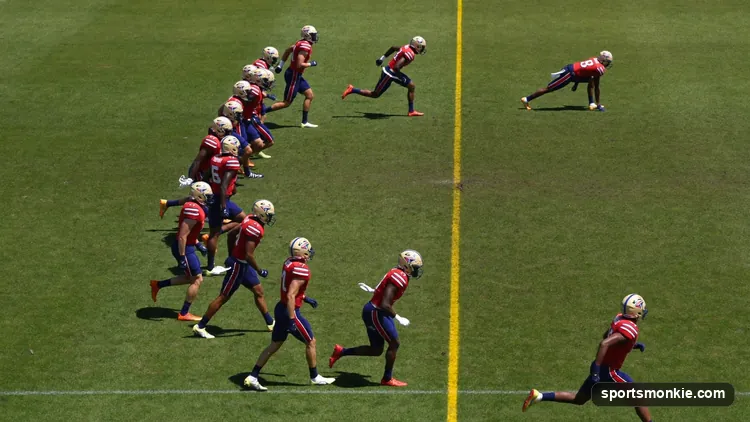
Offensive Positions in Football Explained: Every Role on the Unit
Offensive positions in football explained: QB, RB/FB, WR, TE, and the five offensive line spots (LT, LG, C, RG, RT) with duties and alignment.
Quarterback Position in Football: Role, Skills, and Responsibilities Explained
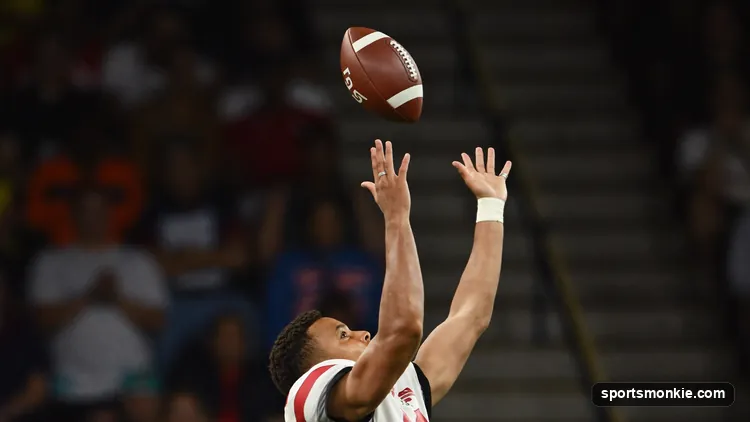
The quarterback position leads the offense, calling plays, taking the snap, and throwing or handing off the ball. Learn the QB's full job in football.
Running Back Position in Football: Role, Skills & Types Explained
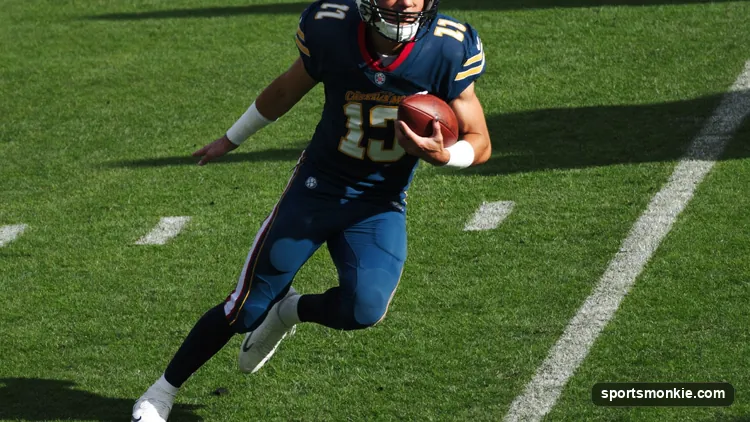
The running back position carries the ball, catches passes, and pass-blocks. Learn the halfback vs. fullback split, key skills, and top RB examples.
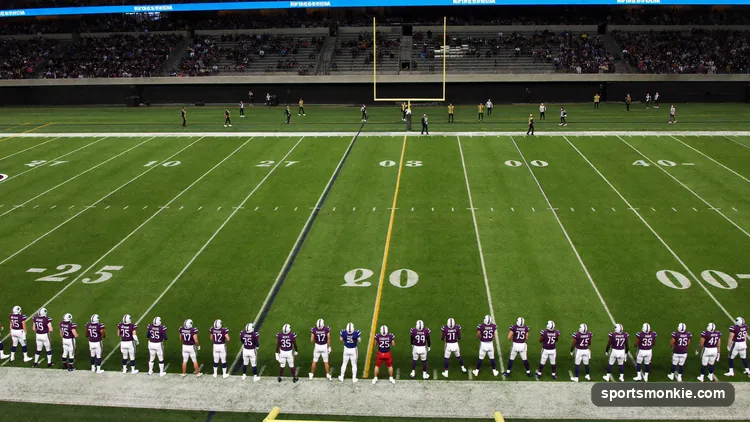
Football Formations and Coverages Explained: The Complete NFL Guide
Football formations and coverages explained: how NFL offenses line up, how defenses answer with zone and man coverage, and why each matchup wins or loses.
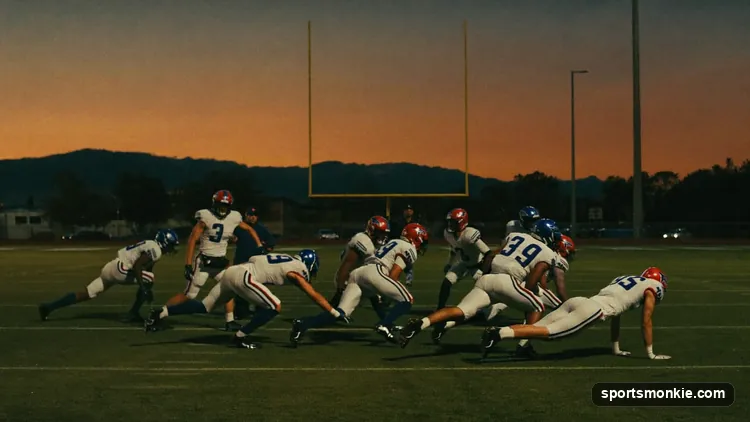
Prevent Defense in Football: What It Is and Why Coaches Get Criticized for It
A prevent defense drops extra defensive backs deep to stop the big play late in a half, trading short completions for protection against a game-changing bomb.
Tight End Position in Football Explained: Role, Skills, and Famous TEs
The tight end position in football is a hybrid blocker-receiver lined up beside the tackle. Learn its rules, responsibilities, skills, and top examples.