
What Is a Linebacker in Football? Position, Roles & Types Explained
On this page6
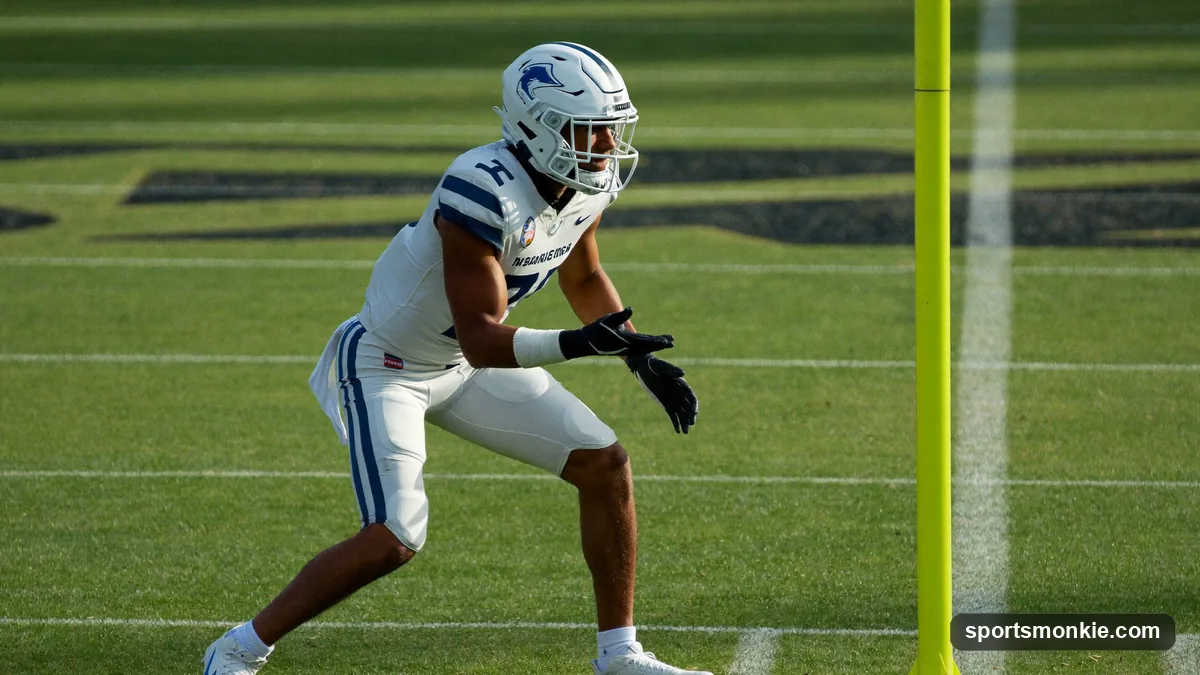
A linebacker (LB) is a defensive player who lines up three to five yards behind the defensive line, reading the offense and reacting to stop the run, cover receivers, or rush the passer. Linebackers form the second level of the defense — the versatile middle layer between the defensive line up front and the cornerbacks and safeties deep in the secondary. On any given play, a linebacker might be asked to fill a run gap, mirror a tight end in man coverage, or sprint through a blitz lane at the quarterback, which is why the position is often described as the most all-around job on defense.
Understanding the linebacker position is essential to understanding American football and the NFL as a whole, since these are usually the players calling out defensive checks and setting the tone before every snap.
Where Linebackers Line Up and What They Do
Linebackers get their name from their alignment: they stand a few yards behind the defensive linemen, giving them a clear view of the offensive backfield while still being close enough to the ball to attack quickly. That vantage point lets them diagnose a play as it unfolds rather than committing blindly at the snap.
Their job splits into three core responsibilities:
- Stopping the run. Linebackers fill gaps, shed blocks, and make open-field tackles on running backs who get past the defensive line.
- Pass coverage. Linebackers drop into zones or match up man-to-man against running backs and tight ends underneath.
- Blitzing. Linebackers are frequently sent after the quarterback, either through interior gaps or off the edge, adding pressure the defensive line alone can’t generate.
Because they’re asked to do all three, linebackers are the connective tissue of a defense — a companion piece to the defensive positions in football that operate in front of and behind them.
Middle/Inside Linebacker vs. Outside Linebacker
Not all linebackers do the same job. The position splits into two broad roles depending on where a player lines up relative to the offensive formation.
Middle linebackers (called inside linebackers in some schemes) play in the heart of the defense. They’re the players most likely to read the offense before the snap, communicate the defensive call to teammates, and attack downhill through the A and B gaps to stop runs between the tackles. Because of that pre-snap responsibility, the middle linebacker is often nicknamed the “quarterback of the defense.”
Outside linebackers line up closer to the edges of the formation, outside the tackles. Their job leans more toward setting the edge against outside runs, covering tight ends and running backs in the passing game, and rushing the passer from the corner. In many modern schemes, outside linebackers function almost like a hybrid between a traditional linebacker and a pass-rushing defensive end.
4-3 vs. 3-4: How Scheme Changes the Linebacker Job
The number of down linemen a defense uses directly shapes how many linebackers it plays and what each one is asked to do.
In a 4-3 defense, four linemen play on the line of scrimmage, backed by three linebackers: one middle linebacker (commonly labeled “Mike”) and two outside linebackers, typically labeled “Sam” (strong side) and “Will” (weak side). The Mike is the lone true inside linebacker and handles most of the downhill run-stopping and defensive signal-calling, while the Sam and Will read run-pass keys from the edges.
In a 3-4 defense, only three linemen play the line, so the defense adds a fourth linebacker to compensate. That group typically includes two inside linebackers, who split run and coverage duties much like a 4-3 Mike, and two outside linebackers, who frequently stand up at the line and rush the passer more like edge defensive ends. The 3-4’s extra linebacker gives defensive coordinators more flexibility to disguise blitzes before the snap.
| Role | Alignment | Primary Job | Common Labels |
|---|---|---|---|
| Middle/Inside Linebacker | Center of the formation | Stop inside runs, call defensive checks, spy the quarterback | Mike (4-3), Mike/Will (3-4) |
| Outside Linebacker (4-3) | Outside the tackles | Set the edge, cover tight ends, occasional blitz | Sam, Will |
| Outside Linebacker (3-4) | Standing up at the line | Edge pass rush, contain outside runs | Sam, Jack |
| Weak-side/Coverage Linebacker | Away from the tight end | Range in coverage, chase plays sideline to sideline | Will |
Skills That Make a Great Linebacker
The best linebackers combine physical traits that don’t always show up together. Tackling technique is non-negotiable — linebackers make more open-field stops than almost any other position group. Range matters just as much: elite linebackers can run sideline to sideline and still get to the ball carrier, which is why speed testing at the position has become a major NFL Combine talking point.
Instincts separate good linebackers from great ones. Reading an offensive lineman’s first step, recognizing a run-pass key, and diagnosing a play before it fully develops all come down to film study and experience rather than raw athleticism alone. Strength still matters for shedding blockers at the point of attack, but the modern linebacker also needs the hips and change-of-direction ability to stay in phase with a tight end or running back in the passing game — a skill set that increasingly overlaps with the safety position in football.
Famous NFL Linebackers
Some of the most recognizable names in NFL history have played linebacker, and each illustrates a different flavor of the position. Dick Butkus and Ray Lewis are remembered as bruising, instinctual middle linebackers who dominated the run game and terrorized ball carriers in the middle of the field. Lawrence Taylor redefined the outside linebacker role in the 1980s by turning it into a premier pass-rushing position. Bobby Wagner has built a Hall of Fame-caliber career on range and tackling volume as a modern inside linebacker, while Micah Parsons has become one of the league’s most disruptive edge-rushing outside linebackers, showing how far the position has evolved toward hybrid pass-rush duty.
Why the Linebacker Position Matters
Linebackers sit at the intersection of every phase of a defense, which is why teams invest heavily in the position across all football positions. A defense with a weak linebacker corps is vulnerable to being gashed on the ground between the tackles, exposed against tight ends and running backs in the passing game, and unable to generate pressure without blitzing extra defensive backs. Conversely, a dominant linebacker can single-handedly change how an offensive coordinator scripts a game plan, since he has to be accounted for on almost every snap regardless of whether the play is a run or a pass.
Whether a team runs a 4-3, a 3-4, or a hybrid front, the linebacker remains the versatile middle layer that ties the defensive line to the secondary — reading the offense, filling gaps, covering receivers, and occasionally blitzing the quarterback, all in the same game.
Frequently asked questions
What is a linebacker in football?+
A linebacker is a defensive player who lines up a few yards behind the defensive linemen, positioned to read the offense and react to both run and pass plays. Linebackers form the second level of the defense, filling the gap between the defensive line up front and the cornerbacks and safeties in the secondary. They are the most versatile defenders on the field, expected to stop ball carriers, cover backs and tight ends, and rush the passer on any given snap.
What is the difference between a middle linebacker and an outside linebacker?+
The middle (or inside) linebacker plays in the center of the defense, reads the offense pre-snap, calls out defensive checks, and is primarily responsible for stopping runs between the tackles. Outside linebackers line up closer to the edges of the formation; they set the edge against outside runs, cover tight ends and running backs, and are frequently used as pass rushers off the corner.
What does the 'Mike' linebacker do?+
The Mike is the middle linebacker in a 4-3 defense and is often called the quarterback of the defense. He reads the offensive formation before the snap, relays the defensive play call to teammates, and is the primary run-stopper working through the A and B gaps between the tackles.
What is the difference between a 4-3 and a 3-4 linebacker group?+
In a 4-3 defense, four down linemen are backed by three linebackers: one middle linebacker (Mike) and two outside linebackers (Sam and Will). In a 3-4 defense, only three linemen play the line, so the defense adds a fourth linebacker: two inside linebackers who share run and coverage duties, plus two outside linebackers who often function like stand-up pass rushers.
What skills does a linebacker need?+
Linebackers need reliable open-field tackling, sideline-to-sideline range to chase down plays, and the instincts to diagnose run or pass before the ball is snapped. They also need enough strength to shed blockers at the line and enough athleticism to keep pace in coverage against running backs and tight ends.
Do linebackers blitz the quarterback?+
Yes. Blitzing is a core part of the job, especially for outside linebackers and 3-4 inside linebackers, who are often sent on delayed or edge blitzes to pressure the quarterback. Even middle linebackers blitz through interior gaps on designed pressure packages.
Who are some famous NFL linebackers?+
Historic and modern greats include Lawrence Taylor, Ray Lewis, Dick Butkus, Bobby Wagner, and Micah Parsons, each known for a different blend of the position's core traits: run-stopping power, coverage range, or pass-rush disruption.
How far behind the line of scrimmage do linebackers line up?+
Linebackers typically line up three to five yards behind the line of scrimmage, close enough to attack the run quickly but far enough back to read the play and react to the pass.
Sources
Play & tools
Free browser games and tools — no account, no download.
- Play 17-0 — Draft nine and chase a flawless NFL regular season — the perfect 17-0 run, no playoffs.
- Play 20-0 — Draft nine and chase a perfect NFL season — regular season and playoffs, undefeated.
- Play 16-0 — Draft nine and chase a perfect 16-0 — the classic 16-game NFL regular season, no playoffs.
- Play Flawless Six — Draft five players and a head coach, then chase a perfect NFL season with the right chemistry.
- Play Guess the NFL Player — A new mystery NFL player every day. Eight guesses, with a clue on each — plus free unlimited mode.
- Play NFL Wordle — A Wordle for football — guess the daily NFL player in eight tries, with green-amber-grey feedback on every clue.
- Play NFL Connections — Sort sixteen football tiles into four hidden groups of four. A new daily puzzle, four mistakes allowed, plus unlimited mode.
- Explore all our games →
- Open the schedule simulator — Pick every 2026 NFL game and watch the standings and playoff seeds update live.
- Open the squares generator — Generate a randomized, printable Super Bowl squares grid for your party — free, no sign-up.
- Open the trade calculator — Weigh any fantasy football trade instantly — clear winner and value gap.
- Run the NFL predictor — Simulate the NFL bracket and see who your picks send to the Super Bowl.
- Open the passer rating calculator — Calculate the official NFL passer rating (0–158.3) from any passing line, with the formula shown.
- Explore all our free sports tools →
Related nfl guides
View all →
What Is a Cornerback in Football? Position, Role & Skills Explained
A cornerback in football is the defensive back who covers wide receivers in man or zone coverage. Learn the role, skills, and famous CBs.
Quarterback Position in Football: Role, Skills, and Responsibilities Explained
The quarterback position leads the offense, calling plays, taking the snap, and throwing or handing off the ball. Learn the QB's full job in football.
Safety Position in Football: Free Safety vs. Strong Safety Explained
The safety position in football is the deepest defensive back, splitting into free safety (deep coverage) and strong safety (run support) roles.
What Is a Blitz in American Football? Pressure Package Explained
A blitz sends more pass rushers than the standard rush, trying to pressure the quarterback before the offense can exploit the extra defender.
Cover 3 Defense in Football: How It Works, Strengths & Weaknesses
Cover 3 defense explained: three deep defenders split the field into thirds while four underneath defenders play zone. Strengths, weaknesses, and how to beat it.
Cover 4 Defense (Quarters Coverage) in Football: Rules and Weaknesses
Cover 4 defense explained: four deep defenders split the field into quarters, pattern-match rules, run strengths, and how it differs from Cover 2/Cover 3.