
What Is a Good 40-Yard Dash Time?
On this page6
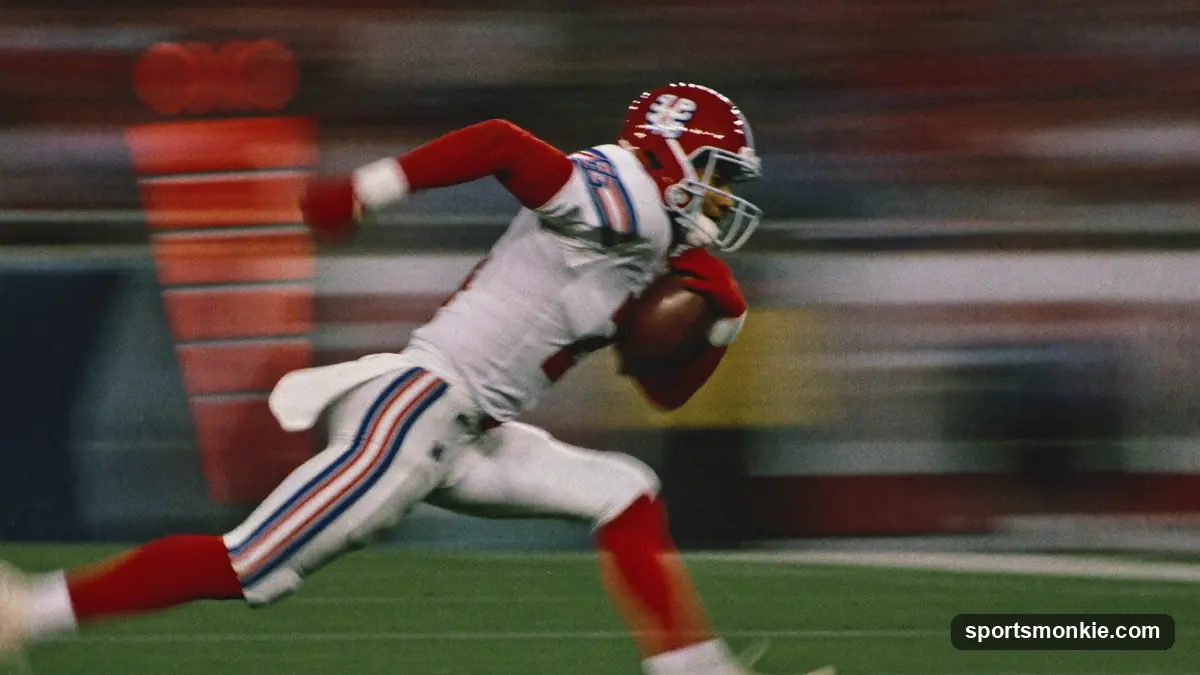
A good 40-yard dash time depends heavily on the player’s position, but as a general rule anything around 4.5 seconds is considered fast for an NFL prospect, elite skill-position players run in the 4.3s, and the fastest times ever clocked at the NFL Scouting Combine sit around 4.2 seconds. There is no single “good” number, because a time that is elite for a 320-pound lineman would be slow for a wide receiver.
The 40-yard dash is the headline event of the NFL Combine, the most talked-about number in the whole pre-draft process. Here is what counts as a good time, broken down by position, and why context is everything.
What the 40-yard dash measures
The 40 is a straight-line sprint from a stationary three-point stance, timed electronically. It is meant to gauge a player’s explosive acceleration and top-end speed, traits that matter enormously for chasing down a ball-carrier or getting open deep, and far less for, say, a quarterback standing in the pocket.
That is the crucial framing: the 40 measures one physical trait, not football ability. Plenty of great players ran unremarkable 40s, and plenty of fast runners never made it in the league.
Good 40 times by position
Because heavier players cannot accelerate the same 40-yard distance as lighter, sprint-built ones, scouts read the number relative to position. Here is a practical guide to what “good” looks like across the roster.
| Position | Elite | Good | Notes |
|---|---|---|---|
| Wide receiver / Cornerback | Under 4.40 | 4.40 – 4.50 | Pure speed positions; deep threats want sub-4.4 |
| Running back | 4.40 – 4.45 | 4.45 – 4.55 | Blend of speed and power |
| Safety | 4.40 – 4.50 | 4.50 – 4.60 | Range and closing speed matter |
| Linebacker | 4.50 – 4.60 | 4.60 – 4.75 | Bigger frame; sideline-to-sideline speed |
| Tight end | 4.55 – 4.65 | 4.65 – 4.80 | Fast for their size is a big plus |
| Quarterback | 4.60 – 4.80 | 4.80 – 5.00 | Rarely a priority for pocket passers |
| Offensive / Defensive line | Under 4.90 | 4.90 – 5.20 | Anything sub-5.0 is impressive at their weight |
Use these as guideposts rather than hard cut-offs. A cornerback running 4.38 turns heads; an offensive tackle running 4.95 turns heads just as much, for the opposite reason.
The elite tier: sub-4.3
Times under 4.3 seconds are extraordinarily rare and belong to a tiny group of the fastest athletes on earth. The all-time Combine record sits around 4.2 seconds, and only a handful of players in history have officially broken 4.3. When a receiver or corner posts a time like that, it can meaningfully raise their draft stock overnight, because game-breaking speed is so valuable and so hard to find.
For a sense of just how fast that is, consider that world-class 100-metre sprinter Usain Bolt is estimated, from his race splits, to have run around 4.2 seconds for 40 yards, and NFL burner Tyreek Hill has been timed in the low-4.2s to 4.29 range in unofficial settings. That is the ceiling of human straight-line speed.
When a slow 40 doesn’t matter
The counterpoint is just as important. Tom Brady ran a 5.28-second 40 at the 2000 Combine, one of the slowest quarterback times on record, and went on to arguably the greatest career in NFL history. For a pocket passer, the 40 is close to irrelevant; decision-making, accuracy and pocket presence decide everything.
The same logic applies to interior linemen, whose jobs are about power and technique in a phone-booth-sized space, not sprinting. This is why smart evaluators treat the 40 as one data point among many, height, weight, agility drills, tape and interviews all feed the final judgment.
How the 40 fits the bigger scouting picture
A blazing 40 can boost a prospect’s draft position and, ultimately, their earning power, since speed at premium positions is scarce and expensive. The players who translate that speed into production, piling up yards and touchdowns, are the ones who eventually command top contracts and tools like the franchise tag. If you want to see what elite athleticism looks like once it reaches the field, our look at the most rushing yards in a season shows speed turned into results.
It is also worth remembering the 40 is a very different test from endurance running; a great sprint time has little to do with, say, a good 5K time, which measures a completely different energy system. Explosive speed and stamina are separate gifts.
The bottom line
There is no universal “good” 40-yard dash time; the right benchmark depends on position. Sub-4.4 is elite for receivers and corners, mid-4.5s is solid for running backs, the 4.6s–4.7s range is good for linebackers and tight ends, and anything under 5.0 is strong for linemen. The very fastest ever hover around 4.2 seconds. And as Tom Brady proved, a slow 40 need not define a career, because the dash measures speed, not football greatness.
Frequently asked questions
What is Usain Bolt's 40 time?+
Usain Bolt never ran an official 40-yard dash, but based on the split times from his world-record 100-metre sprints, analysts estimate he would have covered 40 yards in roughly 4.2 seconds or even faster from a sprinter's start. That would rival or beat the fastest times ever recorded at the NFL Combine. The comparison is inexact, because the 40 uses a different start and timing method than track sprinting, so any figure for Bolt is an estimate rather than an official result.
What is Tyreek Hill's 40 time?+
Tyreek Hill, one of the fastest players in the NFL, has reportedly run the 40-yard dash in the low 4.2s to around 4.29 seconds in unofficial and pre-draft settings, times that would place him among the quickest ever. Because Hill did not post a widely recognised official Combine 40, the exact figure varies by source, but there is no dispute that he sits in the elite, sub-4.3 tier of pure speed.
How fast was Tom Brady's 40 time?+
Tom Brady ran a famously slow 5.28 seconds in the 40-yard dash at the 2000 NFL Combine, one of the slowest times ever recorded for a quarterback. It became a symbol of how little the 40 matters for a pocket passer, since Brady went on to become arguably the greatest player in NFL history despite his lack of straight-line speed. His career is the classic reminder that the 40 measures one trait, not football ability.
Is 4.7 a good 40 time?+
It depends entirely on position. A 4.7-second 40 is slow for a wide receiver, cornerback or running back, where speed is central, but it is a solid and even good time for a linebacker or tight end, and it would be excellent for an offensive or defensive lineman, who are much heavier. So 4.7 is not 'good' or 'bad' in isolation; you have to judge it against the demands of the position the player is being timed for.
Sources
Play & tools
Free browser games and tools — no account, no download.
- Play 17-0 — Draft nine and chase a flawless NFL regular season — the perfect 17-0 run, no playoffs.
- Play 20-0 — Draft nine and chase a perfect NFL season — regular season and playoffs, undefeated.
- Play 16-0 — Draft nine and chase a perfect 16-0 — the classic 16-game NFL regular season, no playoffs.
- Play Flawless Six — Draft five players and a head coach, then chase a perfect NFL season with the right chemistry.
- Play Guess the NFL Player — A new mystery NFL player every day. Eight guesses, with a clue on each — plus free unlimited mode.
- Play NFL Wordle — A Wordle for football — guess the daily NFL player in eight tries, with green-amber-grey feedback on every clue.
- Play NFL Connections — Sort sixteen football tiles into four hidden groups of four. A new daily puzzle, four mistakes allowed, plus unlimited mode.
- Explore all our games →
- Open the schedule simulator — Pick every 2026 NFL game and watch the standings and playoff seeds update live.
- Open the squares generator — Generate a randomized, printable Super Bowl squares grid for your party — free, no sign-up.
- Open the trade calculator — Weigh any fantasy football trade instantly — clear winner and value gap.
- Run the NFL predictor — Simulate the NFL bracket and see who your picks send to the Super Bowl.
- Open the passer rating calculator — Calculate the official NFL passer rating (0–158.3) from any passing line, with the formula shown.
- Explore all our free sports tools →
Related nfl guides
View all →
What Is the Wonderlic Test in the NFL?
The Wonderlic is a 50-question, 12-minute cognitive test the NFL long used at the Combine. What it measured, scoring, and why it's been phased out.
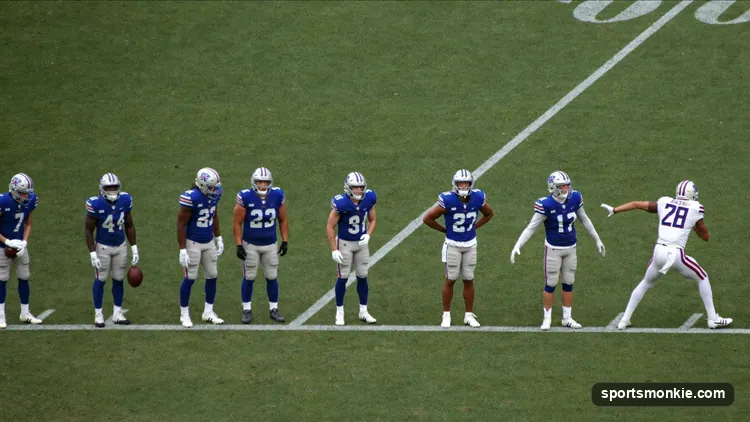
Defensive Positions in Football Explained
Defensive positions in football fall into three groups: the defensive line (ends, tackles, nose tackle), linebackers, and the secondary (corners, safeties).
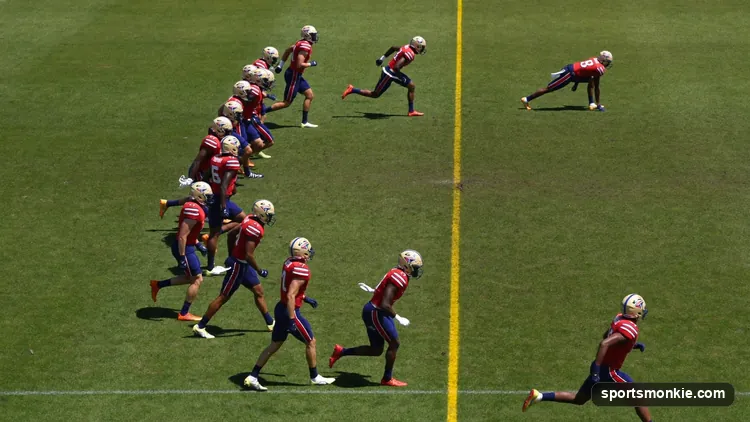
Offensive Positions in Football Explained: Every Role on the Unit
Offensive positions in football explained: QB, RB/FB, WR, TE, and the five offensive line spots (LT, LG, C, RG, RT) with duties and alignment.
Football Referee Signals: The Complete NFL Hand Signal Chart
Football referee signals explained: touchdown, first down, holding, false start, pass interference, and every hand signal NFL officials use on the field.
Man Coverage in Football: How It Works, Cover 0 vs Cover 1
Man coverage in football has each defender guard one specific receiver, not a zone. Cover 0 vs Cover 1, strengths, weaknesses, and how it differs from zone.
Football Formations and Coverages Explained: The Complete NFL Guide
Football formations and coverages explained: how NFL offenses line up, how defenses answer with zone and man coverage, and why each matchup wins or loses.