
What Is a Cornerback in Football? Position, Role & Skills Explained
On this page8
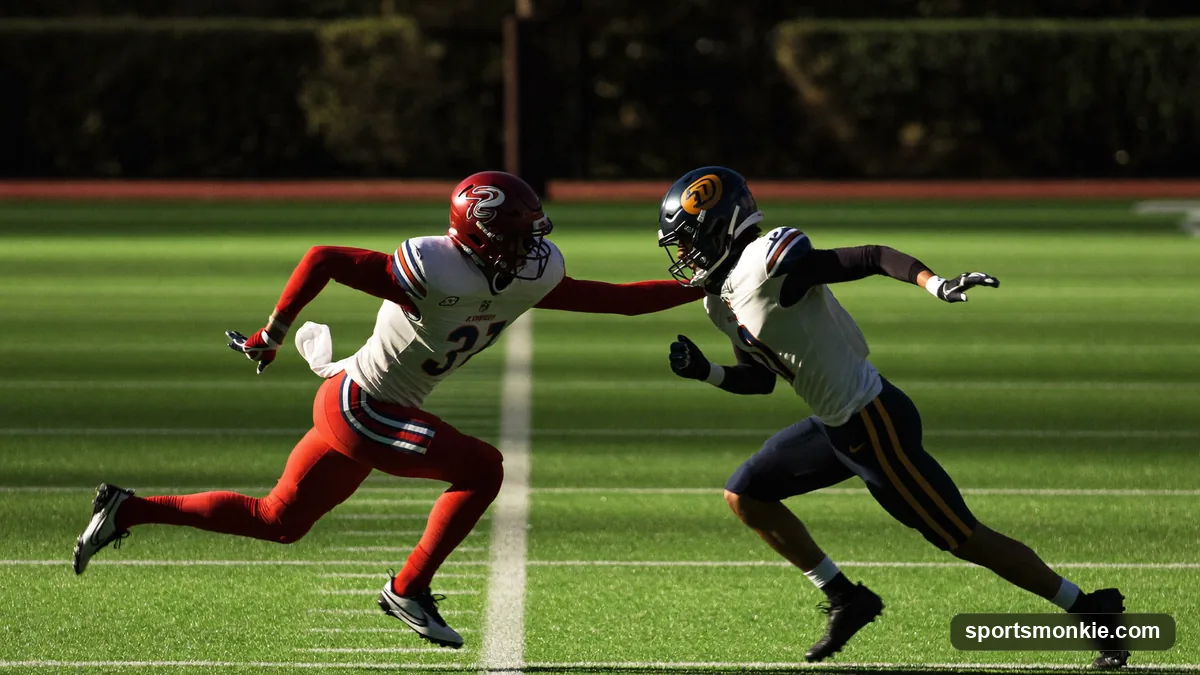
A cornerback (CB) in football is a defensive back who lines up on the perimeter and is primarily responsible for covering wide receivers to prevent completed passes. Cornerbacks are among the most athletically demanding players on the field, and their job sits at the heart of nearly every modern NFL passing game, from a single-high safety shell to an all-out blitz. For a broader rundown of where the cornerback fits among every unit on the roster, see football positions explained.
Cornerback vs. Safety
Cornerbacks and safeties both patrol the defensive secondary, but their jobs diverge in alignment and assignment. Corners play tight to the line across from receivers, while safeties play deeper as the last line of defense and help disguise coverage before the snap. For the full breakdown of that companion role, see the safety position in football.
Where the Cornerback Lines Up
Cornerbacks are part of the defensive secondary, alongside safeties. On a standard defensive snap, you’ll typically find two cornerbacks positioned outside the widest receivers, often several yards off the line of scrimmage in “off” alignment or crowding the receiver in “press” alignment. A third or fourth cornerback, known as the nickel or dime back, comes in for obvious passing situations to cover a slot receiver. To see how that extra defensive back fits into the broader scheme, check out what is a nickel defense. Cornerback is one of several roles inside the larger group of defensive positions; for the complete picture of where corners fit alongside linebackers and linemen, see football defensive positions explained and the broader overview at American football (NFL).
Core Responsibilities of a Cornerback
A cornerback’s job goes well beyond simply “guarding” a receiver. Every snap asks a corner to read, react, and execute in a fraction of a second.
- Man coverage: Locking onto a single receiver and mirroring his route from the snap to the ball’s arrival, using footwork and hand fighting to stay in phase.
- Zone coverage: Defending an assigned area of the field rather than a specific player, reading the quarterback’s eyes and passing off receivers who leave the zone.
- Press technique: Jamming a receiver at the line of scrimmage within the first five yards to disrupt route timing, a tactic that is legal only inside that window.
- Run support: Shedding blocks from receivers and tight ends, then filling the alley to make an open-field tackle on outside runs and screens.
- Ball skills: Locating the football in the air to break up a pass, intercept it, or limit yards after the catch when a completion happens anyway.
- Communication: Signaling coverage rotations and motion adjustments with safeties and linebackers before the snap, since a blown communication assignment often means a big play for the offense.
Skills and Physical Traits Teams Look For
Because cornerbacks are matched against the fastest, most agile players on the opposing offense, the position demands a specific athletic profile:
- Speed - straight-line speed to run vertically with deep threats without help over the top.
- Hip fluidity - the ability to open the hips and flip from a backpedal into a full sprint without losing stride.
- Recovery speed - closing burst to erase a step lost on a double move or hesitation route.
- Ball skills - locating and attacking the football at its highest point, whether to bat it away or intercept it.
- Length and physicality - reach and strength to press receivers and contest jump balls at the catch point.
- Instincts and film study - recognizing route concepts, splits, and formation tendencies before the snap.
- Tackling in space - wrapping up a receiver in the open field after a short completion, without wasted angles.
Boundary Corner vs. Slot (Nickel) Corner
Not every cornerback plays the same role. Teams generally split the position into two distinct jobs.
| Role | Alignment | Primary Challenge | Typical Traits |
|---|---|---|---|
| Boundary (outside) corner | Lines up wide, outside the numbers, often with sideline help | Defending deep vertical routes on an island | Long speed, length, press technique |
| Slot (nickel) corner | Lines up inside, over the slot receiver | Defending sharp breaks in every direction with no sideline help | Quickness, change-of-direction, tackling |
| Dime back | Extra fifth or sixth defensive back | Matching up on a third or fourth receiver in obvious passing downs | Coverage versatility, often a converted safety |
A boundary corner benefits from the sideline acting as an extra defender, cutting off half the field a receiver can attack. A slot corner has no such help and must defend option routes that can break inside, outside, or vertically, which is why the position rewards quickness and short-area burst over pure top-end speed. Many nickelbacks are converted safeties because the job blends coverage instincts with the tackling responsibility of run support closer to the box.
Coverage Schemes Cornerbacks Execute
Defensive coordinators build entire game plans around what their cornerbacks can execute reliably.
- Cover 1 (man-free): Cornerbacks play tight man coverage on receivers while one safety plays deep as a free defender.
- Cover 2: Corners jam receivers at the line, then pass them off to the two deep safeties, taking the shorter, underneath zones themselves.
- Cover 3: Each cornerback owns a deep third of the field, working with a deep-middle safety to split the field into three vertical zones.
- Cover 4 (quarters): Corners and safeties each take a deep quarter of the field, a scheme built to prevent explosive plays.
- Man-to-man across the board: Used on passing downs when a defense wants to bring extra pass rushers, trusting corners to win their individual matchups.
Famous Cornerbacks in NFL History
The position has produced some of the league’s most electric and decorated defenders. Deion Sanders redefined the shutdown corner role in the 1990s with rare closing speed and ball skills. Darrelle Revis earned the nickname “Revis Island” for erasing the league’s top receivers in true man coverage. Champ Bailey and Rod Woodson combined longevity with elite instincts across Hall of Fame careers, while Richard Sherman anchored Seattle’s “Legion of Boom” secondary with size and route recognition. More recently, Sauce Gardner and Patrick Surtain II have carried the shutdown-corner tradition into the current era, drawing the opposing offense’s top receiver on nearly every snap.
The Bottom Line
A cornerback is the defensive back tasked with covering wide receivers, using a mix of press technique, man and zone coverage, and open-field tackling to slow down the pass game. Whether lined up on the boundary or in the slot, the position demands a rare combination of speed, hips, and instincts, which is why it remains one of the hardest jobs in football to play at a high level.
Frequently asked questions
What is a cornerback in football?+
A cornerback is a defensive back positioned at the outer edges of the defense whose primary job is covering wide receivers to prevent completed passes. Cornerbacks also support run defense by shedding blocks and tackling in space, and they must communicate coverage assignments with safeties and linebackers before the snap.
What is the difference between a cornerback and a safety?+
Cornerbacks line up closer to the line of scrimmage across from wide receivers and specialize in man and zone coverage on the perimeter. Safeties play deeper, act as the last line of defense, and help disguise coverages. For a full breakdown of that back-half role, see the safety position in football.
What is the difference between a boundary corner and a slot (nickel) corner?+
A boundary corner lines up outside on the short or wide side of the field and typically has one-on-one help from the sideline. A slot or nickel corner lines up inside against slot receivers, has to defend routes breaking in multiple directions without a sideline as help, and usually enters on passing downs as part of what is a nickel defense.
What skills make a great cornerback?+
Top cornerbacks combine straight-line speed, quick hip transitions to flip and run with receivers, strong ball skills to locate and attack the football, physical press technique at the line, and the recovery speed to close a step lost on a double move.
What is press coverage for a cornerback?+
Press coverage is when a cornerback lines up directly across from a receiver at the line of scrimmage and tries to jam or redirect him within the first five yards, disrupting the route's timing before settling into man or zone coverage.
How many cornerbacks does an NFL team usually play?+
Base defenses use two starting cornerbacks, but most NFL teams now play sub-packages with three or more defensive backs on the majority of snaps, adding a nickelback or dime back to cover extra receivers in passing situations.
Who are some of the best cornerbacks in NFL history?+
Historically great cornerbacks include Deion Sanders, Darrelle Revis, Champ Bailey, and Rod Woodson, while Sauce Gardner and Patrick Surtain II represent the current generation of shutdown corners.
Can a cornerback play zone and man coverage in the same game?+
Yes. Nearly every NFL cornerback is asked to play both man coverage, where he tracks a single receiver, and zone coverage, where he covers an area of the field and reads the quarterback's eyes, often switching between the two from snap to snap.
Sources
Play & tools
Free browser games and tools — no account, no download.
- Play 17-0 — Draft nine and chase a flawless NFL regular season — the perfect 17-0 run, no playoffs.
- Play 20-0 — Draft nine and chase a perfect NFL season — regular season and playoffs, undefeated.
- Play 16-0 — Draft nine and chase a perfect 16-0 — the classic 16-game NFL regular season, no playoffs.
- Play Flawless Six — Draft five players and a head coach, then chase a perfect NFL season with the right chemistry.
- Play Guess the NFL Player — A new mystery NFL player every day. Eight guesses, with a clue on each — plus free unlimited mode.
- Play NFL Wordle — A Wordle for football — guess the daily NFL player in eight tries, with green-amber-grey feedback on every clue.
- Play NFL Connections — Sort sixteen football tiles into four hidden groups of four. A new daily puzzle, four mistakes allowed, plus unlimited mode.
- Explore all our games →
- Open the schedule simulator — Pick every 2026 NFL game and watch the standings and playoff seeds update live.
- Open the squares generator — Generate a randomized, printable Super Bowl squares grid for your party — free, no sign-up.
- Open the trade calculator — Weigh any fantasy football trade instantly — clear winner and value gap.
- Run the NFL predictor — Simulate the NFL bracket and see who your picks send to the Super Bowl.
- Open the passer rating calculator — Calculate the official NFL passer rating (0–158.3) from any passing line, with the formula shown.
- Explore all our free sports tools →
Related nfl guides
View all →
What Is a Linebacker in Football? Position, Roles & Types Explained
A linebacker (LB) is a defensive player who lines up behind the line to stop the run, cover receivers, and blitz the quarterback. Full breakdown here.
Quarterback Position in Football: Role, Skills, and Responsibilities Explained
The quarterback position leads the offense, calling plays, taking the snap, and throwing or handing off the ball. Learn the QB's full job in football.
Football Positions Explained: Every Offense, Defense & Special Teams Role
Football positions explained: every offense, defense, and special teams role in American football, what each one does, and how they fit together.
Offensive Positions in Football Explained: Every Role on the Unit
Offensive positions in football explained: QB, RB/FB, WR, TE, and the five offensive line spots (LT, LG, C, RG, RT) with duties and alignment.
Safety Position in Football: Free Safety vs. Strong Safety Explained
The safety position in football is the deepest defensive back, splitting into free safety (deep coverage) and strong safety (run support) roles.
What Is a Blitz in American Football? Pressure Package Explained
A blitz sends more pass rushers than the standard rush, trying to pressure the quarterback before the offense can exploit the extra defender.