
Volleyball Referee Signals: Every Official Hand Signal Explained
On this page7
Volleyball referee signals are the standardized hand and arm gestures officials use to rule on every point, fault, and stoppage without a word — a raised arm for a point, four fingers for a four-hits violation, brushed fingers for a ball touched call, and crossed forearms to end a set. FIVB, USA Volleyball, and every national federation use the same signal set, so once you learn it you can read any match, from a high school gym to the Olympics, the same way the players and line judges do.
Why volleyball referee signals matter
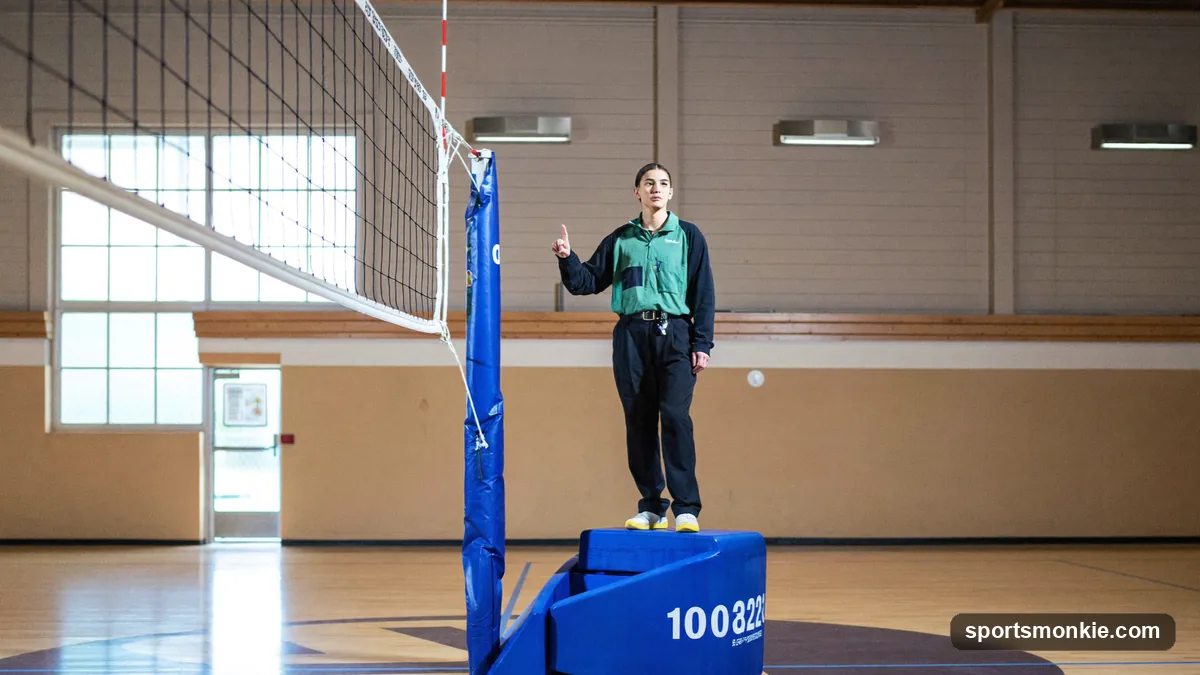
Volleyball is played fast, loud, and across a net that separates two benches, two teams of six, and often a packed gym. A referee can’t rely on shouting a ruling and expecting everyone to hear it correctly, so the sport built a universal visual language instead. The first referee (standing on a platform above the net) makes the primary calls, the second referee (at floor level) backs up net and center-line calls, and line judges use flags for in/out and foot-fault calls on the boundary lines. Every signal is deliberately exaggerated and held for a beat so it reads clearly from the scorer’s table, the bench, and the stands — which is also why they’re just as easy for spectators and new fans to pick up.
The core signals table
This table covers the signals named most often by fans trying to follow a match: who scored, whether the ball was in or out, and the most common faults that stop play.
| Signal | Gesture | Meaning |
|---|---|---|
| Point / Ball In | Arm extended toward the scoring team at roughly 45°, or the other arm/fingers pointed straight down at the floor | Awards a rally, or confirms the ball landed inbounds on or within the court lines |
| Ball Out | Both forearms raised vertically, hands open, palms facing the referee’s own body | The ball landed completely outside the court, or touched an antenna, pole, ceiling obstruction, or other out-of-bounds object |
| Four Hits | Four fingers raised and spread, held above the head | A team contacted the ball four times (excluding a block touch) before returning it over the net — one contact too many |
| Double Contact | Two fingers raised and spread, held above the head | One player illegally hit the ball twice in succession with no block involved |
| Net Touch | Referee points to or briefly touches the section of net where contact occurred, then points to the offending player/team | A player touched the net with any body part while the ball was in play |
| Foot Fault | Referee points down at the specific line (service/end line or center line) | The server stepped on/over the end line before contact, or a player crossed the center line under the net into the opponent’s space |
| Ball Touched | Referee brushes the palm of one hand across the fingers of the other hand, held vertical | A defender’s body touched a ball that then went out of bounds — the point does not go to the hitting team |
| Delay (Warning/Penalty) | Referee covers their own wrist with an open hand (warning); adds a yellow card for a formal penalty | A team is taking too long between rallies, during a lineup check, or before serving |
| Substitution | Both forearms circle around one another | A completed player substitution has been authorized |
| End of Set / Match | Forearms crossed in front of the chest, hands open | The set or the full match has concluded |
Reading a rally from start to finish
A single rally can chain several of these signals together. Say a server foots the end line — the referee points down at the line for a foot fault, then extends an arm toward the receiving team for the point. Or a hitter’s spike is touched by a blocker’s fingertips before landing out of bounds: the referee brushes the palm across the vertical fingers for “ball touched,” which overrules what would otherwise look like an out-of-bounds point for the hitting team, and instead awards the rally to the blocking team. Watching for that sequence — fault signal, then point signal toward the correct side — is the fastest way to follow a match without needing the scoreboard to catch up. These conventions aren’t unique to volleyball; officials in most net-and-court sports layer a fault call with a point call the same way, which is part of why our broader breakdown of referee hand signals by sport is useful once you want to compare across games.
Signals unique to net faults and ball handling
Net-related and ball-handling faults are where new volleyball fans get confused fastest, because several signals look similar at a glance. Net touch, foot fault, and ball touched are visually distinct on purpose: net touch involves the referee’s hand going to the net itself, foot fault points down at a line on the floor, and ball touched is the only one performed entirely with the hands in the air, away from the body. If you’re comparing officiating systems across sports, it’s worth noting how differently other games handle their own boundary and contact calls — basketball referee signals rely heavily on chopping and pointing motions for traveling and fouls, while hockey referee signals use full-arm signals because officials are often separated from players by boards and glass.
Substitution, delay, and end-of-set signals
The remaining signals in the table govern match flow rather than individual faults. Substitution’s circling-forearms gesture confirms a completed and legal player swap, which the second referee tracks against a substitution limit per set. Delay signals protect the pace of the match — a covered wrist warns a team that’s stalling, and a repeated wrist-cover paired with a yellow card formalizes a delay penalty and can eventually cost a point. End-of-set’s crossed forearms is the signal every player and fan waits for, confirming a team has reached the required point total (25, or 15 in a deciding set) with at least a two-point lead, or that the full match has been decided.
Where to see these signals used correctly
The clearest way to lock in these signals is to watch them live during a match, ideally with the referee visible on the officiating stand. FIVB World Championship and Olympic broadcasts consistently frame the first referee, making it easy to match the gesture to the whistle. Club and high school matches are just as useful for practice, since referees at every level use the identical signal set — there’s no simplified version for lower divisions. Once the point, in/out, and fault signals feel automatic, the flow-control signals (substitution, delay, end of set) fall into place quickly because they appear far less often per match.
Bottom line
Volleyball referee signals compress dozens of possible rulings into about ten repeatable gestures, and every one of them is designed to be read from across a gym. Point and ball in/out form the foundation, four hits and double contact cover the most common ball-handling faults, net touch and foot fault cover the most common positional faults, and ball touched, delay, substitution, and end of set round out the set. Learn the table above once, and you’ll never need a scoreboard replay to know what just happened on the court.
Frequently asked questions
What are volleyball referee signals?+
Volleyball referee signals are the official hand and arm gestures the first referee (and second referee and line judges) use to communicate rulings — who scored, what fault occurred, and when play stops — without needing to shout over crowd noise. FIVB and USA Volleyball publish an identical standardized set so every level of the sport, from youth club to the Olympics, uses the same visual language.
What is the hand signal for a point in volleyball?+
The referee extends an arm and points toward the side of the court that won the rally, holding the arm at roughly a 45-degree downward angle. This signal always comes first, followed immediately by the signal explaining the fault that caused the point (such as four hits, net touch, or ball out).
How does a referee signal the ball is out?+
For a ball ruled out, the referee raises both forearms vertically with hands open and palms facing toward their own body. For a ball ruled in, the referee instead points an arm and fingers straight down toward the floor to show the ball landed within the court lines.
What is the four hits signal in volleyball?+
The referee raises four fingers, spread open, above their head. This signals that a team contacted the ball four times before sending it over the net, which is one contact more than the three allowed (not counting a block touch), and awards the point to the opposing team.
What is the difference between the double contact and ball touched signals?+
Double contact is signaled by raising two fingers and means one player illegally hit the ball twice in a row without a block involved. Ball touched is a completely different gesture — brushing the palm of one hand across the fingers of the other, held vertical — and means a defender's body touched a ball that then went out, so the point does NOT go to the team that hit it.
What signal does a referee use for a net touch fault?+
The referee indicates the side of the net where the fault happened by pointing to or briefly touching that section of the net with the hand on the corresponding side, then points toward the team that committed the fault.
How does a referee signal a foot fault or center line violation?+
The referee points down at the line in question — either the service line/end line for a server foot fault, or the center line beneath the net for a player crossing into the opponent's space — to show exactly where the infraction occurred.
What is the delay signal in volleyball?+
A delay warning is signaled by the referee covering their own wrist with an open hand, mimicking a wristwatch, to show a team is taking too long between rallies (for example, during a lineup check or before serving). If the delay continues, the referee repeats the gesture while displaying a yellow card for a formal delay penalty.
Sources
Play & tools
Free browser games and tools — no account, no download.
- Play today's Sports Connections — Today's Sports Connections — daily hints, answers, and play the grid.
- Play Guess the NFL Player — A new mystery NFL player every day. Eight guesses, with a clue on each — plus free unlimited mode.
- Explore all our games →
Related guides
Football Referee Signals: The Complete NFL Hand Signal Chart
Football referee signals explained: touchdown, first down, holding, false start, pass interference, and every hand signal NFL officials use on the field.

Referee Hand Signals Explained: Every Major Sport's System
Referee hand signals let officials call fouls, scores, and timing decisions silently. See how NFL, NBA, MLB, NHL, and soccer signals compare.
Hockey Referee Signals Explained: Every Penalty Arm Signal
Hockey referee signals decoded: the exact arm signal for hooking, tripping, slashing, cross-checking, high-sticking, holding, interference, and more.
Volleyball Net Height: Men, Women and Juniors
Official volleyball net height is 2.43 m (7 ft 11 5/8 in) for men and 2.24 m (7 ft 4 1/8 in) for women. Full chart for juniors, coed, beach and sitting.
Soccer Referee Hand Signals: The Complete Guide
Soccer referee hand signals explained: direct/indirect free kick, penalty, cards, advantage, corner, goal kick, throw-in, offside flag, and subs.
Volleyball Positions Explained: Every Role
Volleyball has six player roles: setter, outside hitter, opposite, middle blocker, libero and defensive specialist. Each position explained clearly.