
Volleyball Rotation Explained Simply
On this page6
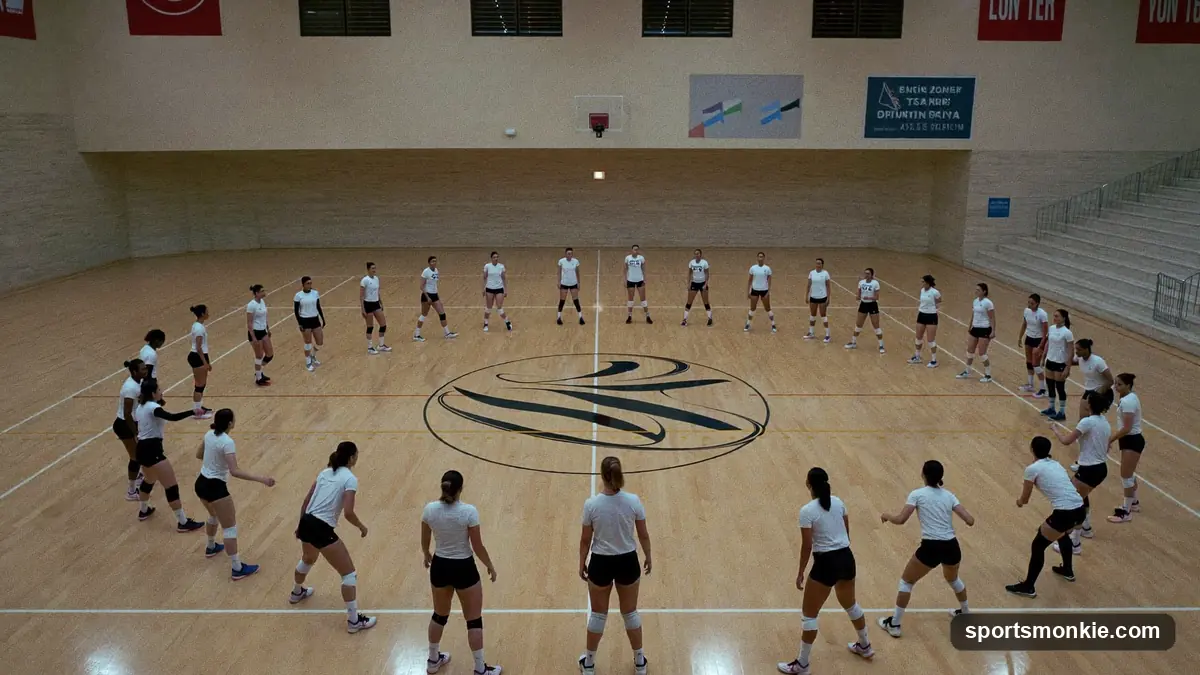
In indoor volleyball, rotation means the six players on a team all move one position clockwise each time their team wins back the right to serve from the opponent. This keeps the serving order fair and ensures every player takes a turn in both the front and back rows during a set.
That is the core of it, but rotation trips up almost every newcomer because of two extra layers: the strict order players must hold at the moment of the serve (the overlap rule), and the formations like 5-1, 6-2 and 4-2 that teams build on top of the rotation. Here is the whole system, explained simply.
The six positions and the clockwise rotation
The court is divided into six positions, three in the front row (near the net) and three in the back row. They are numbered so that officials and players can track the serving order:
- Position 1 — back right (this player serves)
- Position 2 — front right
- Position 3 — front centre
- Position 4 — front left
- Position 5 — back left
- Position 6 — back centre
When a team wins back the serve, every player rotates one spot clockwise. The player who was in position 2 (front right) drops to position 1 (back right) and becomes the new server; everyone else shifts around to fill the gap. After six rotations the team has cycled all the way around and is back where it began. The crucial rule that catches beginners: a team only rotates when it wins back the serve from the opponent. If your team is already serving and wins the point, you keep serving with the same player, you do not rotate.
Rotation and rally scoring
Rotation is tied directly to how points are scored. Modern volleyball uses rally scoring, where a point is awarded on every single rally regardless of which team served. Whenever the receiving team wins a rally, it earns both the point and the serve, and that is the trigger to rotate. Because every rally produces a point, sets move quickly and the serve, and therefore the rotation, changes hands often.
The overlap rule: staying in order
Here is the part that confuses everyone. At the exact moment the server strikes the ball, all six players must be in their correct rotational order relative to their neighbours. This is the overlap rule. In practice it means:
- Back-row players cannot have a foot closer to the net than the front-row player they line up behind.
- Left-to-right order among adjacent players must be preserved.
If a player is out of order when the serve is contacted, the officials call an overlap fault (an illegal rotation) and the team loses the rally. The vital detail is timing: the overlap rule applies only at the instant of the serve. The very moment the ball is struck, players are free to move anywhere on the court and switch to their specialist roles, which is exactly what teams do.
| Term | What it means |
|---|---|
| Rotation | All six players move one position clockwise when the team wins back the serve |
| Serving order | The fixed sequence in which players serve, set at the start of the set |
| Overlap rule | Players must hold correct relative order at the moment of the serve |
| Overlap fault | Illegal alignment at serve; the offending team loses the rally |
| Switching | After the serve, players move to their preferred positions |
Why teams “switch” after the serve
Because the overlap rule only bites at the moment of serve, teams line up legally and then immediately switch to put players in their best positions once the ball is live. A setter stuck in the back-left corner by the rotation can sprint to the middle-front to run the offense the instant the serve is away. This dance between legal alignment and specialist positioning is why understanding rotation matters even for fans, and it connects directly to the specialist roles covered in our guide to volleyball positions explained.
Formations: 4-2, 6-2 and 5-1
Teams build an offensive system on top of the rotation, described by two numbers: hitters, then setters.
- 4-2 — four hitters, two setters, with a setter in the front row. Simple and popular for beginners, but it leaves only two front-row attackers.
- 6-2 — six hitters, two setters, where the setter always comes out of the back row. This gives three front-row attackers, but demands two players who can both set and hit.
- 5-1 — five hitters and a single setter who sets in every rotation. It is the most common system at higher levels because one consistent setter keeps the offense stable, though when that setter rotates to the front row the team has only two front-row hitters.
The choice of system determines how a coach arranges players within the six rotations, but the underlying clockwise rotation and overlap rules stay the same in all of them.
Governing bodies and where rotation applies
The rotation and overlap rules are set internationally by the FIVB (Fédération Internationale de Volleyball) and, in the United States, administered by USA Volleyball. They apply to the six-a-side indoor game. The two-a-side beach game has no rotation at all, one of many contrasts covered in our guide to beach vs indoor volleyball. Rotation also depends on the court itself: the volleyball court dimensions guide maps the attack line, zones and free space, while how tall a volleyball net is covers the barrier players attack over. Once you grasp rotation, the payoff is understanding how a team engineers a good attacking swing, the kill that ends a rally.
The short version: volleyball rotation means all six players move one position clockwise each time their team wins back the serve, which fixes the serving order and rotates everyone through the front and back rows. At the moment of serve, players must hold their correct order (the overlap rule) or lose the rally; immediately after, they switch to their specialist spots. Systems like the 5-1, 6-2 and 4-2 describe how many setters and hitters a team uses within that rotation, all under FIVB and USA Volleyball rules.
Frequently asked questions
What are the 6 volleyball rotations?+
The 'six rotations' refers to the six positions each player passes through in a set, numbered 1 through 6. Position 1 is the back-right (the server), and the numbers run 1 (back right), 6 (back centre), 5 (back left), 4 (front left), 3 (front centre) and 2 (front right). Each time a team earns the serve back, all six players rotate one spot clockwise, so a player moves from position 2 to position 1 to serve, then continues around. After six rotations, the team is back where it started. Every player therefore rotates through all six spots over a full cycle.
What is 4-2, 6-2 and 5-1 in volleyball?+
These numbers describe a team's offensive system: the first number is how many hitters (attackers) are on the court and the second is how many setters. A 4-2 uses four hitters and two setters, with the setter in the front row, a simple system common in beginner play. A 6-2 uses six hitters and two setters, where the setter always comes from the back row so there are three front-row attackers, but it requires two capable setters. A 5-1 uses five hitters and one setter who sets in every rotation, the most common system at higher levels because it is consistent, though it means only two front-row attackers when the setter is in front.
What is the correct way to rotate in volleyball?+
Players rotate clockwise, and a team only rotates when it wins back the serve from the opponent (not when it wins a point on its own serve). The player in position 2 (front right) moves to position 1 (back right) to become the new server, and everyone else shifts one position clockwise to fill in. This keeps the serving order fixed for the whole set. At the instant the ball is served, players must respect the overlap rule, staying in the correct order relative to their adjacent teammates; after the serve they can move freely to their preferred positions.
What is an illegal rotation (overlap) in volleyball?+
An illegal rotation, usually called an overlap fault, happens when players are not in their correct rotational order at the moment the server contacts the ball. Each player must be positioned correctly relative to their neighbours: for example, a back-row player must not have a foot closer to the net than the front-row player they are behind, and side-to-side order must be preserved too. If the officials judge an overlap at the moment of serve, the serving team loses the rally (or the receiving team is penalised). Once the serve is struck, players may move anywhere and the overlap no longer applies.
Sources
Play & tools
Free browser games and tools — no account, no download.
- Play today's Sports Connections — Today's Sports Connections — daily hints, answers, and play the grid.
- Play Guess the NFL Player — A new mystery NFL player every day. Eight guesses, with a clue on each — plus free unlimited mode.
- Explore all our games →
Related guides

Volleyball Net Height: Men, Women and Juniors
Official volleyball net height is 2.43 m (7 ft 11 5/8 in) for men and 2.24 m (7 ft 4 1/8 in) for women. Full chart for juniors, coed, beach and sitting.
Middle Blocker in Volleyball: Role, Skills and Quick Sets Explained
A middle blocker volleyball player anchors the net's block and hits fast quick-tempo sets. Full guide to the role, footwork, quick sets and top players.
What Is the Volleyball Nations League (VNL)?
The Volleyball Nations League is FIVB's top annual national-team tournament, with 16 men's and 16 women's teams playing a group stage and a Finals each summer.

Beach vs Indoor Volleyball: Differences
Beach volleyball is 2v2 on sand with a smaller court and a softer, larger ball; indoor is 6v6 on a hard court. Key differences in rules, court and ball.
How Much Does Club Volleyball Cost?
Club volleyball typically costs a few thousand dollars a season once fees, travel and gear are added. Full cost breakdown and why it's expensive.

What Is a Pancake in Volleyball?
A pancake is an emergency dig where a player slides a flat hand under the ball on the floor so it bounces off the back of the hand and stays in play.